Critically Endangered
Rhizosomichthys
Rhizosomichthys totae
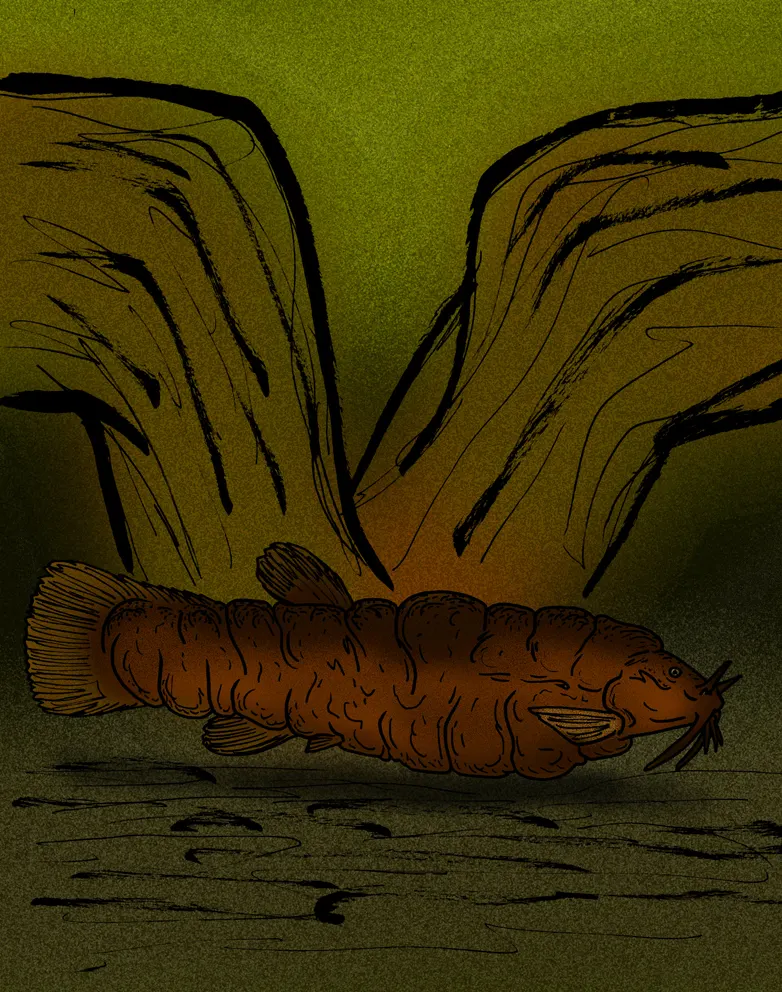
The fat catfish or greasefish (Rhizosomichthys totae) is a small catfish with rings of body fat, known only from Lake Tota, high in the Colombian Andes. It hasn't been recorded since 1957. The IUCN Red List rated it Critically Endangered, possibly extinct, in 2016, and searchers have been planning to look for survivors.
How to recognise it
No other fish in its family looks quite like it. Its body carries eight rings of connective fat, plus two large fat pads, one on the back near the tail and one on the head. It grew to about 13.8 cm (5.4 in), though one account gives up to 15 cm.
It belongs to the catfish family Trichomycteridae and is the only species in its genus. It was described in 1942 by Cecil Miles, and its anatomy was redescribed in a 2009 paper in the journal Copeia. It is so greasy that it is sometimes called the greasefish, and local people reportedly set it alight on sticks to use as a torch.
Where it lives
The fish is native only to the Lake Tota basin in Colombia, and the IUCN records a single location. Lake Tota is the country's largest lake, more than 3,000 m above sea level in the Eastern Cordillera. It is about 50 m deep, with water around 12 degrees C. The IUCN gives an elevation of 3,060 m and lists permanent freshwater lakes as its habitat.
Whether it also lived in nearby streams and ravines is unknown. A few local people interviewed in 2022 said they had seen the fish in ravines or stuck in household hoses, and one said they had cooked and eaten it.
Pins are Wikidata “endemic to” fields. Orange dots, when present, are GBIF occurrence tiles — survey bias included.
Why it is in trouble
Only about 10 specimens have ever been recorded, and the last known one dates to 1957 (one account gives 1958). Surveys in the 1990s did not find it. The cause of its disappearance is not established.
The leading suspect is introduced fish. About 100,000 rainbow trout eggs imported from North America were released into the lake in 1936, and trout farming began in 1939. Miles himself claimed the trout would drive the catfish extinct. In 1990 the Colombian ichthyologist Jose Ivan Mojica disputed this, arguing that the two fish lived in different parts of the lake. The IUCN also names Eremophilus mutisii and Grundulus bogotensis alongside the rainbow trout, and agricultural chemicals, as ongoing threats.
Re:wild says the lake holds only a handful of fish species and that the catfish is the only native one, so it may have been the lake's only native fish.
What is being done
The fat catfish is on Re:wild's list of most wanted lost species, and SHOAL lists it in its Search for Lost Fishes. A social research team from Ictiologia y Cultura interviewed locals in 2022. After a preliminary visit in June 2023, the team planned to sample water at five sites in August 2023 using environmental DNA, which detects genetic traces in water.
Searchers face a gap: the roughly 10 museum specimens are preserved in formalin, which damages DNA, so no genetic sequence exists for comparison. Any plan would also have to weigh the livelihoods of local trout fishers, and the team works with the local fishermen's association and the regional environmental authority.
The IUCN assessment lists no conservation actions in place and no confirmed protected area, and its population trend is unknown.
Sources
Written for this catalog in our own words from the sources below, checked against them on 12 November 2026. Population figures are estimates and carry the year they were made. Status and assessment year: IUCN. 2026. The IUCN Red List of Threatened Species. Version 2026-1. iucnredlist.org.




