Endangered
Rhinolophus hilli
Rhinolophus hilli
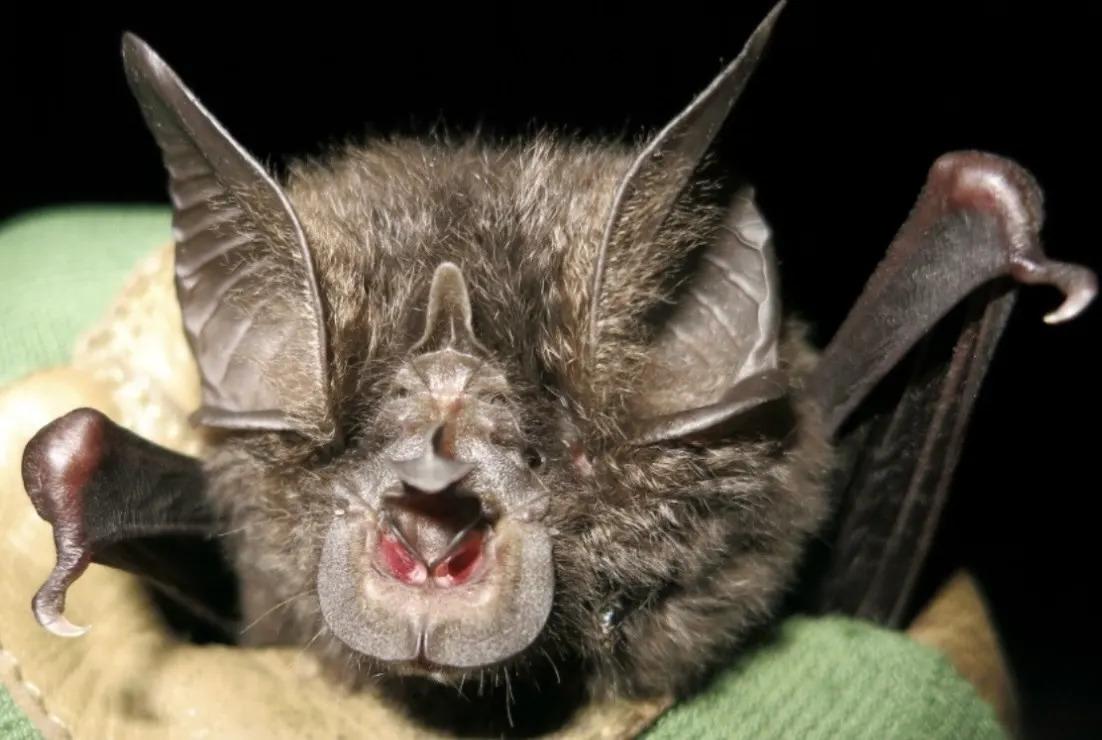
Hill's horseshoe bat, Rhinolophus hilli, is a forest bat known only from the mountains of Rwanda. After going unrecorded for nearly forty years it was found again in Nyungwe National Park in 2019. The IUCN Red List assessed it as Endangered in 2025, down a step from Critically Endangered in 2021.
How to recognise it
Like other horseshoe bats, it has a horseshoe-shaped nose leaf around the nostrils. Its face is flattened and its ears are large, and researcher Winifred Frick has described the facial features as exaggerated to the point of comical. It belongs to a group of six large-eared horseshoe bats, the maclaudi group, and was long confused with the Rwenzori horseshoe bat, itself once treated as a subspecies of Maclaud's horseshoe bat. Aellen described Hill's horseshoe bat as a species in 1973.
Where it lives
It is endemic to Rwanda. The IUCN assessment counts a single location and a single subpopulation, at elevations between about 1,750 and 2,512 metres, and names moist montane forest, caves and other underground sites as its habitats. The 2025 assessment estimates its extent of occurrence at about 1,650 square kilometres, while older accounts gave a known range of under 100 square kilometres.
For many years almost nothing was known of it. Only two individuals had ever been recorded, in 1964 and 1981, about 8 kilometres apart, and its daytime roost is still unknown.
Pins are Wikidata “endemic to” fields. Orange dots, when present, are GBIF occurrence tiles — survey bias included.
The 2019 rediscovery
In January 2019 a team led by Bat Conservation International, with the Rwanda Development Board and the Rwanda Wildlife Conservation Association, caught Hill's horseshoe bats during a ten-day expedition in Nyungwe National Park. Accounts differ on whether one bat or a pair was caught. The team measured it, released it, compared it with records held in European museum archives to confirm the identification, and recorded the species' echolocation calls for the first time.
Rangers then set up acoustic recorders. A nine-month survey at 23 sites produced about 250,000 sound files, and the bat turned up at eight of the sites, all within a small area. The findings were announced in March 2022.
Why it is in trouble
The IUCN lists the population as decreasing and the area it uses as shrinking. The threats it names are small-holder farming and shifting agriculture, which clear and fragment the forest. Bushmeat hunting has also been reported as a threat, though the IUCN threat list does not include it. Generation length is estimated at 7.5 years, so recovery would be slow.
The population is still listed as decreasing, so the move from Critically Endangered to Endangered should not be read as a recovery.
What is being done
Bat Conservation International put the species on its 2013 list of 35 global priority bat species. After the rediscovery the team said it would work with the Rwanda Development Board and the Nyungwe Management Company to strengthen existing conservation work and find ways to protect the species over the long term. The survey data were to be shared openly through GBIF.
The IUCN records that no species recovery plan and no systematic monitoring scheme are in place, that the species occurs in a protected area, and that awareness programmes exist. It lists site protection and management, habitat restoration and species recovery among the relevant actions.
Sources
Written for this catalog in our own words from the sources below, checked against them on 12 November 2026. Population figures are estimates and carry the year they were made. Status and assessment year: IUCN. 2026. The IUCN Red List of Threatened Species. Version 2026-1. iucnredlist.org.




