Endangered
Wrinkled hornbill
Rhabdotorrhinus corrugatus
The wrinkled hornbill is a large, mostly black forest bird of the Malay Peninsula, Sumatra and Borneo, with a heavy bill and a wrinkled casque. The IUCN Red List raised it from Near Threatened to Endangered in 2018, driven by the clearing of the lowland forest it depends on.
How to recognise it
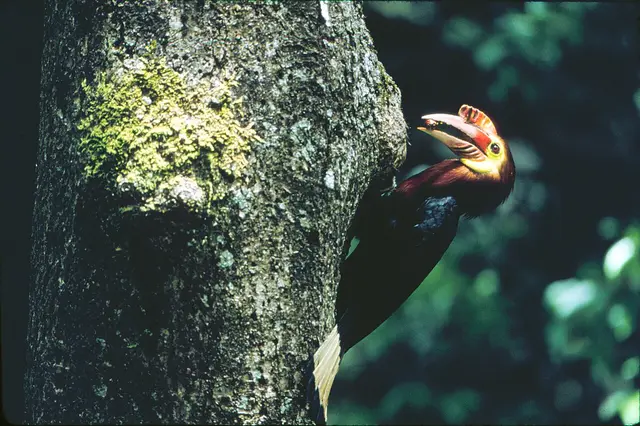
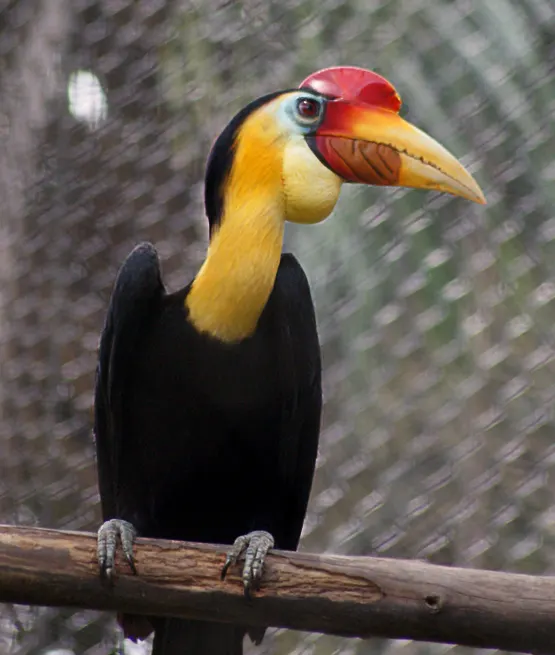
It is a big bird, roughly 65 to 75 cm long, mostly black, with blue skin around the eyes and a very large bill fused to the skull. Males weigh about 1.6 kg, and females are smaller.
Males and females look different. In males, the face and throat are white stained yellow, the bill is yellowish with red at the base, and the casque on top is high, red and wrinkled, which gives the species its name. Females are mostly black, with a blue throat, a yellow bill and a plain casque without ridges. Young birds resemble males but have no casque.
Its call is a harsh coughing note, repeated at intervals.
Where it lives
The IUCN lists Thailand, Malaysia, Singapore, Brunei and Indonesia. That covers southern Thailand, the Malay Peninsula, Sumatra (including Rupat and Payong islands), the Batu Islands and Borneo. A zoo account also reports a recent record from south-western Cambodia, which the IUCN assessment does not list.
It belongs to lowland rainforest, especially coastal swamp forest. The IUCN gives an upper elevation of 30 m, though birds have been recorded up to 400 m. It tolerates selectively logged forest but is not found in secondary forest.
Pins are Wikidata “endemic to” fields. Orange dots, when present, are GBIF occurrence tiles — survey bias included.
How it lives
Wrinkled hornbills usually travel in pairs, though flocks of up to 30 have been seen, and they use communal roosts. They range widely in search of fruiting trees. During breeding about two-thirds of the diet is fruit (mainly figs, plus palms, laurels and other trees) and about a third is animal food, mainly insects and land snails, with some frogs, reptiles and birds' eggs.
Pairs are monogamous and nest in tree cavities, which a zoo source puts 40 to 50 m above the ground. The female seals the entrance with mud and droppings, leaving a small opening through which the male feeds her and the chicks. The same zoo source gives the whole nesting cycle as roughly 111 to 124 days, with about two eggs and chicks leaving after 65 to 73 days. Breeding usually falls in the December to January rains. It was reportedly first bred in captivity in 1988.
Why it is in trouble
The IUCN raised it from Near Threatened to Endangered in 2018. That assessment records a continuing decline, projects a population reduction of 50 to 79 percent over three generations (19 years each), and gives the population size as unknown. The threats it names are large plantations, small-holder farming, increased fire, and both targeted and accidental harvest.
Logging is described as the biggest threat because it destroys habitat and removes the large trees with cavities that the birds nest in. In some areas the tail feathers are also taken for traditional costumes.
What is being done
It occurs in at least one protected area, and conservation sites have been identified across its entire range. Site and area protection is the action the IUCN lists, and international trade controls apply to the species. As of 2018 there was no recovery plan, no systematic monitoring scheme and no ex situ conservation programme.
Sources
Written for this catalog in our own words from the sources below, checked against them on 12 November 2026. Population figures are estimates and carry the year they were made. Status and assessment year: IUCN. 2026. The IUCN Red List of Threatened Species. Version 2026-1. iucnredlist.org.