Endangered
Relict splitfin
Xenoophorus captivus
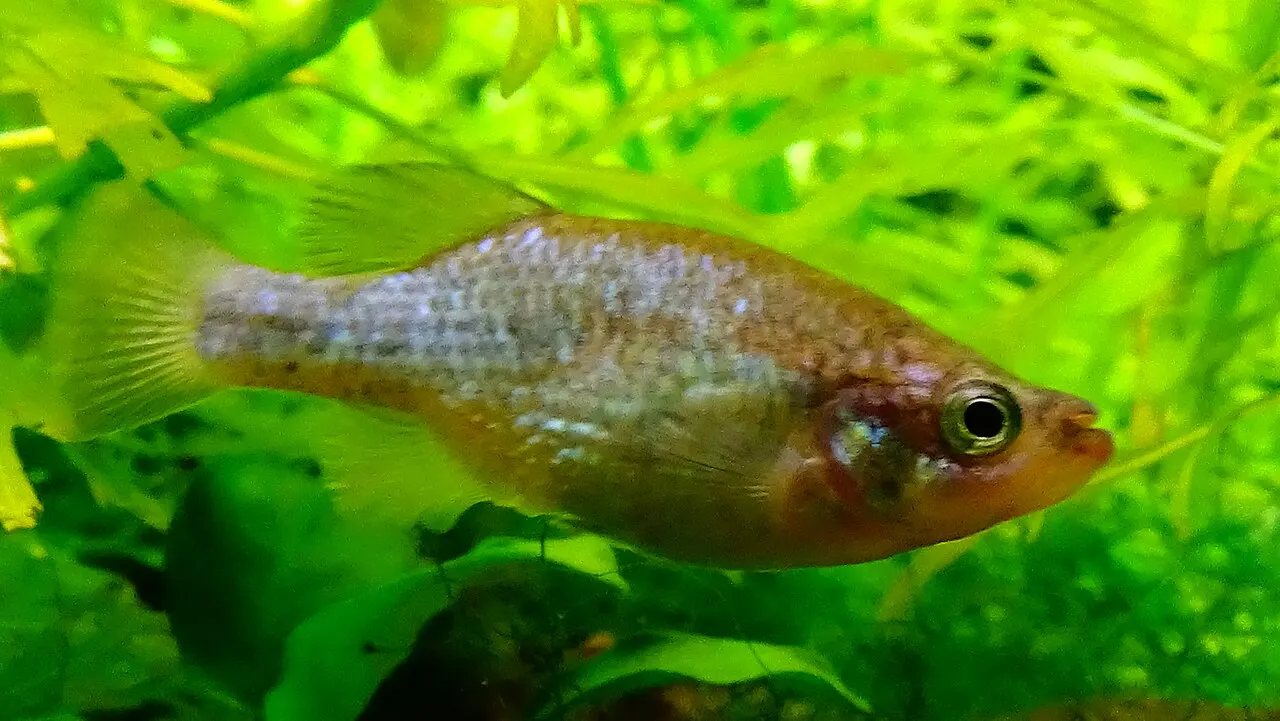
The relict splitfin (Xenoophorus captivus) is a small live-bearing fish from the upper Pánuco river system in San Luis Potosí, Mexico. The IUCN Red List rated it Endangered in 2019, with the population decreasing and badly fragmented. Many of the springs and streams where it once lived have dried up.
How to recognise it
It is a small goodeid, a family of Mexican livebearers whose females give birth to fully formed young. Males reach about 5 cm in length and females about 6 cm. It is the only known member of its genus. Carl Hubbs first described it in 1924 as Goodea captiva, and Hubbs and Turner moved it into its own genus in 1939. The genus name comes from Greek words meaning strange ovary. In Mexico it is called mexclapique viejo.
Where it lives
Wild populations come from the Pánuco basin on the Mexican plateau. Known localities include the Río Santa María (the type locality, near Santa María del Río) and Jesús María upstream of it, the Río San José at Bledos, the springs of Illescas, the Río de Venado and the Arroyo de Moctezuma. The IUCN records it from rivers, small freshwater marshes and pools, and springs, at elevations of 1,700 to 2,000 m, and counts only two locations.
It feeds on algae and lives in water with plenty of it. Females typically bear 10 to 25 young, and larger broods are rare.
Pins are Wikidata “endemic to” fields. Orange dots, when present, are GBIF occurrence tiles — survey bias included.
Why it is in trouble
Water is the problem. The IUCN lists farming by smallholders, pumping of surface water for crops and homes, small dams, drought, sewage, run-off and renewable energy projects, along with pressure from another species. The population is recorded as severely fragmented and decreasing, and the assessment applies two sets of criteria, one for a suspected decline and one for a small, shrinking range.
A 2019 status review by Lyons and colleagues, summarised by the Goodeid Working Group, links the decline to groundwater pumping and spring diversion, which have lowered water levels and worsened water quality. The springs at Illescas reportedly dried up in 1996, and the last confirmed collection there was in 1994. The population in the Yesca subbasin went extinct in the late 1990s after its water was pumped out for agriculture, though some of those fish were rescued and survive in aquariums. The review rated one of the three lineages it recognises as critically endangered, one as extinct in the wild and one as endangered.
An undated field report by researcher Juan Miguel Artigas Azas describes three weekends spent searching along the Río Santa María from the type locality up to Jesús María. He found the river without water and the springs and small dams dry, and caught no relict splitfin. A few pools near Rodrigo still held water, but he caught none there either. He described most known localities as now dry.
What is being done
The IUCN lists captive breeding, invasive species control, site protection and management, habitat protection and awareness work among the actions in place or needed. The 2019 review reports a few captive populations in Mexico, the United States and Europe, and Mexico's own list of species at risk (NOM-059) classes the fish as in danger of extinction. The species is also kept in the aquarium trade.
Sources
Written for this catalog in our own words from the sources below, checked against them on 12 November 2026. Population figures are estimates and carry the year they were made. Status and assessment year: IUCN. 2026. The IUCN Red List of Threatened Species. Version 2026-1. iucnredlist.org.




