Endangered
Round ebonyshell
Reginaia rotulata
The round ebonyshell is a thick, dark freshwater mussel found only in the main channel of the Conecuh and Escambia river system, in Alabama and Florida. The IUCN Red List assessed it as Endangered in 2000. It has one of the smallest ranges of any North American mussel, and living animals are rarely found.
How to recognise it
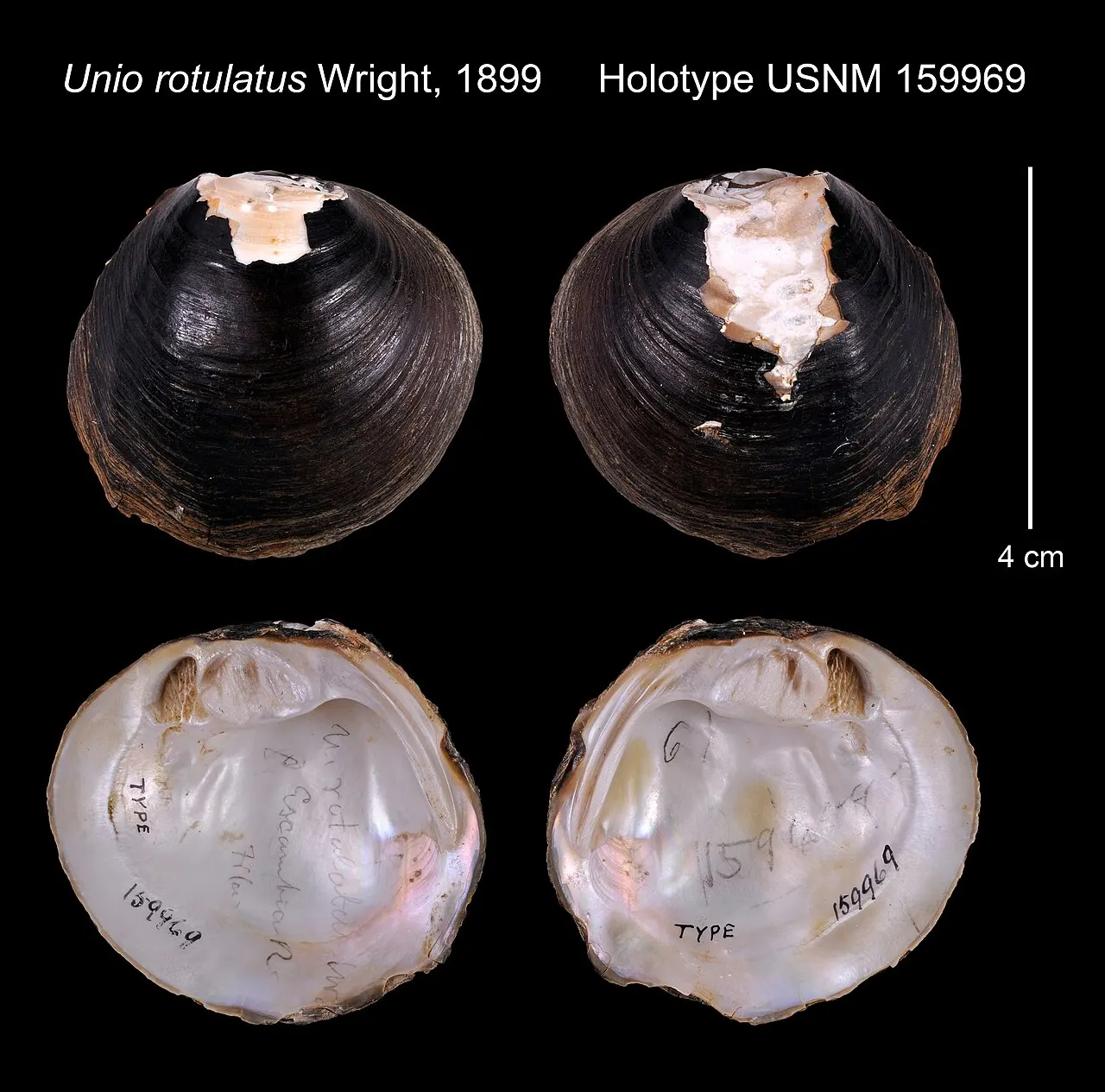
Reginaia rotulata is a medium-small mussel, usually round and occasionally oval, with a thick smooth shell. The outside is dark olive brown to black and the inside is white and shiny. The U.S. Fish and Wildlife Service gives a length of about 70 mm (2.8 in), and a Florida field guide gives a maximum of 77 mm (3.0 in), though most Florida shells are under 55 mm (2.2 in).
It can be mistaken for a small round pearlshell (Glebula rotundata). The round ebonyshell has a wide gap between its hinge teeth, a deep cavity under the hinge, and triangular teeth rather than serrated ridges. The scientific name has changed over the years. B. H. Wright described it in 1899, it was later placed in Obovaria and then Fusconaia, and a 2012 genetic study reportedly led to its own genus, Reginaia.
Where it lives
The species is known from the Escambia River system only. The river is called the Conecuh in south-central Alabama and the Escambia once it crosses into the western Florida panhandle on its way to the Gulf of Mexico. It is the only mussel species restricted to this river drainage.
In Florida it has been recorded from the Alabama state line down to Molino. A 2012 federal rule put its current range at about 144 km (89 mi) of main channel. It lives on sand, small gravel or sandy mud, in slow to moderate current. It is mainly a main-channel animal, possibly also using the lower reaches of large tributary creeks.
Pins are Wikidata “endemic to” fields. Orange dots, when present, are GBIF occurrence tiles — survey bias included.
How it lives
Very little is known. Females are thought to brood their young for a short time, and gravid females have been seen in spring and summer. Like other freshwater mussels, the larvae probably need a fish to carry them for a while, but the host fish for this species has not been identified. Adults stay in the riverbed all year.
Why it is in trouble
Rarity is the main problem. In a 2006 dive survey researchers found three live animals, and a 2011 survey found four more. At the stations where it turned up in 2011, 219 other mussels were collected for every round ebonyshell. Because it lives in the main channel of a single river, one flood scour or contaminant spill could do real harm.
The IUCN assessment names soil erosion and sedimentation and shipping lanes as threats. The 2012 federal rule adds gravel mining, dredging, and clearing snags for navigation, which all disturb the streambed. Pollution from upstream sources is a known problem, and the introduced Asian clam (Corbicula fluminea) is also present in the river.
What is being done
The U.S. Fish and Wildlife Service listed the round ebonyshell as endangered in 2012, with critical habitat on the river in Alabama and Florida. Florida's field guide counts about 558 km of streams as critical habitat for this species. Most of the Florida floodplain sits inside a state water management area, which helps but cannot stop pollution coming from upstream. Florida's field guide says the river needs clean water, steady flows, and no damming or dredging, and calls for buffers along farmland, forestry and mining, more protected floodplain, and monitoring of mussels and their host fish. The IUCN assessment, from 2000, lists no conservation actions.
Sources
Written for this catalog in our own words from the sources below, checked against them on 12 November 2026. Population figures are estimates and carry the year they were made. Status and assessment year: IUCN. 2026. The IUCN Red List of Threatened Species. Version 2026-1. iucnredlist.org.




