Endangered
Red-faced Parrot
Hapalopsittaca pyrrhops
The red-faced parrot (Hapalopsittaca pyrrhops) is a green, red-masked parrot of cool Andean cloud forest in southern Ecuador and northwestern Peru. The IUCN Red List lists it as Endangered (assessment published 2023), after a steep decline in habitat and numbers. Fewer than about 2,400 birds are thought to remain.
How to recognise it
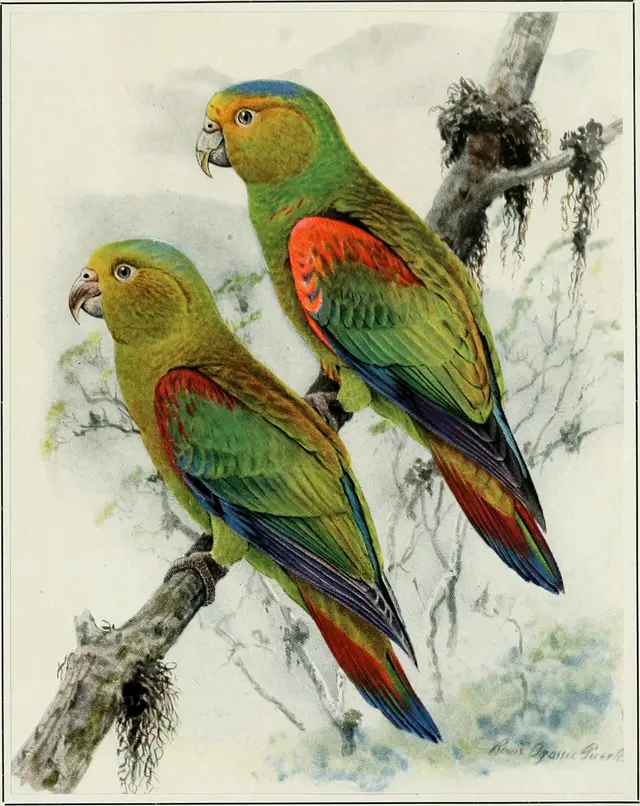
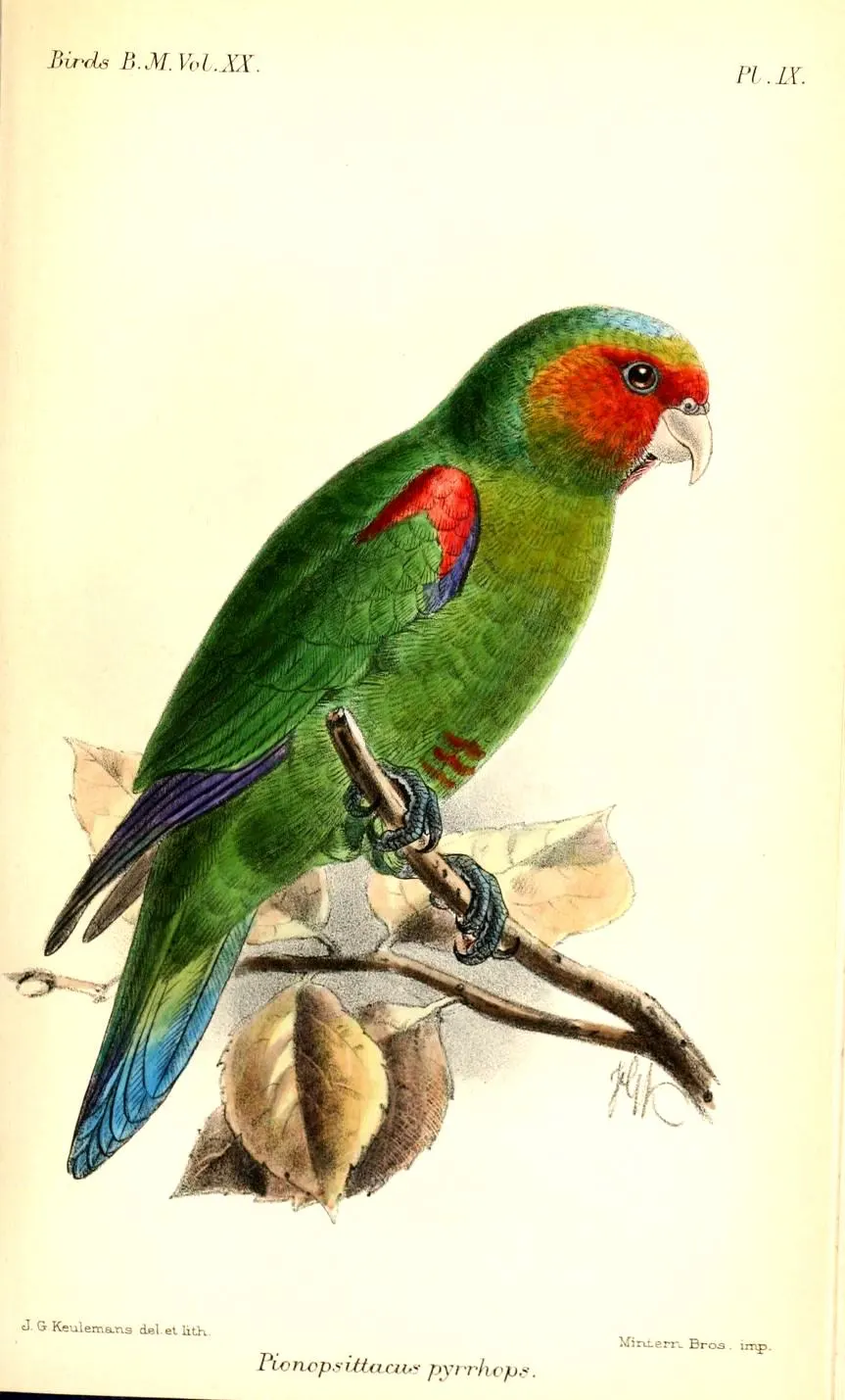
It's a bulky, mostly green parrot, about 22 centimetres long, which is small for a parrot. Red marks the forehead, cheeks and a stripe above each eye, and the ear patches are streaked with yellow. The shoulders are red, a patch that shows best in flight, and the wing and tail feathers are dark blue.
Its voice is loud and screechy, a two-syllable call given from perches and while feeding. The green plumage blends into the leaves, so birds feeding in the canopy are easy to miss.
Where it lives
It is found only on the eastern slope of the Andes, in southern Ecuador and adjoining northwestern Peru. In Ecuador, records come from the provinces of Azuay, Loja and Morona-Santiago, and in Peru from the department of Piura. The IUCN estimates an extent of occurrence of about 23,300 square kilometres and an area of occupancy of about 4,600 square kilometres.
The parrot lives in humid upper montane forest between roughly 2,500 and 3,500 metres, and it also uses forest patches and shrubby ground beside high-altitude paramo grassland. The IUCN classes it as an altitudinal migrant, meaning it probably moves up and down slopes.
Pins are Wikidata “endemic to” fields. Orange dots, when present, are GBIF occurrence tiles — survey bias included.
How it lives
Pairs and small flocks, often around 20 birds, fly over the forest and then drop in to feed. They eat fruit, flowers, seeds, berries and shoots, taken from canopy trees and from smaller fruiting trees and shrubs.
It nests in tree cavities, natural ones or holes made by woodpeckers. The female lays two or three eggs and incubates them, and the male helps feed the chicks. Much of its breeding biology is still poorly documented.
Why it is in trouble
The IUCN estimates a population of 1,200 to 1,600 birds, spread across 10 to 100 subpopulations, with the largest holding about 51 to 250 birds. It judges the population to have already fallen by 40 to 69 percent and to be still falling at a similar rate.
The causes are mostly about the forest. Cloud forest is cleared and fragmented by small-scale farming and grazing and is burned more often. The IUCN lists mining as a future threat and unintended effects of small-scale harvest as an ongoing one. The American Bird Conservancy adds logging and infrastructure, and says climate change deepens the habitat loss.
The Red List history is unsteady. The species was Endangered in 1994 and 1996, Vulnerable from 2000 to 2016, Least Concern in 2021, and back to Endangered in 2023.
What is being done
It occurs in at least one protected area, and conservation sites have been identified across its whole range. The IUCN records that a recovery plan exists but that no systematic monitoring scheme is in place. It calls for preventing mining within the range and protecting the remaining cloud forest, especially near Saraguro and the Cordillera de Chilla.
In 2025 the American Bird Conservancy reported the creation of the Ridgley Reserve at Selva Alegre in Ecuador, part of the Conserva Aves initiative, which improves habitat connectivity. International trade is regulated, and the species is on Appendix II of CITES.
Sources
Written for this catalog in our own words from the sources below, checked against them on 12 November 2026. Population figures are estimates and carry the year they were made. Status and assessment year: IUCN. 2026. The IUCN Red List of Threatened Species. Version 2026-1. iucnredlist.org.