Critically Endangered
Rainbow goodeid
Characodon lateralis
The rainbow goodeid (Characodon lateralis) is a small livebearing fish from spring-fed pools in the Mexican state of Durango. The IUCN Red List placed it in the Critically Endangered category in 2019. Males are brightly coloured, with red fins and bluish-green scales, but the species now survives in very few places.
How to recognise it
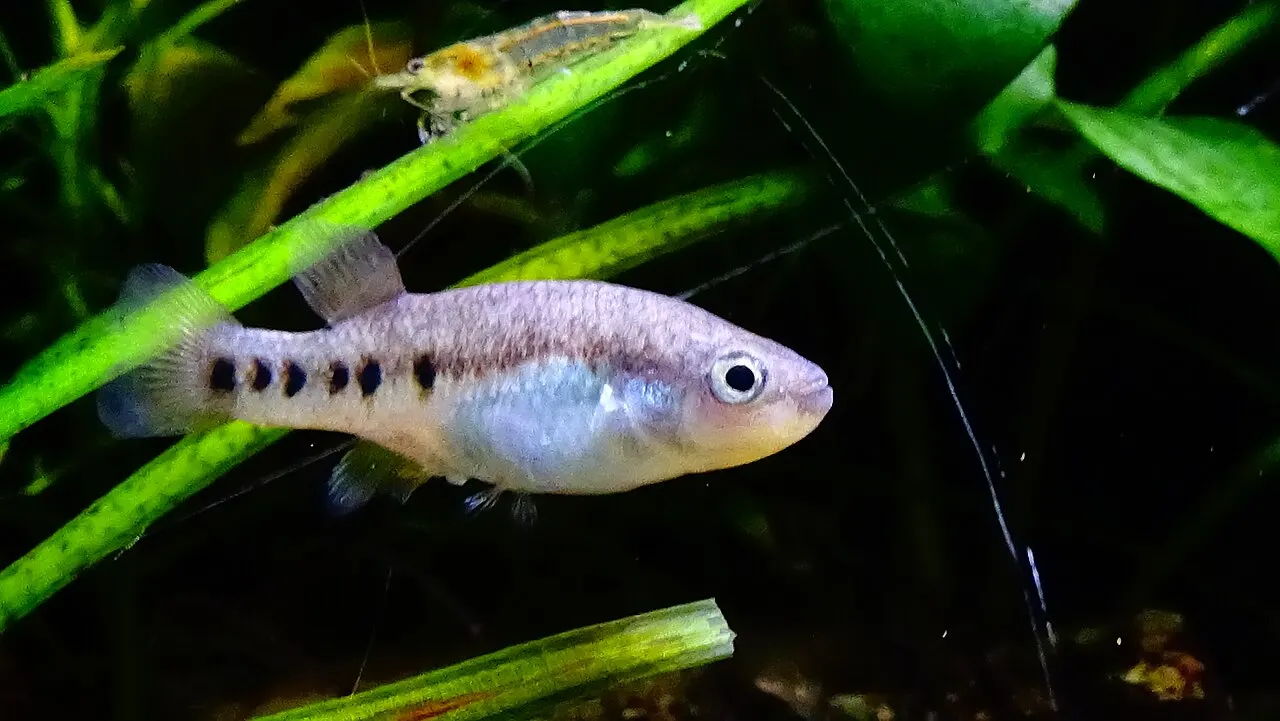
Both sexes are olive-brown with bluish-green scales, but they look quite different. Males have red unpaired fins with a black band near the tip, and reddish flanks that deepen to red in older fish. Females are plainer, with two to seven dark blotches along the midline and yellowish or clear fins.
It is a small fish, with a largest recorded standard length of about 6.3 cm. Males can be hard to tell from females at a glance, and some show a female-type pattern. The reliable mark is a notch in the anal fin, which males use to transfer sperm.
Where it lives
The species is found only in Durango, in the Rio Durango subbasin of the Rio San Pedro basin, at roughly 1,750 to 1,850 m above sea level. It lives in marshy pools, springs and spring outflows, usually in water shallower than half a metre, with little or no current and dense underwater plants such as water milfoil, hornwort and pondweed.
Historically it occurred north of Nombre de Dios, in springs and small streams including Ojo de Agua de San Juan, and it has vanished from several of them. Current wild sites are the Los Berros springs and a tiny spring on private land at La Constancia, about 4 km to the south. The Red List assessment counts one location, three subpopulations, an area of occupancy of about 12 square kilometres and an extent of occurrence of about 29 square kilometres.
Pins are Wikidata “endemic to” fields. Orange dots, when present, are GBIF occurrence tiles — survey bias included.
How it lives
Females give birth to live young. The embryos are reportedly nourished through a placenta-like structure, after a gestation of roughly 55 days, with 5 to 20 fry per brood. Young fish were caught between March and early September in one survey summary, which points to a long breeding season from early spring into late summer.
Diet is described differently by different sources. The Goodeid Working Group calls it mainly a feeder on small invertebrates such as insect larvae, with some algae and filamentous growth taken as well, while another account describes it as mostly an algae eater.
Taxonomy is unsettled. The Goodeid Working Group treats the fish from below the El Salto falls in Durango as Characodon sp. 1, and a 2019 study by Lyons and colleagues grouped all Durango Characodon together pending a wider revision of the genus.
Why it is in trouble
The Red List records a 65 percent reduction in range, and the population is still declining. Springs are drying because of groundwater pumping and water diversion, and drought makes shallow pools worse. Small dams, small-scale farming, fish culture, recreation, sewage and farm run-off are all listed as threats.
Introduced animals are a serious pressure. A 2015 survey by the Goodeid Working Group at Ojo de Agua de San Juan, once a stronghold, found only non-native fish, including green swordtails, mollies, gambusias, tilapia and Mexican tetras. At Los Berros, few fish were seen in the main spring, probably because of predatory crayfish.
What is being done
Two wild populations, from Los Berros and La Constancia, are held in captivity, and the Red List records the species as subject to ex-situ conservation. A laboratory at Michoacan University in Morelia is reported to run a breeding programme, and hobbyists occasionally breed the fish too. Actions the Red List calls for include site protection, habitat restoration, invasive species control and eventual reintroduction. Mexico lists the species as in danger of extinction.
Sources
Written for this catalog in our own words from the sources below, checked against them on 12 November 2026. Population figures are estimates and carry the year they were made. Status and assessment year: IUCN. 2026. The IUCN Red List of Threatened Species. Version 2026-1. iucnredlist.org.




