Endangered
Cambarellus patzcuarensis
Cambarellus patzcuarensis
The Mexican dwarf crayfish (Cambarellus patzcuarensis) is a small freshwater crayfish found only in Michoacán, in central Mexico, mostly in and around Lake Pátzcuaro. The IUCN Red List lists it as Endangered (assessed 2010). It is a familiar aquarium animal, but its lake habitat is polluted and shrinking.
How to recognise it
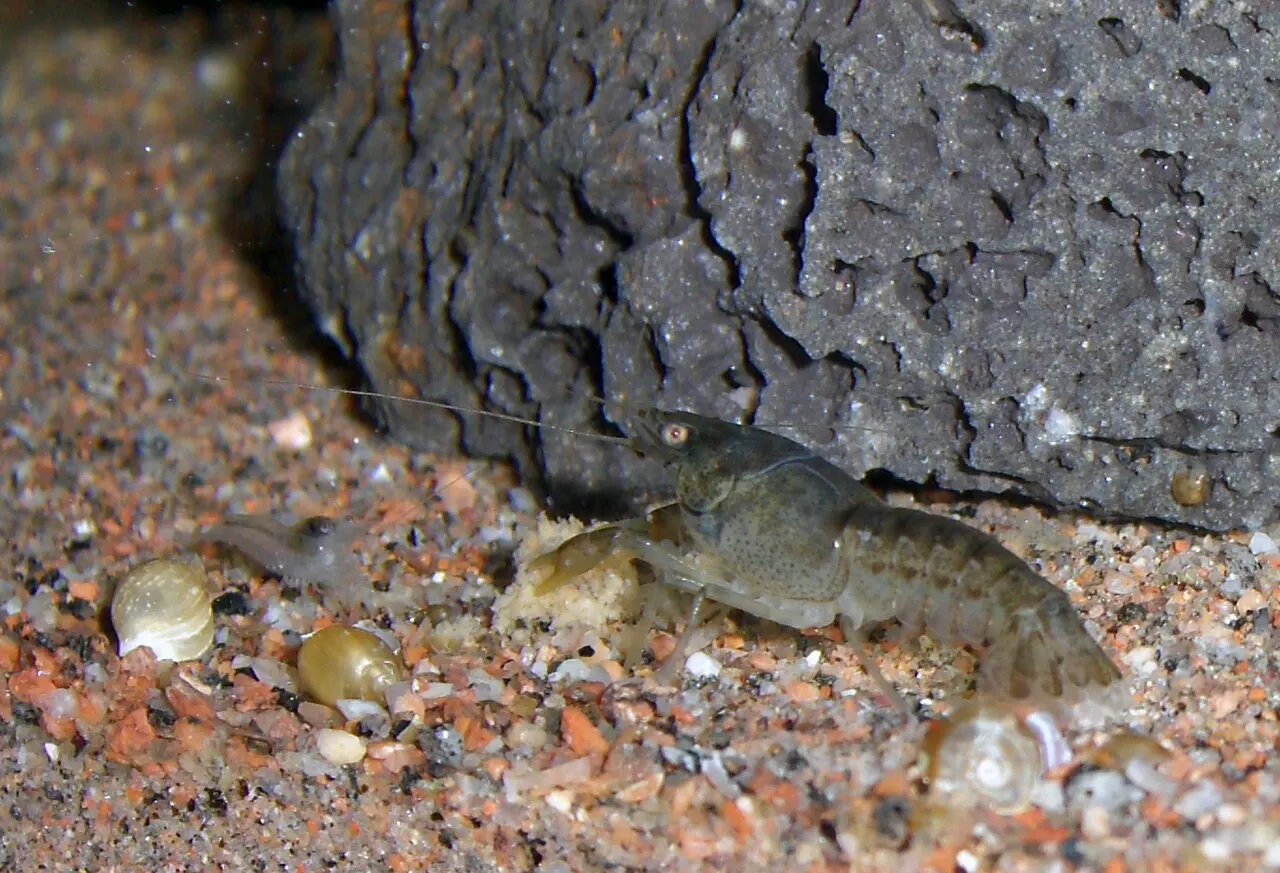
It's a small animal. A standard reference description gives a total length of 4 to 5 cm including the claws. One German aquarium supplier puts typical adults nearer 3 cm for males and 3.5 cm for females, and says 5 cm is reached only in rare cases.
Wild crayfish are mostly brown, sometimes with a grey or blue tint. The bright orange animals sold in the pet trade are a colour form that began in aquariums and was fixed by selective breeding. It is rarely, if ever, seen in the lake.
Where it lives
The species was described in 1943 by Villalobos from Lake Pátzcuaro. The lake sits about 2,035 m above sea level, in a basin with no outlet to the sea. It covers roughly 130 square kilometres and is up to 12 m deep. The crayfish also lives in springs at Chapultepec, Opopeo and Tzurumutaro, where the populations are usually isolated from each other.
The Red List estimates that the species occupies about 200 square kilometres, across between one and five locations, in permanent lake water and freshwater springs. The wider basin is far larger (982 square kilometres), but the crayfish is probably restricted to a limited area around the lake.
Pins are Wikidata “endemic to” fields. Orange dots, when present, are GBIF occurrence tiles — survey bias included.
How it lives
Little has been published on its way of life in the wild. The Red List describes it as abundant in the past: about 400 individuals were collected during survey work in the 1950s, and later surveys around Janitzio Island in the lake also found it abundant. The population trend is recorded as unknown.
Crayfish of this kind are cannibalistic, which is why young ones can't be kept together in small containers for long. Today's aquarium lines descend from only a few animals brought back by private expeditions, according to the supplier, and no commercial wild catches are reported.
Why it is in trouble
The lake has been squeezed from several directions. Untreated sewage, chemical contamination and introduced species all put pressure on Pátzcuaro, and silt builds up on the bottom at about 1 cm a year. Cattle ranching, deforestation and water abstraction in the basin add to it. Water drawn off for farms and towns has shrunk the lake by about 40 square kilometres and lowered it by roughly 2.6 m.
For the crayfish itself, the Red List records sewage, sedimentation, small-scale farming and grazing, surface water abstraction and accidental catch (it is sometimes taken as by-catch and eaten) as threats. It also records that the area it occupies is still declining, while noting that the effect of these pressures on the species is not known. The aquarium supplier adds that fish introduced for food have disturbed the lake's ecosystem.
What is being done
The Red List says the species occurs in at least one protected area, and the wetlands around the lake have been a Ramsar site since 2005. It lists no conservation actions specific to the crayfish. About 5 billion pesos has been spent on lake cleanup since 2006, but in 2021 the Supreme Indigenous Council of Michoacán said poor coordination had undermined the effort.
Sources
Written for this catalog in our own words from the sources below, checked against them on 12 November 2026. Population figures are estimates and carry the year they were made. Status and assessment year: IUCN. 2026. The IUCN Red List of Threatened Species. Version 2026-1. iucnredlist.org.




