Critically Endangered
Pyrrhosoma elisabethae
Pyrrhosoma elisabethae
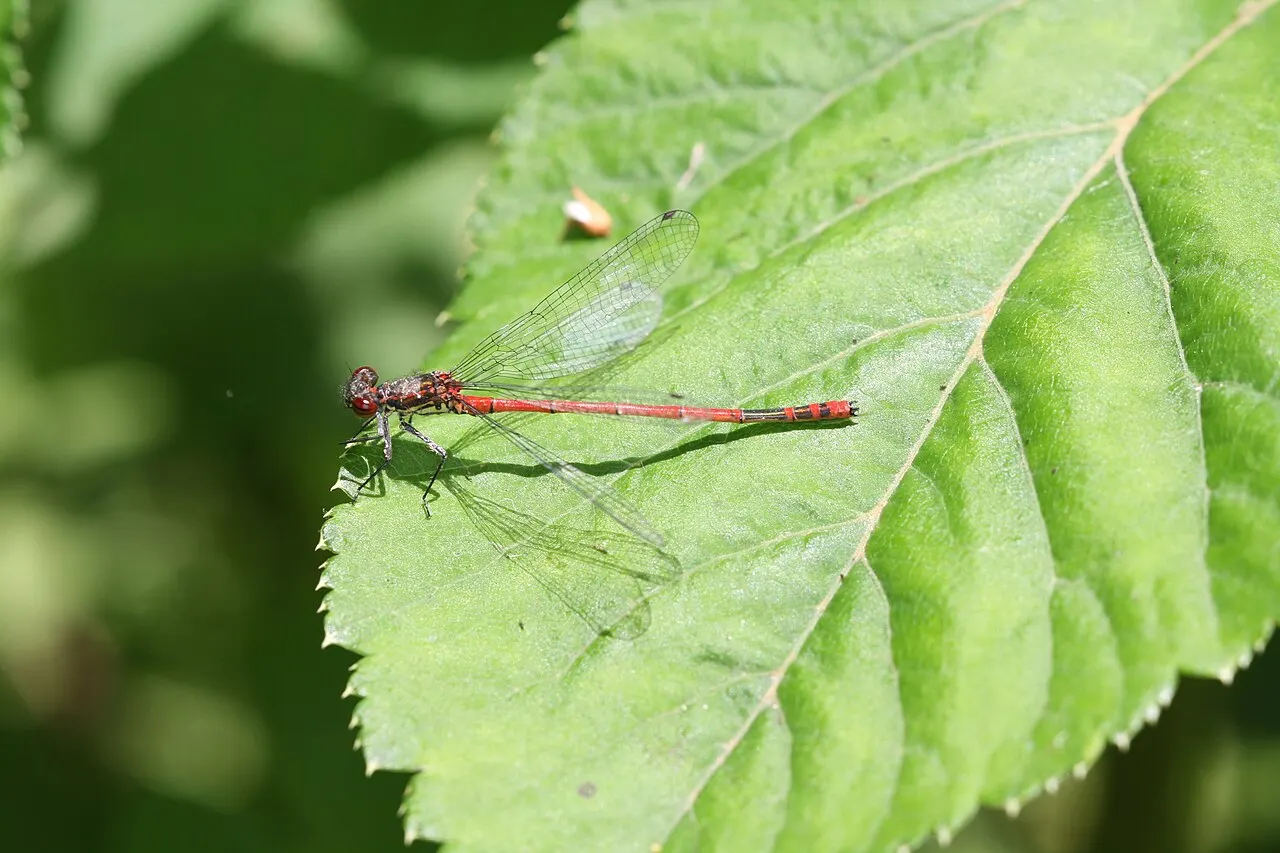
The Greek red damselfly (Pyrrhosoma elisabethae) is a red-and-black damselfly known only from a handful of small streams in Greece and southern Albania. The IUCN Red List assessed it as Critically Endangered in 2023, estimating its numbers at only 500 to 1,000 individuals.
How to recognise it
It looks very like the large red damselfly (Pyrrhosoma nymphula) and has often been treated as a subspecies of it. It is about 36 to 38 mm long, with red eyes and a red-and-black body. The amount of red varies and can be very limited.
Two details separate it from its lookalike. Males have lower abdominal appendages as long as the upper ones, where the large red damselfly's are much shorter. Females have a deep fold in the rear edge of the pronotum, the plate behind the head, which the large red damselfly lacks.
Where it lives
It was described by Schmidt in 1948 and occurs in Albania and Greece. A 2006 paper by Vincent Kalkman and Lopau, which argued it deserves full species status, could list only eight localities: four in the Peloponnese, three on Corfu and one in southern Albania.
Most populations are on clear streams with rich plant growth. The IUCN also records it in seasonal streams, and in canals and drainage ditches, from sea level up to about 900 m.
Pins are Wikidata “endemic to” fields. Orange dots, when present, are GBIF occurrence tiles — survey bias included.
Why it is in trouble
The 2023 assessment counts 5 locations and 7 subpopulations, with the largest holding an estimated 354 individuals. It estimates an 80 percent reduction, past, ongoing and projected, and calls the population severely fragmented and still declining. Its area of occupancy is only 64 square km.
The threats are mostly about water. They include taking water from streams for homes and farms, dams, drought, and pollution from sewage, nutrients and pesticides. Silt washing in from erosion and farming are also listed, and tourism development is recorded as a past pressure. Young damselflies live in the water, so streams that dry up or turn foul cut off the next generation.
What is being done
Little has been put in place. The assessment records no species recovery plan and no systematic monitoring scheme. It lists protecting streams and the land around them, restoring habitat, site management, awareness work and training among the actions needed.
Sources
Written for this catalog in our own words from the sources below, checked against them on 12 November 2026. Population figures are estimates and carry the year they were made. Status and assessment year: IUCN. 2026. The IUCN Red List of Threatened Species. Version 2026-1. iucnredlist.org.




