Critically Endangered
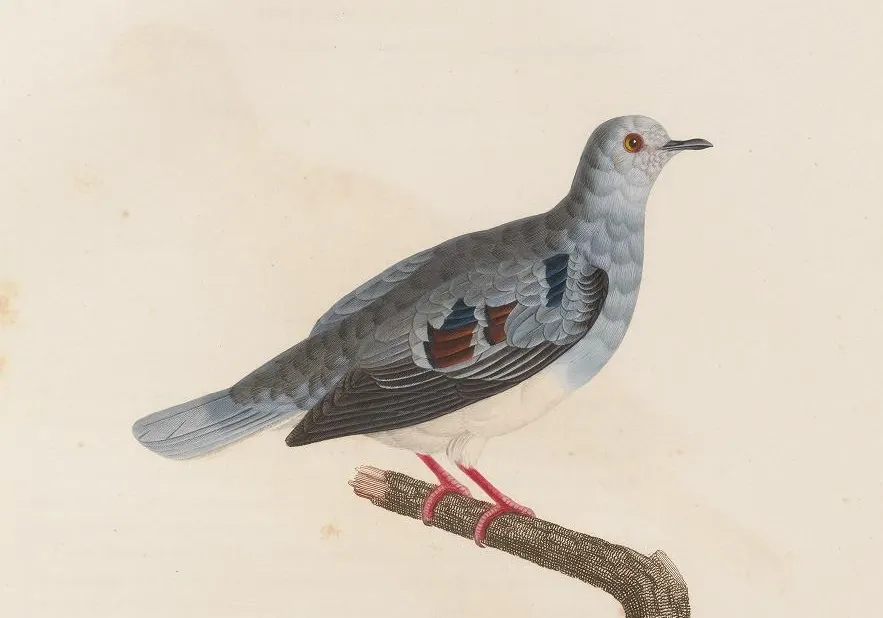
Purple-winged Ground Dove
Paraclaravis geoffroyi
The purple-winged ground dove (Paraclaravis geoffroyi) is a secretive, nomadic dove of the Atlantic Forest in south-eastern Brazil, eastern Paraguay and Argentina's Misiones province, tied to bamboo seed. The IUCN Red List assessed it as Critically Endangered in 2025, and nobody can say for sure that it still exists.
How to recognise it
In its genus, males are mostly pale grey-blue and females mostly brown, and both sexes have bands or spots on the wings.
Identification is a real problem. In poor light it is easily mistaken for the blue ground dove (Claravis pretiosa), which shares its forests. That confusion makes some recent sightings doubtful. The bird was long placed in the genus Claravis and was moved to the new genus Paraclaravis in 2018.
Where it lives
Historically the dove ranged across south-eastern Brazil, far eastern Paraguay and, in Argentina, only Misiones. The IUCN lists moist subtropical and tropical forest, both lowland and montane, from sea level up to 2,300 m.
A 2021 study in Frontiers in Ecology and Evolution suggested searching east-central Santa Catarina, south-west Paraná and most of Misiones, including Iguazú National Park, as well as cold spots in the Serra do Mar.
Pins are Wikidata “endemic to” fields. Orange dots, when present, are GBIF occurrence tiles — survey bias included.
How it lives
The dove is linked to bamboo, in particular to mass seeding of two Guadua bamboos, takuarusu (Guadua chacoensis) and yatevó (Guadua trinii). A bird that depends on such episodic seed supplies has to wander to find the next patch, and the IUCN classes the dove as nomadic.
It is extremely secretive and hard to detect outside seeding events. The 2021 study recommends autonomous sound recorders and playback of its voice at bamboo seeding events in priority areas.
Why it is in trouble
The last unambiguous wild record is a female collected on 15 January 1985 at Taquara, Rio de Janeiro. The 2021 study found no verifiable photo, video or sound recording after that. Unverified sightings continue, the latest in Argentina in 2017.
Its extinction models gave dates between 2006 and 2010 using specimens only, and 2028 to 2030 when sight records were added. It put the chance that the species is still alive at about 0.86 with all records and 0.67 with specimens only.
The 2025 IUCN assessment gives a population of 0 to 49 mature individuals, with an unknown trend. It lists urban and commercial development as ongoing threats, along with targeted capture of the bird. Habitat loss in the Atlantic Forest is the usual suspect behind the decline.
What is being done
The IUCN records conservation sites identified across the entire range and an area-based management plan, but no species recovery plan and no monitoring scheme. No captive birds exist now.
Brazilian aviculturists kept and bred the dove from the 1970s, with a peak of about 150 birds. Breeding groups were broken up, and all captive birds had died by the mid-1990s. The 2021 study urges working with private breeders, starting a captive breeding programme if wild birds are found, and restoring forest connectivity.
Sources
Written for this catalog in our own words from the sources below, checked against them on 12 November 2026. Population figures are estimates and carry the year they were made. Status and assessment year: IUCN. 2026. The IUCN Red List of Threatened Species. Version 2026-1. iucnredlist.org.




