Endangered
Purple-naped Lory
Lorius domicella
The purple-naped lory is a small red parrot from the Maluku islands of Indonesia, living in forest on Seram and possibly a few neighbouring islands. The IUCN Red List classed it as Endangered in 2024, and trapping for the cage-bird trade is the main pressure on its dwindling numbers.
How to recognise it
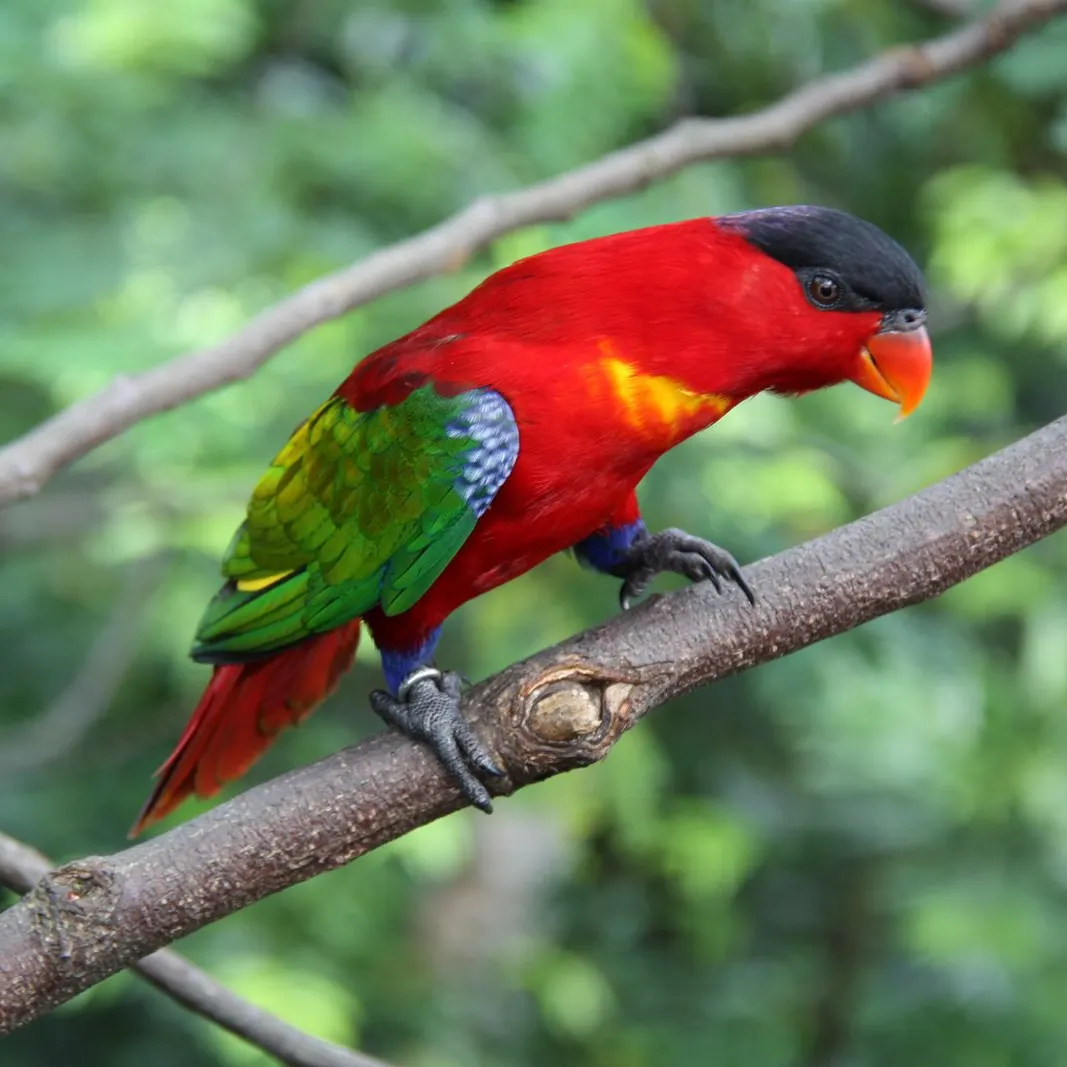
This is a compact parrot, about 28 cm long and roughly 235 g, and mostly bright red. Adults have a black crown that fades to purple at the back of the neck, green wings, blue thighs and an orange beak. A yellow band across the chest varies from bird to bird. The tail is red and darkens toward the tip.
Young birds look different. They have a brown beak, brown eyes, a wider yellow chest band and a larger purple patch on the nape.
Where it lives
The species is native to Seram and Ambon in South Maluku, Indonesia, and may also occur on Haruku and Saparua. The IUCN counts 6 to 25 locations, treats the birds as a single population, and gives an elevation range of 300 to 1,300 m, covering lowland and moist montane forest. The World Parrot Trust gives a narrower 600 to 1,000 m.
Pins are Wikidata “endemic to” fields. Orange dots, when present, are GBIF occurrence tiles — survey bias included.
How it lives
Wild birds eat fruit, nectar, pollen, berries and rattan seeds. They usually travel in pairs and only rarely in groups, staying high in tall trees. They tend to be quiet and shy while feeding or resting, then noisy and easy to spot when flying over the canopy.
A clutch is two eggs, and young birds in captivity fledge at around 11 weeks. The IUCN puts one generation at roughly 8.6 years.
Why it is in trouble
Trapping for the cage-bird trade is the leading threat. A 2021 study in Diversity, based on surveys in and around Manusela National Park on Seram, concluded that parrots there are largely threatened by poaching, and it named this lory among three endemic species of concern. Forest loss adds to the strain. The IUCN lists shifting agriculture, small-holder farming and small-holder plantations as pressures, and records ecosystem degradation, deaths and reduced breeding success among the effects.
The numbers are rough. The Red List estimates 500 to 5,000 mature birds in 2024 and a declining population, with its range and number of locations also shrinking.
What is being done
The species is on Appendix II of CITES, which regulates international trade. The IUCN records trade management, site protection, awareness work and captive breeding among the actions listed, and says a recovery plan exists. It also reports that the species occurs in at least one protected area, and the 2021 parrot survey took place in one of them, Manusela National Park on Seram.
Sources
Written for this catalog in our own words from the sources below, checked against them on 12 November 2026. Population figures are estimates and carry the year they were made. Status and assessment year: IUCN. 2026. The IUCN Red List of Threatened Species. Version 2026-1. iucnredlist.org.




