Endangered
Puerto Rican crested toad
Peltophryne lemur
The Puerto Rican crested toad (Peltophryne lemur) is the only toad native to Puerto Rico. It now survives mainly in the dry forest around Guánica on the south coast, propped up by decades of captive breeding. The IUCN assessed it as Endangered in 2021, after earlier listings as Critically Endangered.
How to recognise it
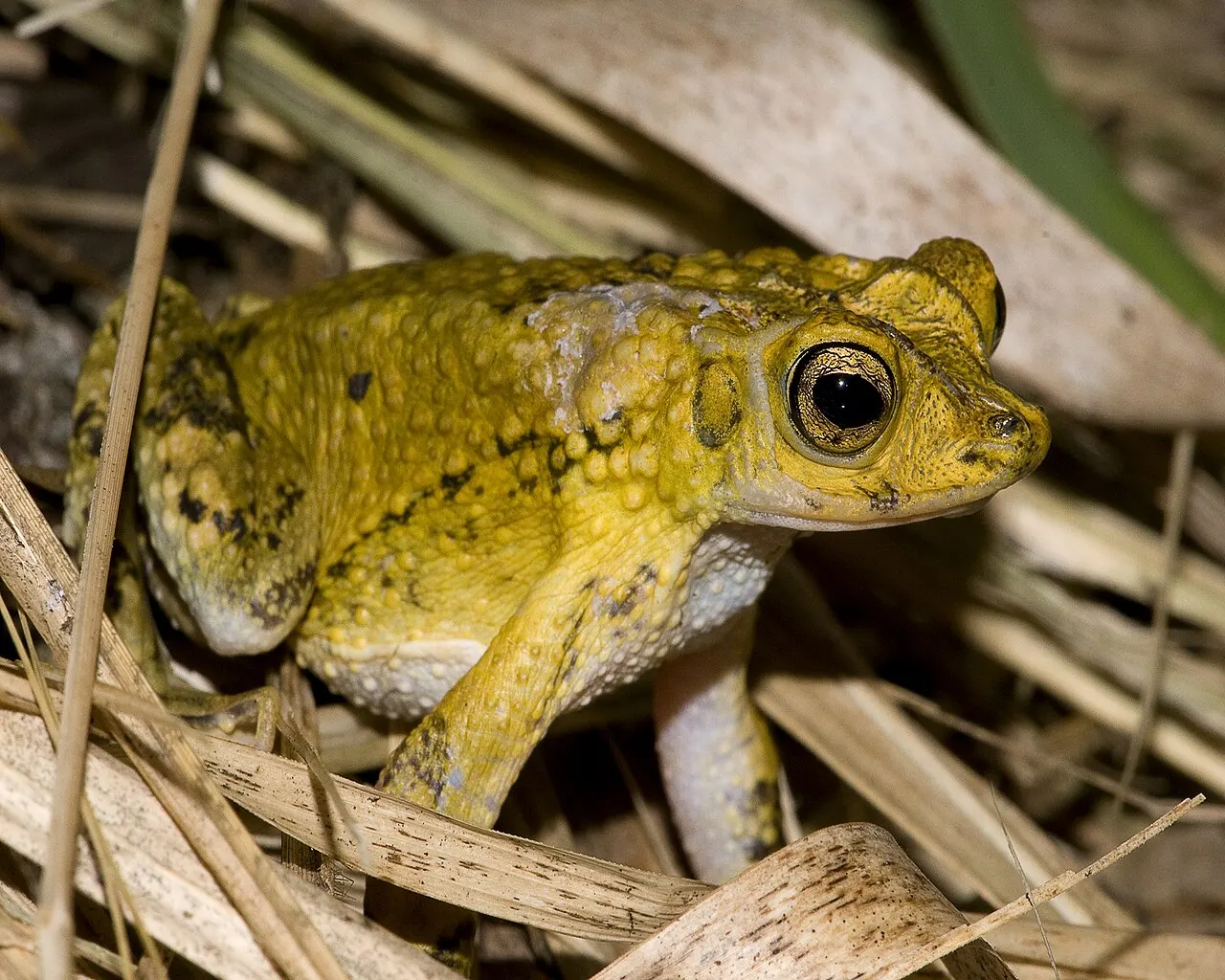
This is a medium-sized toad, 64 to 120 millimetres long from snout to vent (about 2.5 to 4.5 inches). The giveaway is a large bony crest on the head, which is why it's also called the ridge-headed toad. Locals know it as sapo concho.
The muzzle is short and flattened, the eyes are large, and the irises are metallic gold flecked with black. The skin carries big rounded warts, and there's a blunt spine low on the back. The toes are less than half webbed.
Where it lives
The toad is native to Puerto Rico and once also lived in the British and US Virgin Islands, where the Red List now treats it as gone. On Puerto Rico none have been recorded on the north coast since 1992. The last known wild population is in Guánica forest on the south coast, and captive-bred tadpoles are released at sites in both north and south.
It lives close to sea level, from the shore up to roughly 50 metres, in lowland moist and dry forest. It also uses seasonal and permanent pools, small ponds and limestone cave waters. The Red List puts its occupied area at somewhere between 36 and 100 square kilometres.
Pins are Wikidata “endemic to” fields. Orange dots, when present, are GBIF occurrence tiles — survey bias included.
How it lives
Adults are nocturnal and spend most of their time buried or tucked into crab burrows, spider lairs and bird nests. They eat ants, beetles, crickets and spiders.
Breeding is tied to rain. It takes at least four inches to fill shallow temporary pools, and males may travel up to two miles to reach them. A female can lay up to 15,000 eggs, which hatch within a day, and tadpoles turn into toadlets in 18 to 24 days. In years without enough rain there may be no breeding at all.
Why it is in trouble
Habitat loss is the main historical cause. The Red List counts housing as a past threat and small-scale farming as an ongoing, minor one. Introduced predators and the giant cane toad, brought to the island to control sugarcane pests, add pressure. The 2021 assessment scores drought and storms and flooding as medium impacts across the whole population, and the trend is decreasing.
The largest known breeding pond faces rising seas and possible salt intrusion, and only two natural breeding sites are reported to remain. Counts are hard to make. A 2014 report put the wild population at around 200 animals after a fall of more than 80 percent in a decade, while National Geographic gives an undated estimate of 1,000 to 3,000 adults.
What is being done
The toad was believed extinct from 1931 until a small population turned up in 1966. In 1984 the Association of Zoos and Aquariums started a Species Survival Plan, the first for an amphibian. Captive breeding began in 1992. By 2014 sixteen zoos took part each year, and more than 300,000 toads had been released.
Release ponds are ringed with mesh to keep out dragonfly larvae, marine toads and birds, and predators such as mongooses are removed. A new wetland on higher ground is planned near the biggest breeding site. A toad conceived by in vitro fertilisation was reportedly born in 2019.
Sources
Written for this catalog in our own words from the sources below, checked against them on 12 November 2026. Population figures are estimates and carry the year they were made. Status and assessment year: IUCN. 2026. The IUCN Red List of Threatened Species. Version 2026-1. iucnredlist.org.




