Endangered
Atlantihyla spinipollex (formerly Ptychohyla spinipollex)
Ptychohyla spinipollex
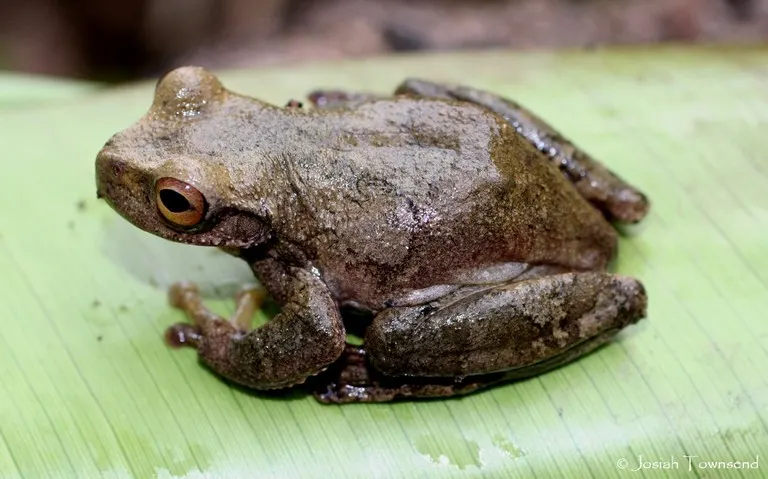
The Atlantihyla spinipollex (formerly Ptychohyla spinipollex) (Atlantihyla spinipollex, formerly Ptychohyla spinipollex) is a tree frog of fast streams found only in Honduras. The IUCN Red List rated it Endangered in 2022, mainly because the forests around its streams are being cleared and degraded across a small range.
How to recognise it
The frog belongs to the tree frog family Hylidae and to the small genus Atlantihyla, whose members are called stream frogs. Adults across the genus measure about 30 to 46 mm from snout to vent, with females somewhat larger than males, and the tadpoles have large oral discs. A pale stripe along the lower flank is the only feature tentatively linking the genus. Measurements for this species alone are not published in the sources available.
K. P. Schmidt described the species in 1936 as Hyla spinipollex. It later moved to Ptychohyla, and the genus Atlantihyla was erected in 2018 with this frog as its type species. Older books and databases still use the Ptychohyla name.
Where it lives
It is endemic to Honduras. The Red List records it from 160 to 1,580 m above sea level, in moist lowland and montane forest and along permanent rivers and streams. It occurs in 1 to 5 locations and in at least one protected area.
Its known range was trimmed in 2020, when frogs from the montane rainforest of the Texiguat wildlife refuge, long counted as this species, were described as a separate species, Atlantihyla melissa. It is the sister species of the Atlantihyla spinipollex (formerly Ptychohyla spinipollex), which is now restricted to the central and eastern parts of the Cordillera Nombre de Dios. The Red List puts its extent of occurrence at about 1,480 square kilometres.
Pins are Wikidata “endemic to” fields. Orange dots, when present, are GBIF occurrence tiles — survey bias included.
Why it is in trouble
The assessment lists a long run of pressures on its habitat: small-holder and industrial farming, grazing, plantations and housing, plus more frequent fires, drought, storms and flooding, landslides and soil erosion. Together these clear or degrade the forest and silt up streams, and the area the frog occupies is still declining. The population trend is listed as decreasing.
The assessment also lists unintentional harm from small-scale harvesting activity.
What is being done
The Red List records protection of its sites and of its resources and habitat as the main response, and part of the population lives inside a protected area. Site management is also listed. No species-specific recovery programme is documented, and little is published on its breeding or numbers.
Sources
Written for this catalog in our own words from the sources below, checked against them on 12 November 2026. Population figures are estimates and carry the year they were made. Status and assessment year: IUCN. 2026. The IUCN Red List of Threatened Species. Version 2026-1. iucnredlist.org.




