Endangered
Smoky flying squirrel
Pteromyscus pulverulentus
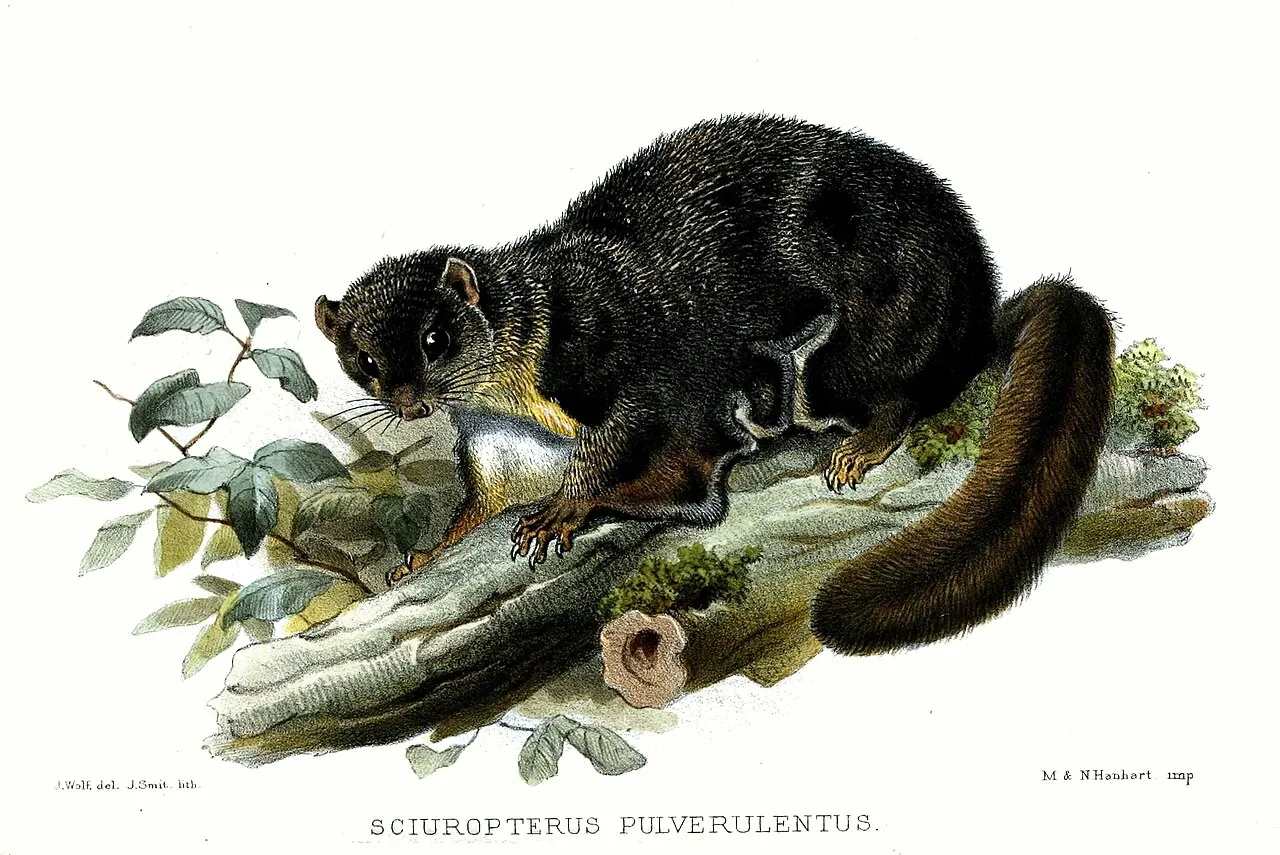
The smoky flying squirrel (Pteromyscus pulverulentus) is a dark, finely speckled glider of the rainforests of southern Thailand, the Malay Peninsula, Sumatra and Borneo. The IUCN Red List assessed it as Endangered in 2016, mainly because the lowland forest it depends on keeps being cleared.
How to recognise it
It's a medium-sized flying squirrel with very dark grey-brown fur, lightly frosted with pale speckling on the back. The underparts are creamy, the cheeks grey, and the bushy tail is grey-brown with blackish tips. The tail is slightly flattened, though less so than in the northern flying squirrels of the genus Glaucomys.
Head and body measure roughly 20 to 29 cm, with a tail of 18 to 23 cm. Published weights differ: 134 to 252 g in one account and 134 to 315 g in another.
Where it lives
The species is recorded from Brunei, Indonesia (Sumatra and Kalimantan), Malaysia (the peninsula, Sabah and Sarawak) and southern Thailand. Some authorities recognise two subspecies: the nominate form on the mainland and Sumatra, and Pteromyscus pulverulentus borneanus in northern Borneo. Bornean records include Poring, on the foothills of Mount Kinabalu, and several sites in Sarawak.
It lives in tall rainforest, lowland and montane. On Borneo it has been found only in undisturbed primary forest. On the Malay Peninsula it also turns up in partly logged forest, but in more disturbed, replanted areas it tends to be replaced by the Javan flying squirrel.
Pins are Wikidata “endemic to” fields. Orange dots, when present, are GBIF occurrence tiles — survey bias included.
How it lives
It's nocturnal, feeding and gliding between trees after dark. By day it rests in tree holes. At Poring, all seven holes recorded were 3 to 4 m above the ground. Diet is poorly documented. Accounts mention beetles, seeds, fruit and leaves, and one describes it as mainly a leaf-eater.
Breeding appears possible in any month, with a peak from April to June, and females have one or two young. A study in Malaysia found only about 9 percent of the animals pregnant, which suggests breeding varies between years and may pause for some months.
Why it is in trouble
The Red List assessment infers a population decline of 50 percent or more, based on the loss and degradation of its forest rather than on direct counts, and gives the trend as decreasing. The drivers it lists are small-holder farming, shifting agriculture and housing, all of which convert or degrade forest.
The animal is rarely seen even in intact forest, so real numbers are not known and more survey work is needed.
What is being done
The species occurs in at least one protected area, and conservation sites have been identified across its whole range. The assessment lists no species-specific conservation actions. Protecting what remains of the primary forest is the measure most likely to help.
Sources
Written for this catalog in our own words from the sources below, checked against them on 12 November 2026. Population figures are estimates and carry the year they were made. Status and assessment year: IUCN. 2026. The IUCN Red List of Threatened Species. Version 2026-1. iucnredlist.org.




