Endangered
Pterocryptis wynaadensis
Pterocryptis wynaadensis
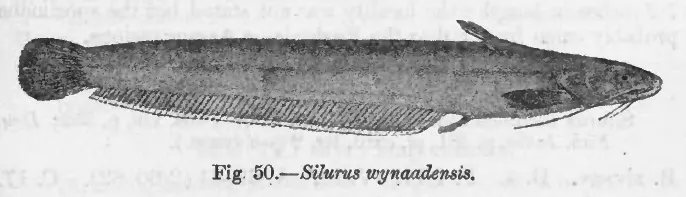
The Malabar silurus (Pterocryptis wynaadensis) is a small freshwater catfish from rivers of southern India. The IUCN Red List assessed it as Endangered in 2011, with a decreasing population trend. It grows to about 30 cm and spends its time on the bottom, hiding among rocks and in holes in fast water.
Where it lives
The first specimen came from Wynaad, now the Wayanad district of Kerala, at about 3,000 feet (roughly 900 m). Francis Day described it in 1873 under the name Silurus wynaadensis, and the species name still honors that place. It was later moved to the genus Pterocryptis, a name built from Greek words that mean roughly fin and hidden.
FishBase places it in the Cauvery drainage in Kerala and the Thungabhadra drainage in Karnataka. The Red List assessment also names Tamil Nadu and Maharashtra, and gives an elevation band of 600 to 900 m. The assessors put its extent of occurrence at about 50,000 square kilometres in 2010, and did not consider the population severely fragmented.
Pins are Wikidata “endemic to” fields. Orange dots, when present, are GBIF occurrence tiles — survey bias included.
How it lives
This is a bottom-dwelling catfish of fast-flowing rivers, streams and canals. It shelters in holes and between rocks and eats small fishes and crustaceans. The largest recorded length is 30 cm. A common length is given as 9 cm, and the size at which it matures hasn't been recorded.
The Red List treats a wide set of water bodies as suitable: permanent and seasonal streams, irrigation channels, drainage ditches and seasonally flooded farmland. Large water storage areas are marginal habitat. In English it is also called the round tailed killer catfish, and the Malayalam name is Thonnan Vaala.
Why it is in trouble
The 2010 assessment recorded a continuing decline in the area it occupies. It listed five ongoing threats, each scored as medium impact: small-scale harvest for subsistence, soil erosion and sedimentation, herbicides and pesticides, other changes to its ecosystems, and one threat of unrecorded type. Uses noted in the assessment are as food and as a pet or display animal.
FishBase also describes the species as critically endangered in the Western Ghats, a harsher verdict than the global Endangered listing.
What is being done
Little protection is on record. The assessment found no recovery plan, no systematic monitoring and no occurrence inside a protected area, although conservation sites had been identified over part of the range. It called for captive breeding, a genome resource bank and habitat protection. The assessment work dates from 2010, so the situation today may differ.
Sources
Written for this catalog in our own words from the sources below, checked against them on 12 November 2026. Population figures are estimates and carry the year they were made. Status and assessment year: IUCN. 2026. The IUCN Red List of Threatened Species. Version 2026-1. iucnredlist.org.




