Critically Endangered
Black-winged trumpeter
Psophia obscura
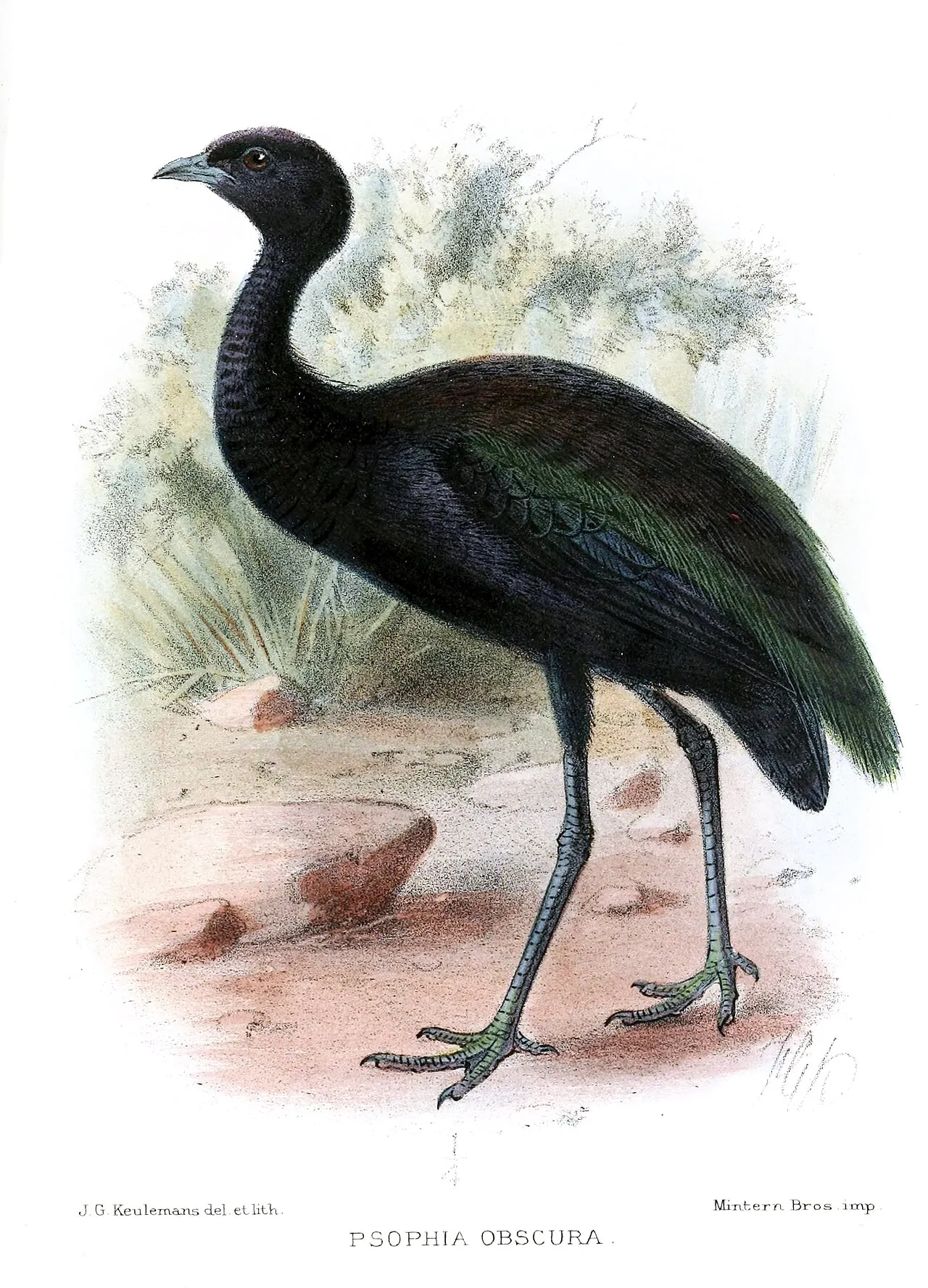
The black-winged trumpeter (Psophia obscura) is a large, ground-living forest bird of eastern Brazilian Amazonia. The IUCN Red List rated it Critically Endangered in 2025 and puts the population at only 50 to 400 individuals. It was long treated as a subspecies of another trumpeter before being recognised as a species of its own.
How to recognise it
Trumpeters are long-legged forest birds with a rounded, hunched shape. This one measures roughly 45 to 52 cm. Its plumage is almost uniformly black, with only a faint sheen on the neck and the outer wing feathers. The back is dark brown shading to dark green toward the rear, and the bill and feet are green to olive.
It was once classed as a subspecies of the dark-winged trumpeter and is now treated as a separate species. It is also called the dusky trumpeter.
Where it lives
The black-winged trumpeter is found only in Brazil, in the Belém Centre of Endemism at the far eastern edge of the Amazon forest. The Red List gives its extent of occurrence as 43,000 to 110,000 square km, though the bird now occupies only parts of that. It lives in lowland moist forest below about 250 m.
Two strongholds are known. One is the Gurupi Biological Reserve, a protected area of about 270,000 hectares, which together with neighbouring Indigenous Lands holds the last large block of continuous forest in this part of the Amazon. The other is a set of unprotected forest remnants around Paragominas.
Pins are Wikidata “endemic to” fields. Orange dots, when present, are GBIF occurrence tiles — survey bias included.
How it lives
Trumpeters are terrestrial, live in groups and defend territories. Territory size has not been measured for this species; the Gurupi researchers assumed about 70 hectares, a figure from other trumpeters. Members of the family mostly eat fruit, swallowing it whole and passing the seeds intact, so they act as seed dispersers.
A 2022 study in Bird Conservation International ran camera traps at 61 sites in Gurupi from 2016 to 2020. It found the birds more likely at sites where forest had had longer to recover from logging, and less likely at higher elevations and in denser stands of trees. Modelled occupancy stayed between about 0.57 and 0.67 across the five years with no significant change, though the birds turned up on camera only rarely (detection chances were 9 to 15 percent), so those figures carry real uncertainty.
Why it is in trouble
Hunting is the first problem. Trumpeters are big, conspicuous and live in groups, which makes them easy targets. The Red List records the species as taken for food and for the pet and display trade, and scores targeted hunting as a high-impact threat.
Habitat loss comes second. Large-scale and small-holder farming, cattle ranching, roads and fire all appear in the assessment. Gurupi itself has lost about 30 percent of its forest cover to illegal deforestation, and much of what is left is degraded by illegal selective logging and fires. The Red List estimates a population decline of 45 to 79 percent, still continuing.
The Red List puts the largest subpopulation at 10 to 100 birds. A 2020 habitat model cited in the 2022 paper suggests the species could lose more than 70 percent of its suitable habitat to climate change by 2050.
What is being done
The species occurs in at least one protected area, conservation sites are identified across its range, and a recovery plan exists. There is no systematic monitoring scheme, no captive population and no reintroduction. The Gurupi researchers call for stronger management of the reserve, continued monitoring, proper population counts there and elsewhere, and surveys of the unprotected forest fragments where the bird may still survive.
Sources
Written for this catalog in our own words from the sources below, checked against them on 12 November 2026. Population figures are estimates and carry the year they were made. Status and assessment year: IUCN. 2026. The IUCN Red List of Threatened Species. Version 2026-1. iucnredlist.org.




