Endangered
Pseudotolithus senegalensis
Pseudotolithus senegalensis
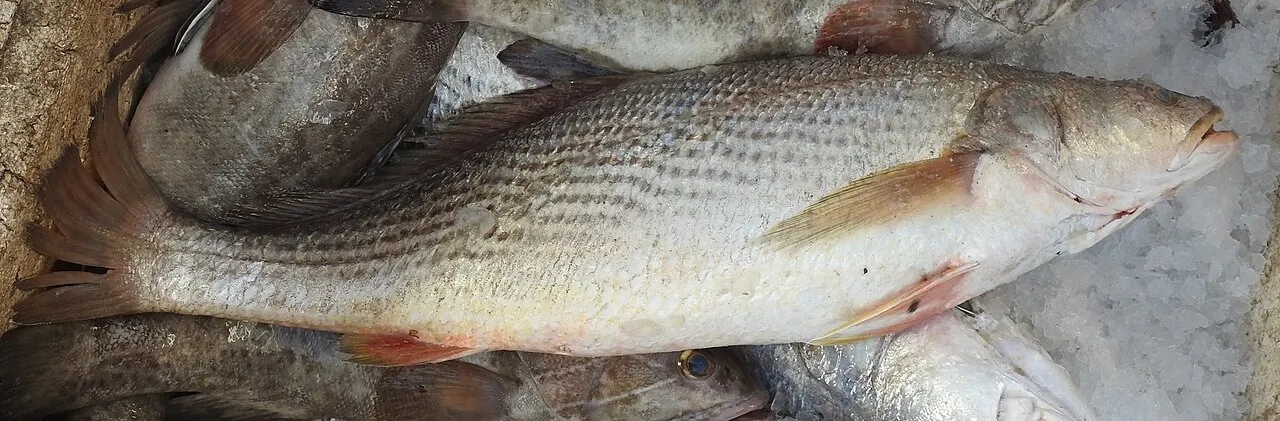
The cassava croaker (Pseudotolithus senegalensis) is a large drum fish of the muddy seabed along the West African coast, from Morocco down to Angola. The IUCN Red List rated it Endangered in 2021 because heavy fishing is thought to have cut its numbers by around half.
How to recognise it
It is a big, greyish-brown fish, paler underneath, with a large mouth and a lower jaw that sticks out slightly past the upper. The maximum recorded length is 114 cm, though adults are commonly about 50 cm. Valenciennes described it in 1833.
Across West Africa it goes by many names: cassava croaker, cassava drum or simply croaker in English, and apo (Yoruba), ekan (Ga and Fante) and law (Wolof) in local languages. A close relative, Pseudotolithus typus, grows faster in the same measurements.
Where it lives
The cassava croaker lives over muddy bottoms on the open continental shelf, in water warmer than about 16 degrees Celsius. The Red List records it from depths of 0 to 100 metres, over estuaries, mud, sandy mud, sand and rocky reef, and lists around two dozen countries and territories along the eastern Atlantic coast, from Western Sahara and Mauritania to Namibia, plus the Canary Islands.
Its diet is mainly prawns and other crustaceans living on the seabed.
Pins are Wikidata “endemic to” fields. Orange dots, when present, are GBIF occurrence tiles — survey bias included.
How it lives
A 2024 study in Frontiers in Fish Science sampled croakers from fish markets in Senegal (2015 to 2016) and from catches in Ghana and Nigeria (a single month in 2022). It defined the spawning period as November to March, and found that growth differed between countries: the calculated maximum length was 42.2 cm in Senegal, 35.0 cm in Ghana and 33.6 cm in Nigeria. The study cautioned that the pattern needs several years of data to confirm. The Red List gives a generation length of 6 to 12 years.
Why it is in trouble
Fishing is the main pressure. The Red List names both large-scale and small-scale harvest, and estimates a decline of about 50 percent, judged from abundance indexes and levels of fishing, with the causes not yet stopped. It also lists pollution from garbage, oil spills and sewage, and changes to coastal habitat. The population trend is decreasing, and no total population size is given.
The 2024 study noted that total catches of croakers in the genus Pseudotolithus have fallen since 1994, possibly because of overfishing by industrial fleets. That figure covers the genus, not this species alone, and is not a formal stock assessment.
What is being done
The Red List records harvest management as the one conservation action in place. The 2024 growth study ends with a call for more sampling and for its results to feed into stock assessments of these commercial species.
Sources
Written for this catalog in our own words from the sources below, checked against them on 12 November 2026. Population figures are estimates and carry the year they were made. Status and assessment year: IUCN. 2026. The IUCN Red List of Threatened Species. Version 2026-1. iucnredlist.org.




