Endangered
Pseudoprumna baldensis
Pseudoprumna baldensis
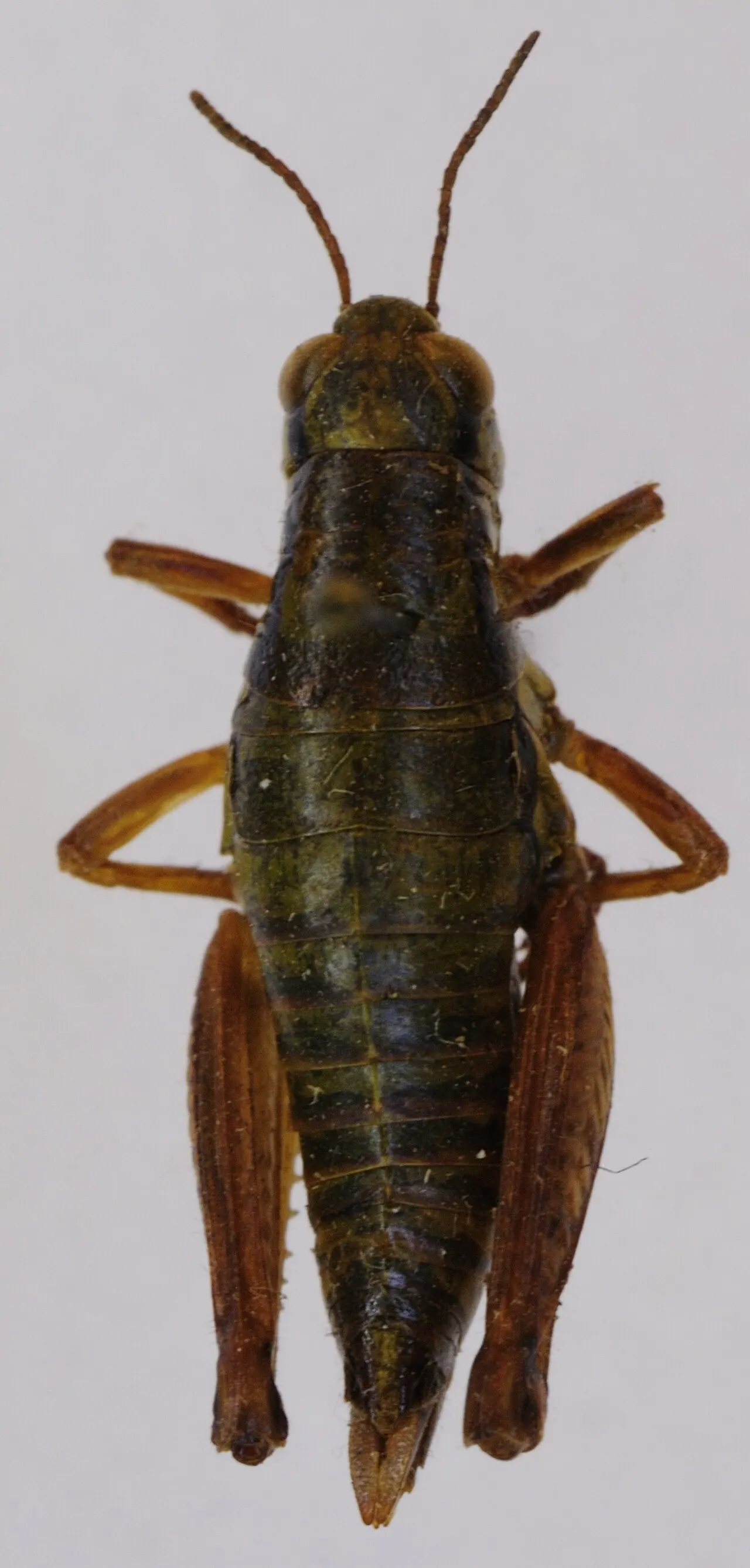
The Baldo mountain grasshopper is a small, wingless, stocky green grasshopper found only on a few high meadows in the Italian Alps, centred on Monte Baldo above Lake Garda. The IUCN Red List listed it as Endangered in 2016 because its range is tiny, fragmented and shrinking.
How to recognise it
This is a stocky, light green grasshopper with no wings. Males measure 14 to 17 mm and females are bigger, at 19 to 22 mm. A dark band runs back from the eye across the hearing organ toward the tip of the abdomen, although it is often broken into spots. The legs and the hearing organ are a murky reddish grey.
Despite having no wings, it has a well-developed hearing organ on each side of the abdomen.
Where it lives
It is found nowhere else but northern Italy. It was first described in 1883, as Pezotettix baldensis, from specimens collected on Monte Baldo, the long ridge on the eastern side of Lake Garda. It also lives on three mountain groups west of the lake, populations first recorded in 1992 by the entomologist Adolf Nadig.
Sources differ on how high it goes. One account gives 1,650 to 1,800 m, another says from about 1,300 m upward with most records near 1,700 m, and the IUCN gives 1,350 to 2,000 m. All agree on the habitat: alpine pastures, grassland and low shrubs. The IUCN counts only five locations.
Pins are Wikidata “endemic to” fields. Orange dots, when present, are GBIF occurrence tiles — survey bias included.
How it lives
Adults sit on the ground or on herbs, especially broad-leaved ones, and feed on the leaves and flowers of herbs and small shrubs. They reach their highest densities in taller, flower-rich vegetation mixed with low plants.
Adults have been recorded from July to October, and other accounts put them mainly in August and September. The IUCN lists it as non-migratory.
Why it is in trouble
The IUCN assessed the population as decreasing in 2016. Its range is split into five locations, with an estimated extent of occurrence of about 1,191 sq km and an area of occupancy of about 32 sq km. The threats it names are tourism and recreation areas, extreme temperatures, and shifting or altered habitat.
No population figure has been published.
What is being done
The grasshopper occurs in at least one protected area, according to the IUCN assessment, which lists site and area protection among the conservation actions. As of 2016 there was no recovery plan, no systematic monitoring scheme, no captive breeding and no awareness programme.
Sources
Written for this catalog in our own words from the sources below, checked against them on 12 November 2026. Population figures are estimates and carry the year they were made. Status and assessment year: IUCN. 2026. The IUCN Red List of Threatened Species. Version 2026-1. iucnredlist.org.




