Endangered
Pseudomugil ivantsoffi
Pseudomugil ivantsoffi
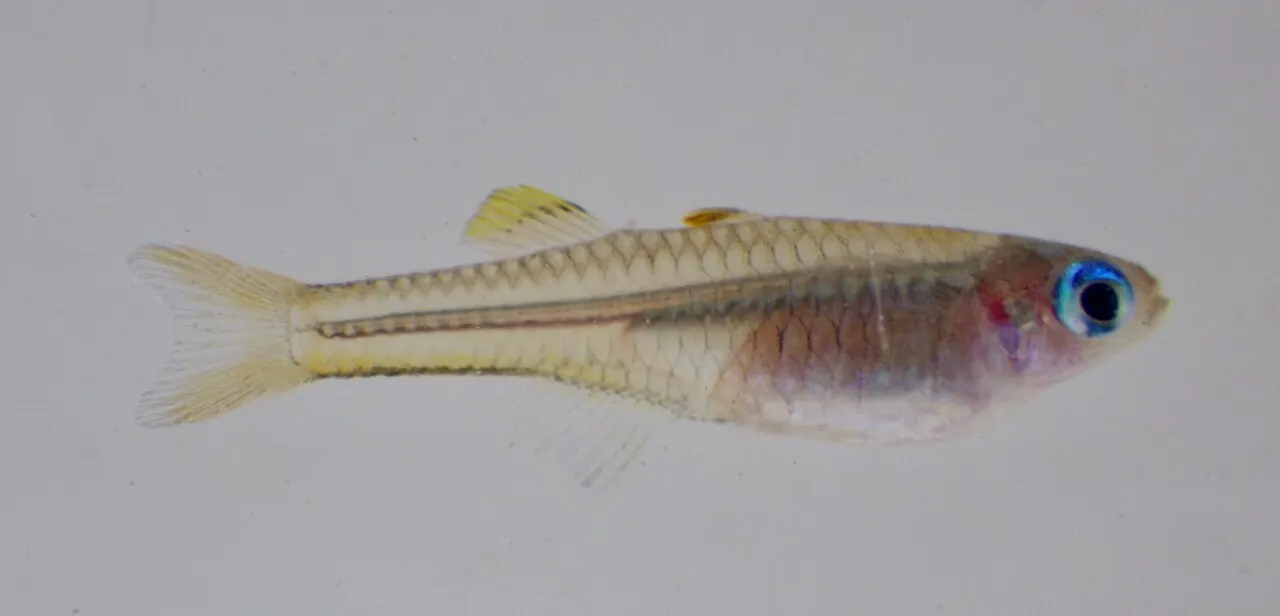
Ivantsoff's blue-eye (Pseudomugil ivantsoffi) is a tiny rainforest stream fish known only from the Timika and Tembagapura region of Papua, Indonesia. The IUCN Red List rated it Endangered in 2020, with the population decreasing. It lives in just two known locations, in streams near mining and settlement.
How to recognise it
This is a slim, flattened little fish, reaching only about 3 cm in standard length. Males are semitransparent with a bluish or reddish tint and a bright blue iris. They have red on parts of both dorsal fins, along the edge of the anal fin and on the upper and lower thirds of the tail. Females lack the red and have clear to faintly yellow fins, with yellow tips on the dorsal fins.
Scientists first took it for another blue-eye, Pseudomugil reticulatus, because females from the Timika area closely matched the only known specimen of that species. Collections made near that species' type locality in 1999 showed the two populations were distinct. Gerald Allen and Samuel Renyaan described it as a new species that year, from fish collected in 1995, and named it for Walter Ivantsoff, an ichthyologist at Macquarie University in Sydney.
Where it lives
It is found in tributaries of the Ajkwa, Iwaka and Kopi Rivers in the Timika to Tembagapura area of West Papua. The type specimens came from a tributary of the Kopi River about a kilometre from the Tembagapura Road and from the Freeport mining company's mile 39 camp.
The habitat is small, shallow, slow streams only 1 to 2 m wide, running through dense rainforest. The water is mostly clear but some streams are stained brown by tannins. The bed is sand, gravel, cobble or rock, with little aquatic plant growth. Temperatures recorded were 24 to 28 degrees C and pH 6.7 to 7.8. Other fish in the same streams include the blue-eye Pseudomugil pellucidus and several rainbowfish of the genus Melanotaenia. The IUCN also lists swamp and marsh habitats.
Pins are Wikidata “endemic to” fields. Orange dots, when present, are GBIF occurrence tiles — survey bias included.
Why it is in trouble
The fish was common in several creeks when first collected in 1995, and the same conditions held in January 1997. After a long El Niño drought in 1998, it could not be found at any of its earlier collecting sites. A fish society's species account suggests that the Kuala Kencana housing development and forest clearing near the Kopi River sites may have wiped it out locally, but that cause is a suggestion, not a finding.
The IUCN's threat list for the species names mining and quarrying, housing and urban development, and plantation agriculture. The same assessment records two locations and a decreasing trend, and lists no conservation actions. No population estimate exists. The same society expects the fish to persist in primary forest east and west of Timika, though that has not been surveyed in detail.
In aquariums
Two varieties, named for Deky Creek on the Iwaka River and for the Kopi River, circulate among hobbyists. Live fish were collected from the Iwaka and Kopi Rivers in 2004. Even so, the species is rarely seen in shops.
Sources
Written for this catalog in our own words from the sources below, checked against them on 12 November 2026. Population figures are estimates and carry the year they were made. Status and assessment year: IUCN. 2026. The IUCN Red List of Threatened Species. Version 2026-1. iucnredlist.org.



