Critically Endangered
Propomacrus cypriacus
Propomacrus cypriacus
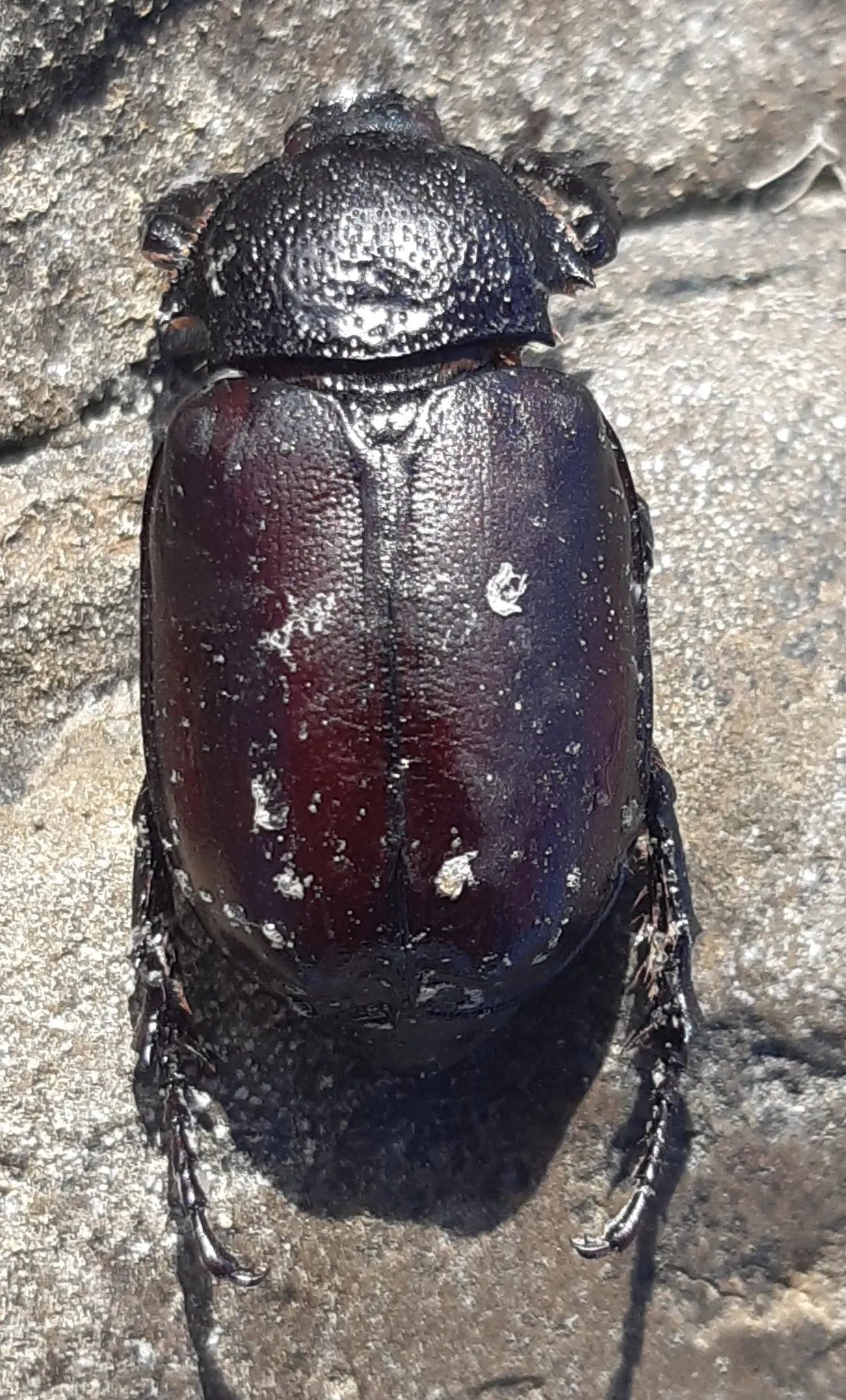
Propomacrus cypriacus is a large, glossy dark beetle found only on the island of Cyprus, where its grubs live in the decaying hollows of old trees. The IUCN Red List rated it Critically Endangered in 2017. Genetic work that year suggested it is better treated as an island subspecies of a wider-ranging beetle.
How to recognise it
Adults reach about 40 mm. The body is shiny, dark brown to almost black, with two pointed projections on each side of the chest. Males have strikingly long, saw-like front legs, and the shape of the male front shins is the one consistent difference between Cypriot beetles and those from Turkey and Lebanon.
Until 2002 old museum specimens were filed under Propomacrus bimucronatus, a beetle of Greece and western Asia. Cypriot researchers' collections allowed a closer study, and Robert Alexis and Christodoulos Makris described the Cypriot beetle as a new species that year.
Where it lives
It occurs from low ground up to roughly 1,000 m, with many records on the southern and western slopes of the Troodos range where old broad-leaved trees survive. Sporadic sightings have also come from Akamas, Panagia, Alethriko, Korfi and Amathousa. A female found in Strovolos, Nicosia, in 2023 was reported as the first record from the Nicosia area.
The Red List gives it an area of occupancy of 0 to 10 and describes the population as severely fragmented. Listed habitats include Mediterranean-type shrubland, temperate forest and urban areas.
Pins are Wikidata “endemic to” fields. Orange dots, when present, are GBIF occurrence tiles — survey bias included.
How it lives
This is a saproxylic beetle, meaning it depends on rotting wood. The larvae develop in hollows packed with decaying material inside old broad-leaved trees. Cyprus oak, carob and almond are linked to larval development, and Oriental plane and Oriental alder have also been recorded. The presence of a suitable hollow seems to matter more than the tree species.
Eggs hatch in about 15 days and are mostly laid in August and September. Larval development takes one to two years, and third-stage larvae measured 82 to 92 mm in studied Cypriot specimens. Pupation falls mainly in June and July, and adults fly from July to early October. Adults are mostly nocturnal and come to light, and captive ones fed on fruit. A short adult season and a hidden larval life make them hard to find.
Why it is in trouble
The Red List notes a continuing decline in the area the beetle occupies. Its listed threats are agro-industry plantations and work and other activities, each scored as low impact, plus a third whose motivation is unrecorded. Cypriot sources point to habitat loss and degradation, deforestation of large natural areas and fragmentation, and the removal of old, hollow or dead trees. Because the grubs take years to grow, a lost veteran tree can take generations of beetles with it.
What is being done
The beetle is listed in Annexes II and IV of the EU Habitats Directive, a listing proposed by Cyprus during its EU accession talks. The Red List assessment records site protection, site management and awareness work as conservation actions. Cypriot researchers argue that protection has to cover the host trees, their hollows and the rotting wood inside, not only adult beetles, and they highlight keeping old trees in woodlands, farmland and traditional orchards. Cyprus's Department of Environment has used the subspecies name in a genetics project estimating the beetle's effective population size.
Sources
Written for this catalog in our own words from the sources below, checked against them on 12 November 2026. Population figures are estimates and carry the year they were made. Status and assessment year: IUCN. 2026. The IUCN Red List of Threatened Species. Version 2026-1. iucnredlist.org.
- IUCN Red List assessment, Propomacrus bimucronatus ssp. cypriacus (2017)
- Cyprus Biodiversity blog, Propomacrus cypriacus Alexis & Makris 2002
- CYCERE (kykpee.org), Scientific name: Propomacrus cypriacus
- Sfenthourakis et al. 2017, Journal of Natural History 51: 1021-1034 (figure record; abstract via search summary)




