Endangered
Proahaetulla antiqua
Proahaetulla antiqua
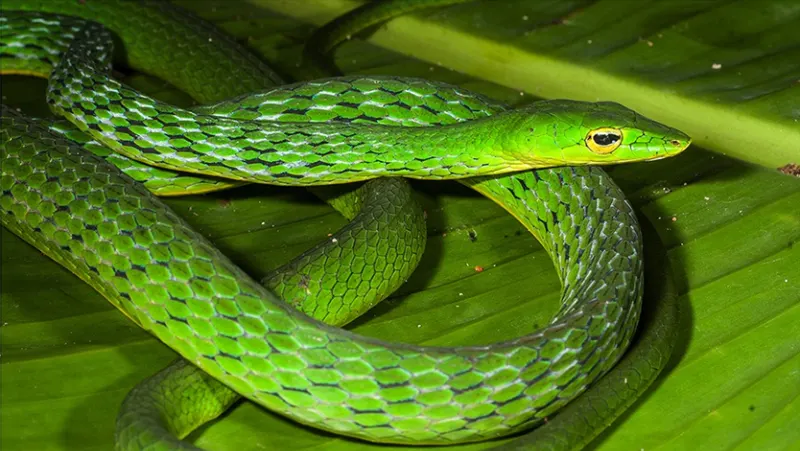
The keeled vine snake (Proahaetulla antiqua) is a slender, bright green tree snake from the high forests of the Agasthyamalai hills in India's southern Western Ghats. Described only in 2019 and known from very few individuals, it was rated Endangered by the IUCN in 2021.
How to recognise it
In life the body is a uniform bright green, with a creamy yellow to light green belly and a greenish yellow tongue with black speckles. The snout is fine and pointed, the pupil is a horizontal ellipse, and the body is very slender and partly flattened from side to side. It looks a lot like the green vine snakes of the genus Ahaetulla. Unlike them, it has keeled back scales in 12 or 13 rows and 20 maxillary teeth, against fewer than 16 in Ahaetulla.
The two snakes in the original description were adult males of 1,113 and 1,189 mm in total length. When threatened, the skin between the scales shows black and white bars that converge toward the head.
Where it lives
The species is known from the Agasthyamalai hills in Tamil Nadu and Kerala. The first specimen came from near Agasthiyar peak in Kalakad Mundanthurai Tiger Reserve at about 1,640 m, and the second from Pandimotta in Shendurney Wildlife Sanctuary, roughly 25 km to the north at about 1,224 m. The IUCN assessment gives its habitat as montane rainforest and high-altitude grassland, counts two to five locations and puts the extent of occurrence under 100 sq km.
Its describers suggest it is a narrow endemic of the high elevations of the massif, and that it may occur elsewhere in the high parts of the Agasthyamalai range.
Pins are Wikidata “endemic to” fields. Orange dots, when present, are GBIF occurrence tiles — survey bias included.
How it lives
It appears to be fully arboreal, and the describers speculate that it is adapted to a completely tree-dwelling life. The first snake was found coiled on a tree about 2.5 m above the ground one afternoon in August 2011, and the second was sleeping on a shrub about 2 m up at night in July 2012. It is reportedly active by day. Diet and breeding have not been described.
The first snake was collected as an unusual-looking vine snake. DNA then showed its lineage split from Ahaetulla about 26.5 million years ago, so it was placed in its own genus, Proahaetulla, and described in 2019. The name antiqua is Latin for old, a nod to that ancient split.
Why it is in trouble
The Endangered rating (criteria B1ab(iii) and 2ab(iii)) reflects a tiny known range, a handful of locations and a continuing decline in the area of habitat. The assessment lists agro-industry farming, tourism and recreation areas, and unintentional harm from subsistence harvesting as threats, and records the population trend as unknown.
It occurs in at least one protected area, but the assessment lists no conservation actions as under way.
Sources
Written for this catalog in our own words from the sources below, checked against them on 12 November 2026. Population figures are estimates and carry the year they were made. Status and assessment year: IUCN. 2026. The IUCN Red List of Threatened Species. Version 2026-1. iucnredlist.org.




