Critically Endangered
Principe Thrush
Turdus xanthorhynchus
The Príncipe thrush (Turdus xanthorhynchus) is a starling-sized songbird found only on Príncipe, a small island in the Gulf of Guinea. The IUCN Red List rated it Critically Endangered in 2021 and puts the population at between 50 and 249 birds. Introduced mammals, especially monkeys that raid nests, are the leading suspects.
How to recognise it
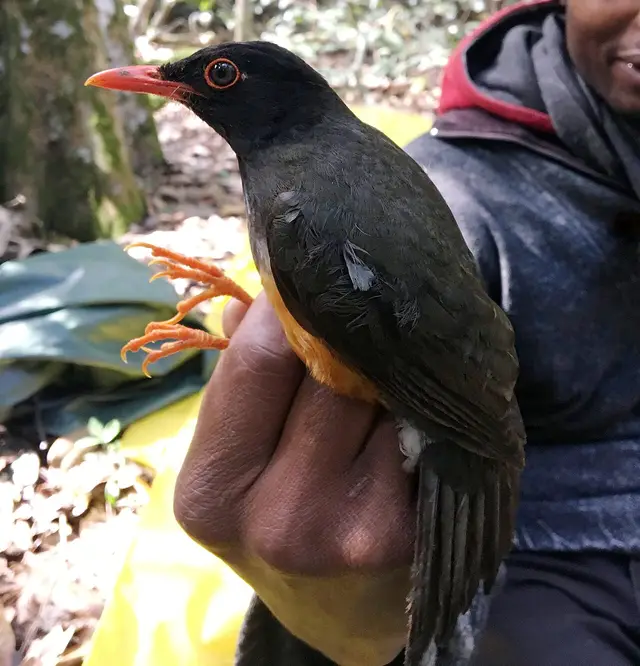
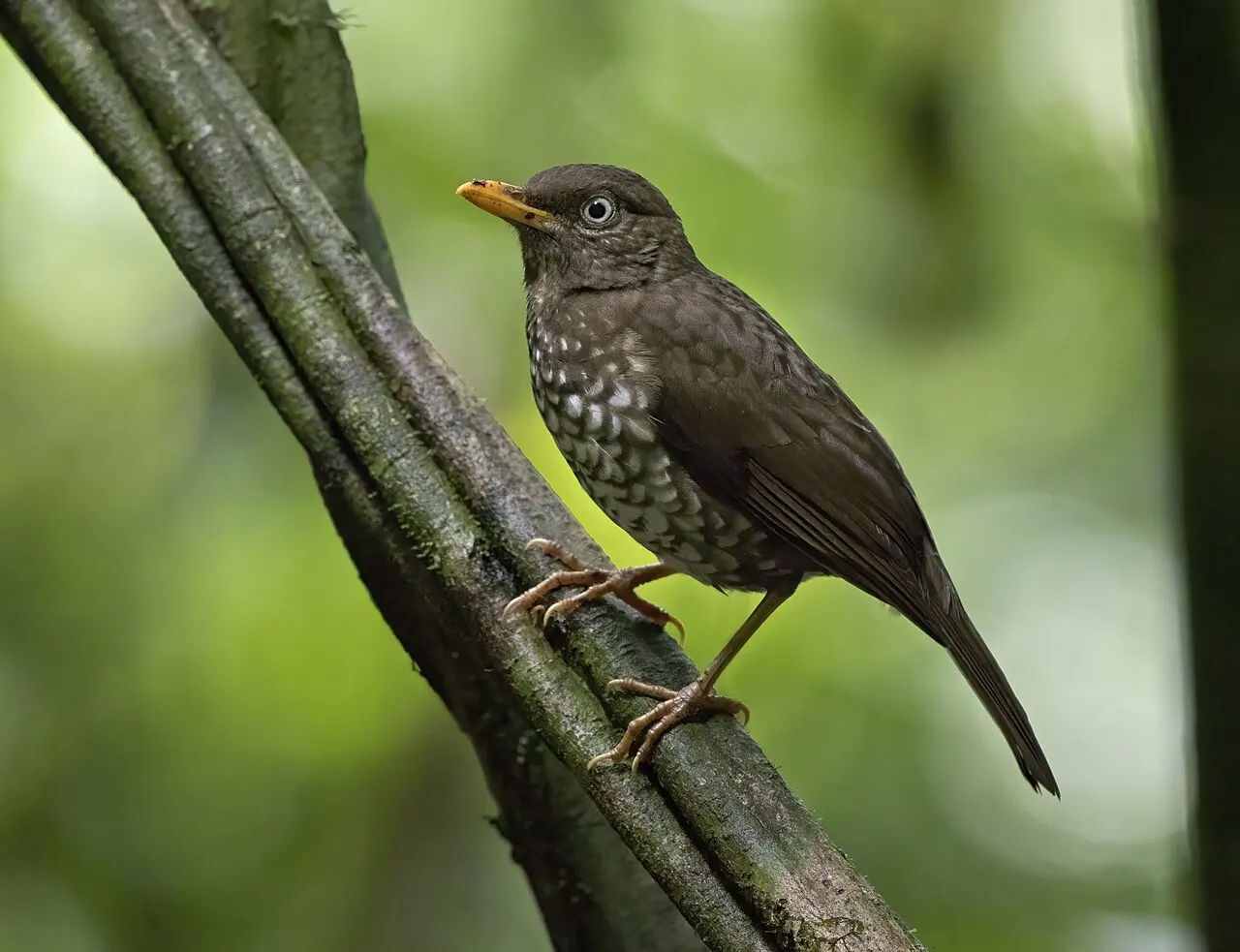
It is about the size of a starling, with an olive-brown back, a white-flecked breast and a bright yellow bill. Birds on the island are described as notably tame. Nests are woven from moss and plant roots and tucked into rock and tree cavities.
Where it lives
The thrush occurs only on Príncipe, which is part of São Tomé and Príncipe. Its range is restricted to the southern forests of Príncipe Natural Park. The Red List treats it as one location, in moist lowland and montane forest at roughly 400 to 800 metres.
For decades it was treated as a form of the São Tomé thrush, which lives on a separate island about 150 kilometres away and is doing well. Song, DNA and physical differences led researchers to treat it as its own species. Tommaso Salvadori described it in 1901, and a few taxonomists still lump the two.
Pins are Wikidata “endemic to” fields. Orange dots, when present, are GBIF occurrence tiles — survey bias included.
Why it is in trouble
Presumed threats include habitat loss, hunting and predation by introduced mammals. Portugal colonised the uninhabited islands in the 1470s, and sailors brought animals with them. Today mona monkeys, black rats, African civets and feral cats and dogs all live there. A 2018 to 2020 camera-trap survey found all the known introduced species across the thrush's range.
Evidence on nest raiding is recent. In an experiment published in Oryx in 2021, researchers set camera traps at 55 artificial nests baited with quail eggs between September 2020 and August 2021. Predators took eggs from 23 nests (42 percent) within six days, and mona monkeys were responsible for 10 nests (18 percent of the total). The other raiders could not be identified, though rats, cats and dogs may be among them.
A real thrush nest found on 6 May 2021 was filmed from 19 May to 7 July. Adult birds used it until 6 July, and mona monkeys inspected it five times. No eggs or chicks were confirmed, so a raid could not be proved. Only a handful of thrush nests have ever been found, which makes the breeding biology hard to study. Monkey numbers have risen inside the park, where hunting is banned.
What is being done
A recovery plan is in place, along with awareness work, according to the Red List assessment. Fundação Príncipe, working with Fauna & Flora International, has run the camera-trap monitoring and nest experiments, and sent monkey and civet stomach samples to a laboratory in Portugal. Authorities have discussed controlled monkey hunting inside the park, though researchers warn that the wider effects are not yet understood.
Removing the monkeys altogether is considered unrealistic. They are widespread, and their meat is a valued food and source of income on the island. The Oryx paper by Guedes and colleagues suggests working with local hunters to reduce monkey numbers and building a mitigation plan with all the groups involved.
Sources
Written for this catalog in our own words from the sources below, checked against them on 12 November 2026. Population figures are estimates and carry the year they were made. Status and assessment year: IUCN. 2026. The IUCN Red List of Threatened Species. Version 2026-1. iucnredlist.org.