Endangered
Preuss's monkey
Allochrocebus preussi
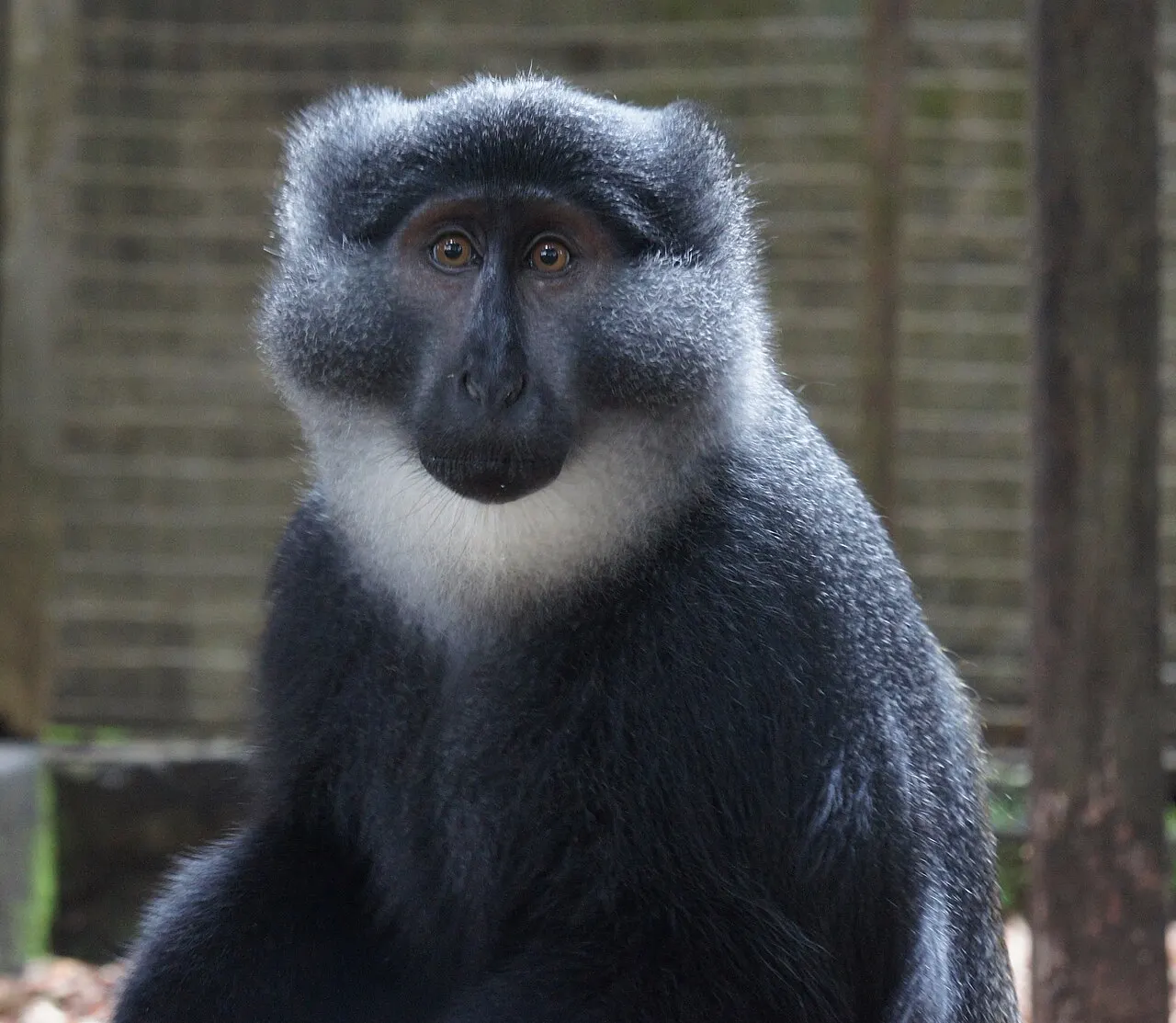
Preuss's monkey (Allochrocebus preussi) is a large, dark, semi-terrestrial guenon of the forests of southwestern Cameroon, southeastern Nigeria and Bioko Island. The IUCN Red List rated it Endangered in its 2019 assessment, with hunting and the loss of forest driving a declining population.
How to recognise it
It's a big, dark monkey with few light markings beyond a whitish chin and throat. Adult males have a blue scrotum. Published weights differ: a general reference gives up to 10 kg, while a 2024 study in Ethnobiology and Conservation gives 9 to 15 kg.
It's semi-terrestrial, and that habit makes it an easy target for poachers. Two subspecies are recognised, the Cameroon form (A. p. preussi) and the Bioko form (A. p. insularis). Paul Matschie described it in 1898, and for years it was treated as a relative of L'Hoest's monkey in the genus Cercopithecus.
Where it lives
The species is found in southwestern Cameroon, southeastern Nigeria and on Bioko, which belongs to Equatorial Guinea. The IUCN assessment lists moist lowland forest, moist montane forest and high-altitude grassland, at elevations from 140 to 3,000 m. It occurs mainly in cloud forest above 800 m.
What remains is scattered. The 2019 assessment describes the population as severely fragmented, and the 2024 study, citing it, puts the species in eight forest fragments covering roughly 17,300 square km. Ebo Forest in Cameroon is described as one of the few remaining strongholds.
Pins are Wikidata “endemic to” fields. Orange dots, when present, are GBIF occurrence tiles — survey bias included.
How it lives
It eats mostly fruit, leaves and insects, and sometimes raids farm crops. Troops reportedly form around a single adult male with several females and their young, averaging about 17 animals.
Females reportedly have one baby roughly every three years, and the young mature at around 4 years old. A pace like that makes it hard for a hunted population to bounce back. The IUCN assessment gives a generation length of about 10 years.
Why it is in trouble
The 2019 assessment records a decreasing population and an estimated reduction of about 50 percent, based on habitat decline and levels of exploitation. It lists deliberate hunting as affecting most of the population, with rapid declines. Shifting agriculture, small farms, nomadic grazing and roads add to the pressure. Most of the range lies outside protected areas.
Local people see it too. In a 2024 interview study of 262 households in 17 villages around Ebo Forest, 235 people had a view on the trend, and 165 of them (70 percent) said numbers were falling. Most (77 percent) named hunting rather than habitat loss as the main threat. About a third of all those interviewed complained of crop raiding by the monkey, which feeds the conflict.
What is being done
Preuss's monkey is a Class A species in Cameroon, which means it is totally protected by law, and the IUCN records it in at least one protected area and under international legislation and trade controls. Individuals are reportedly kept at the CERCOPAN sanctuary in Cross River State, Nigeria, and at the Limbe Wildlife Centre in Cameroon.
Ebo Forest has no legal conservation status, though about three in four households in the 2024 study backed making it a national park. Rufford Foundation grants to a Cameroonian research team have supported work there from 2021, covering population surveys, hunting outreach, crop-conflict management and agroforestry as an alternative livelihood. The Red List assessment names site management, habitat protection, awareness and training among the actions that apply.
Sources
Written for this catalog in our own words from the sources below, checked against them on 12 November 2026. Population figures are estimates and carry the year they were made. Status and assessment year: IUCN. 2026. The IUCN Red List of Threatened Species. Version 2026-1. iucnredlist.org.




