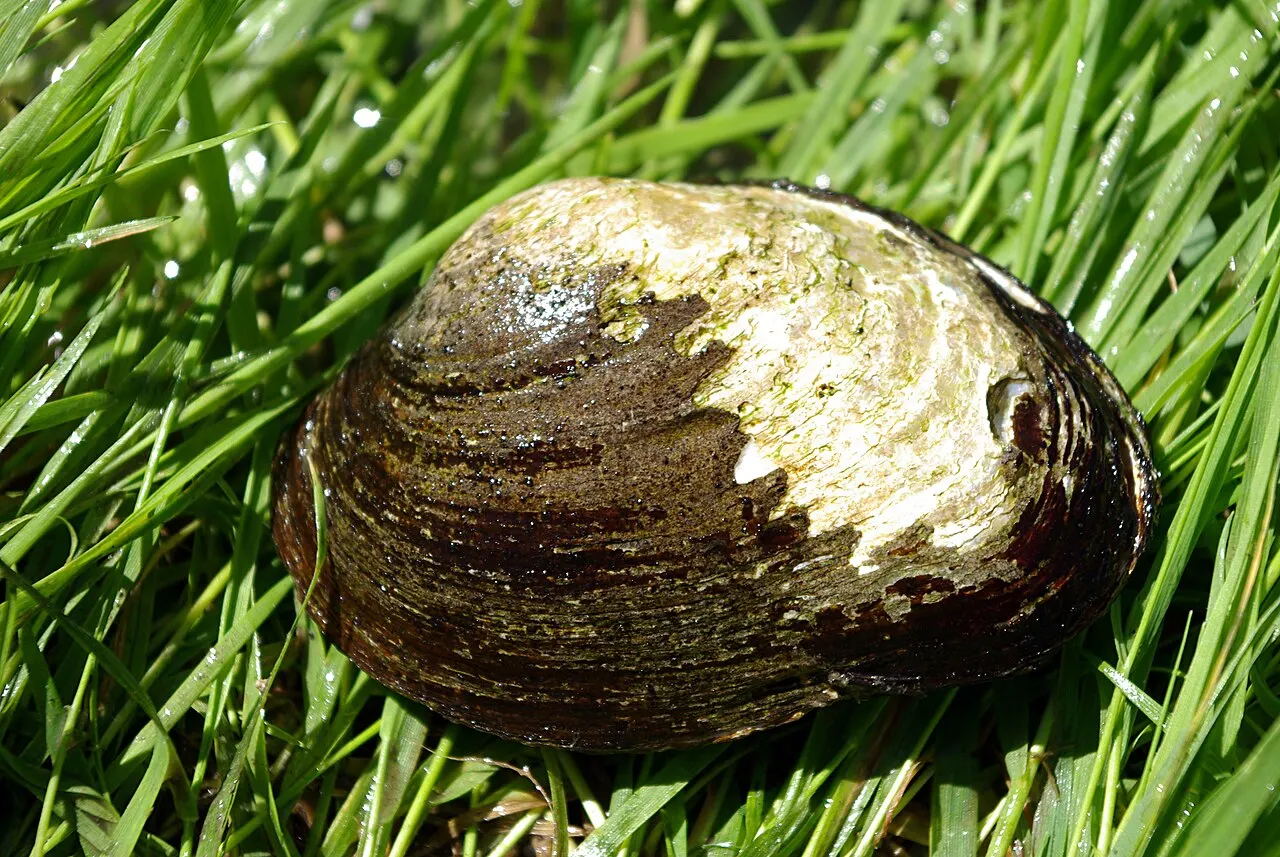
Endangered
Potomida littoralis
Potomida littoralis
Potomida littoralis, the black river mussel, is a freshwater bivalve of rivers in southwestern Europe and northwest Africa. The IUCN Red List assessed it as Endangered in 2024, after an estimated 73 percent past decline and a similar fall projected ahead, driven by drought, water abstraction and farming.
What it is
The black river mussel is a true freshwater mussel in the family Unionidae. Georges Cuvier described it in 1798 as Unio littoralis. Its taxonomy has been revised many times, and its relatives in Greece, Anatolia and the Middle East are now treated as separate species.
A 2016 study in Molecular Phylogenetics and Evolution sampled 323 mussels at 39 sites around the Mediterranean. It found that the western species falls into two mitochondrial lineages. One is restricted to Europe and the other occurs mostly in North Africa, and some European river basins hold both.
Where it lives
The Red List gives its native range as mainland Spain, France and Portugal, plus Morocco and Tunisia. Algeria is listed as a possible record. It lives in permanent rivers and streams, seasonal rivers that dry for part of the year, large lakes, and even canals and drainage ditches, from sea level up to about 900 m. It is most often found in the middle and lower stretches of rivers, and occasionally in the upper reaches of lime-rich ones.
The assessment puts its extent of occurrence at roughly 2.26 million square kilometres, but the area it actually occupies within that is only about 4,400 square kilometres. Its populations are badly fragmented.
Pins are Wikidata “endemic to” fields. Orange dots, when present, are GBIF occurrence tiles — survey bias included.
How it lives
Like other freshwater mussels, it starts life as larvae called glochidia, which must ride on a host fish before they settle on the riverbed. Females brood eggs in both the inner and outer gills, which swell and turn cream to light brown when full. A 2004 study in the journal Iberus, drawing on museum specimens, field samples and published records, found brooding females and released larvae between March and October. The smallest breeding mussels measured 39.3 and 41.0 mm and were in their fourth or fifth year.
Only about a third of the mussels in the samples were brooding at any one time, which points to broods that are not synchronised within a population. The same study suggested the breeding season might be shorter at higher latitudes but said more data were needed. The IUCN assessment sets its generation length at about 10 years.
Why it is in trouble
The 2024 assessment records a past reduction of 73 percent and projects a further 75 percent fall, judged mainly from shrinking habitat and a drop in abundance. No total population count exists. Area, extent and number of subpopulations are all recorded as still declining.
The main pressures involve water. Abstraction of river and ground water for homes and farms, drought and temperature extremes are scored as causing rapid or very rapid declines across most of the range, and large dams do the same over a smaller part of it. Intensive farming, shifting agriculture, sewage, pesticides and herbicides, floods and mining add to the load.
Portugal gives the clearest local picture. A 2023 survey in Biological Conservation compared mussel communities at 132 sites in 15 river basins over about 20 years. The number of sites with mussels fell by 60 percent and overall abundance by 67 percent. The researchers named this species, along with the freshwater pearl mussel and Unio tumidiformis, as now critically low and in need of urgent measures.
What is being done
It occurs in at least one protected area, but the assessment records no recovery plan and no systematic monitoring scheme. The actions it lists as needed include restoring habitat and natural river processes, controlling invasive species, protecting sites and resources, work at national and regional level, awareness and training.
The Portuguese survey went further and called for captive breeding, protection of the remaining populations and large-scale habitat restoration.
Sources
Written for this catalog in our own words from the sources below, checked against them on 12 November 2026. Population figures are estimates and carry the year they were made. Status and assessment year: IUCN. 2026. The IUCN Red List of Threatened Species. Version 2026-1. iucnredlist.org.




