Endangered
Potamotrygon tigrina
Potamotrygon tigrina
The tiger river stingray (Potamotrygon tigrina) is a freshwater ray from the upper Amazon basin in northeastern Peru. The IUCN Red List rated it Endangered in 2025. Its golden, maze-like markings and banded tail have made it a popular ornamental ray, while very little is known about wild numbers.
How to recognise it
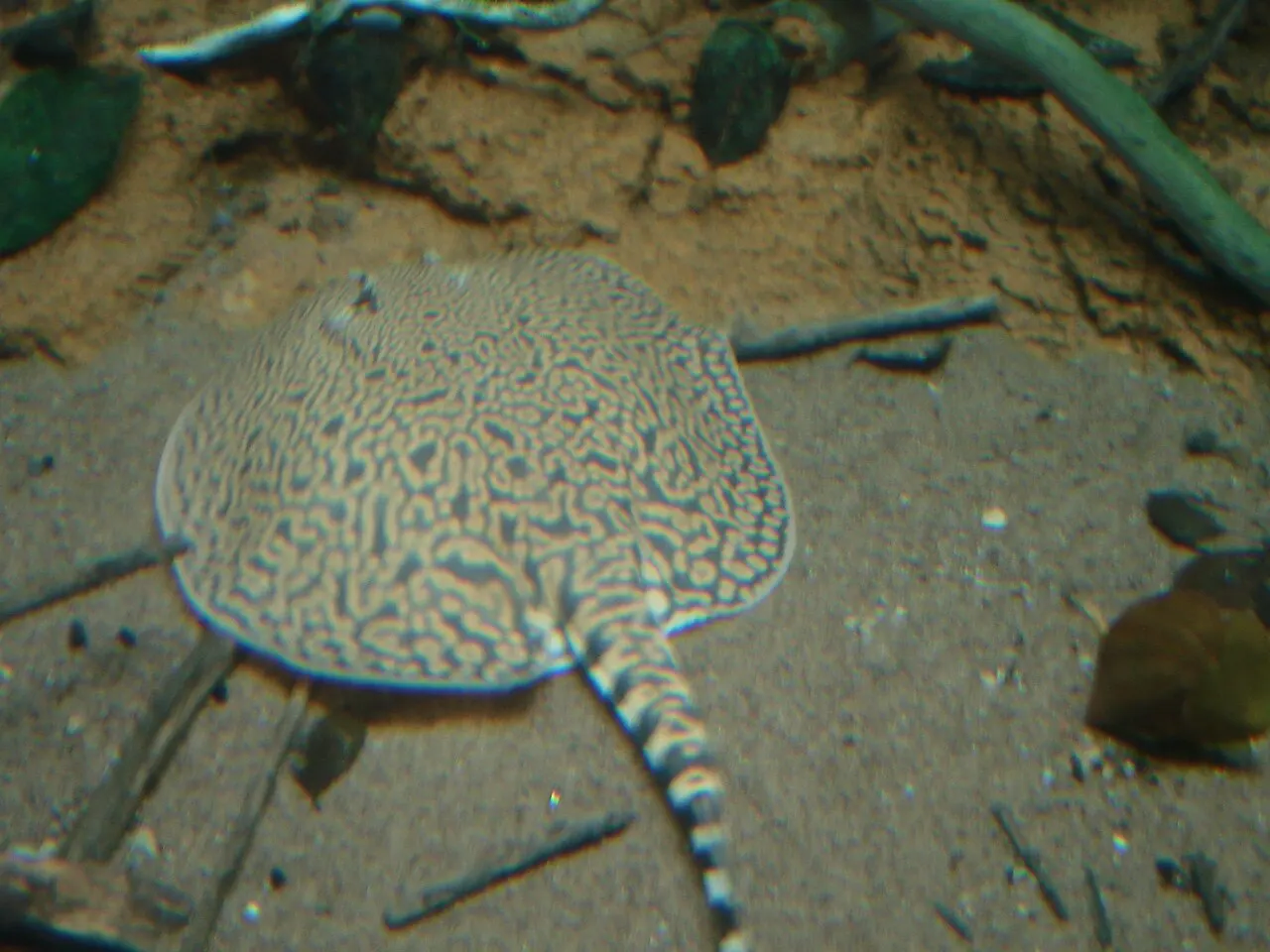
The disc is oval, a little longer than wide, and widest around the middle. The back is dark brown to nearly black, overlaid with a winding, vermiculated pattern in tan, bronze, golden yellow or orange. The squiggles can be tight and fine or broad enough to leave round or streaky dark patches between them.
The tail helps separate it from most other river stingrays. From about the stinging spine outward, it carries five or six dark bars alternating with cream bands. Newborn pups look paler, with light orange markings. The eyes are small and stand slightly proud of the head, with large spiracles right beside them.
How big it gets
Maximum size is not settled. Aquarium animals have reached at least 70 cm across the disc, and females in aquariums mature at about 48 cm. A 2011 National Geographic report gave up to 80 cm, and the species description mentioned an alleged size of up to 1 m.
Where it lives
The type specimen came from the Rio Nanay, a blackwater tributary of the Amazon near Iquitos, Peru, taken at a sandy beach about 11 river kilometres upstream of the confluence. The describers suspected a slightly wider range in the upper Amazon, and an aquarium importer claimed it also occurs in the Putumayo, though that was never confirmed.
The IUCN counts two to five locations, all in Peru, and lists permanent rivers and streams as its habitat. Its 2025 assessment puts the extent of occurrence at about 1,480 square kilometres. In aquariums, animals do best on fine sand with soft, low-mineral water and dark places to hide.
Pins are Wikidata “endemic to” fields. Orange dots, when present, are GBIF occurrence tiles — survey bias included.
Why it is in trouble
The ray was being imported for the aquarium trade for at least 13 years before it was formally described in 2011, and it was reported then as one of the most popular pet rays in Asia, especially Japan and China. The IUCN lists both small-scale fishing aimed at the species and accidental catch as threats, records use for food as well as for display animals, and also lists mining and quarrying.
The Red List says the population is decreasing, and the area it occupies is still shrinking. The Endangered rating rests on an estimated past decline of about 60 percent over roughly three generations (generation length put at 11 years), linked to habitat loss and exploitation. An earlier assessment, in 2016, pointed to the species' low fertility rate combined with the high price it fetches, which keeps pressure on wild stocks. Basic biology, including reproduction and population dynamics, is still poorly studied.
What is being done
The 2025 assessment records no recovery plan and no systematic monitoring scheme. It reports that the species occurs in at least one protected area, and it names harvest management, trade management, species recovery and site protection among the relevant conservation actions. Zoos and public aquariums have bred it, including the Vancouver Aquarium and the Shedd Aquarium in Chicago, and the Association of Zoos and Aquariums freshwater fish advisory group named it one of four stingray species that are a priority for breeding.
Aquarium literature long mislabelled it as Potamotrygon menchacai, a species described from Argentina, which muddies trade records.
Sources
Written for this catalog in our own words from the sources below, checked against them on 12 November 2026. Population figures are estimates and carry the year they were made. Status and assessment year: IUCN. 2026. The IUCN Red List of Threatened Species. Version 2026-1. iucnredlist.org.




