Critically Endangered
Poropuntius tawarensis
Poropuntius tawarensis
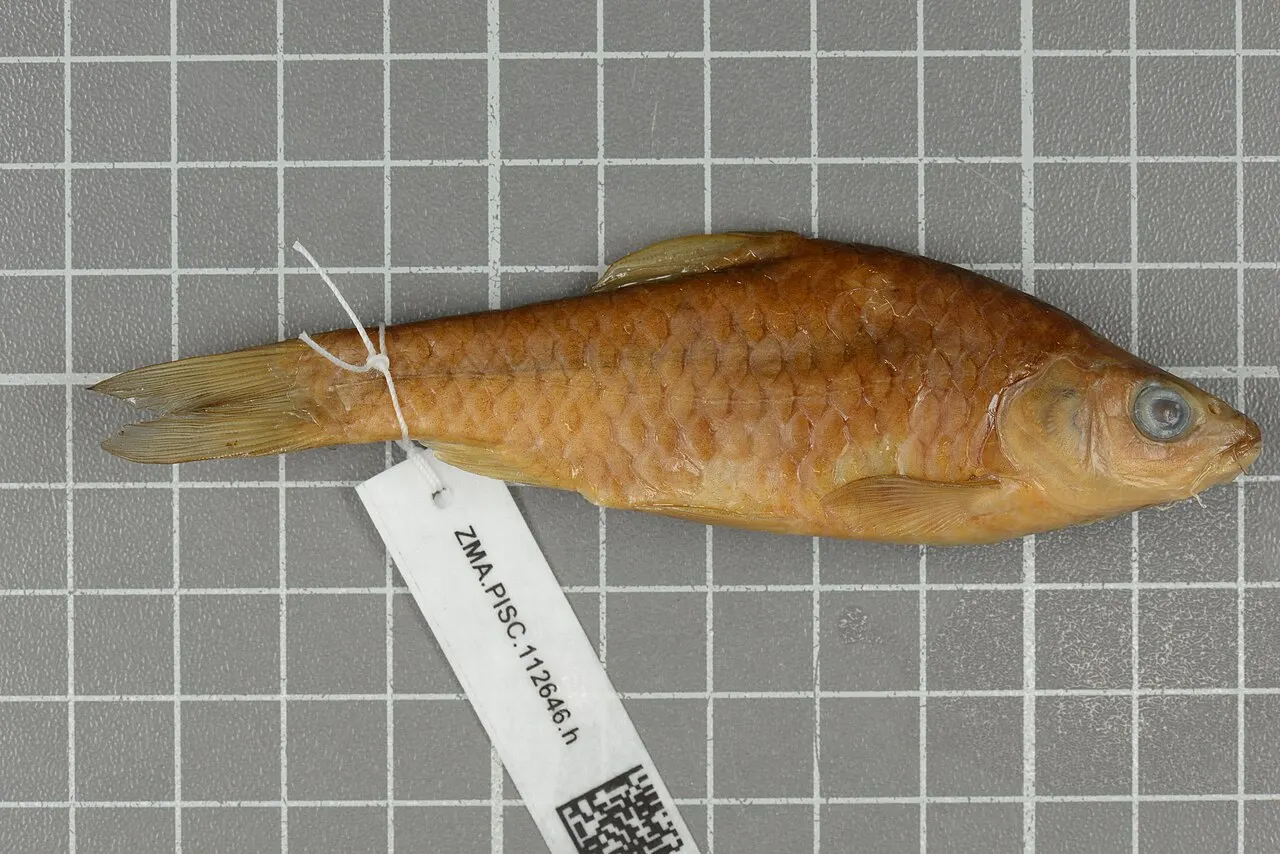
The kawan (Poropuntius tawarensis) is a small, long-whiskered carp relative found nowhere except Lake Laut Tawar, a highland lake in Aceh, northern Sumatra. The IUCN Red List classed it as Critically Endangered in 2020, with a decreasing population. Some individuals grow an odd hump behind the head.
How to recognise it
This is a modest fish. The longest recorded measures about 13.7 cm. It has a streamlined body, large scales and long barbels, the whisker-like feelers around the mouth that carp relatives use to find food.
Two details help set it apart. There's a faint stripe above the lateral line, and some individuals develop a humeral hump, a bulge over the shoulder that is rare in the rest of the genus Poropuntius. The tail fin has no dark margin stripes. Weber and de Beaufort described the species in 1916, originally placing it in Puntius.
Where it lives
Lake Laut Tawar lies in Central Aceh at about 1,100 m above sea level. It covers roughly 70 square km, reaches about 80 m deep, and drains into the Peusangan River. The name means 'freshwater sea'.
The kawan lives only here. The IUCN assessment counts a single location, an extent of occurrence of about 63 square km, and a habitat of permanent freshwater lake. It is not recorded from any protected area.
Pins are Wikidata “endemic to” fields. Orange dots, when present, are GBIF occurrence tiles — survey bias included.
How it lives
Very little has been published on its diet or breeding. FishBase lists it as a benthopelagic fish, one that moves through the lower and middle water, with an estimated trophic level of about 3.2.
A 2024 survey in the journal Depik sampled four sites around the lake (Hakim Balai Bujang, Toweren, Kelitu and Kala Segi). Diversity scores were low at every site, and the fish were clumped in particular spots rather than spread evenly. The IUCN notes the fish is taken for human food at subsistence or small scale.
Why it is in trouble
The 2020 assessment estimates 10,000 to 100,000 individuals, a wide range that shows how little counting has been done. It lists small-scale harvesting, water taken from the lake for household use, soil erosion and sediment, run-off, sewage and introduced fish (common carp, African catfish and Nile tilapia) as threats. The 2024 survey blames habitat degradation, overfishing and predatory alien species.
Studies of the lake's better-known endemic, the depik (Rasbora tawarensis), point the same way. A conservation fund case study reports its catch per unit of net falling from about 1,166 g per square metre in the 1970s to 15 g in 2009, and blames falling water levels, destructive gear, pollution, non-native fish and poorly managed fisheries. A 2011 policy study found nine introduced fish species in Aceh's inland waters, seven of them in Laut Tawar. The kawan shares that water and those pressures.
What is being done
Not much that is targeted. The IUCN lists awareness work and harvest management as the actions needed, and says research is required on population size, distribution, trends and harvest levels, along with a harvest and trade management plan. In 2009 the Mohamed bin Zayed Species Conservation Fund gave a $5,000 grant to a Syiah Kuala University researcher to gather distribution and production data on depik and kawan, including DNA barcoding of the lake's fishes.
Sources
Written for this catalog in our own words from the sources below, checked against them on 12 November 2026. Population figures are estimates and carry the year they were made. Status and assessment year: IUCN. 2026. The IUCN Red List of Threatened Species. Version 2026-1. iucnredlist.org.
- IUCN Red List assessment, Poropuntius tawarensis (2020)
- FishBase species summary
- Rahman et al. 2024, Depik Jurnal (record)
- Mohamed bin Zayed Species Conservation Fund, depik case study
- Analisis Kebijakan Introduksi Spesies Ikan Asing di Perairan Umum Daratan Provinsi Aceh (2011)
- Lake Laut Tawar
- Poropuntius tawarensis




