Endangered
Pointedhead Haplo
Trematocranus microstoma
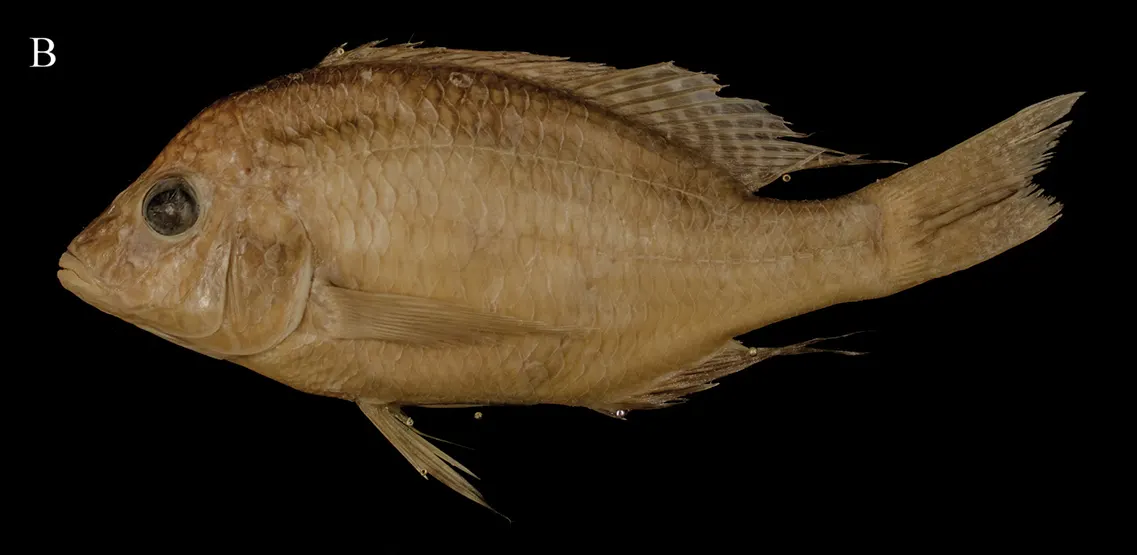
The pointedhead haplo (Trematocranus microstoma) is a cichlid fish found only in Lake Malawi, in the waters of Malawi, Mozambique and Tanzania. It lives close to shore and grows to about 23 cm. The IUCN Red List assessed it as Endangered in 2018, after an estimated population fall of about 75 percent.
How to recognise it
Ethelwynn Trewavas described this fish in 1935, and it is the type species of its genus, Trematocranus. Adults reach a maximum of about 23.2 cm in total length. In the aquarium trade it is sold as the "Haplochromis placodon pointed head", and placodon is the name of a related species in the same genus.
The mouth is where the species earns its name. A 2018 museum study of trawled specimens found long, slender, recurved, single-pointed teeth in the jaws, set in six to eight inner rows at the front of the lower jaw. Deeper in the throat, the pharyngeal teeth are enlarged and molar-like. Its lips are of intermediate thickness, thinner than those of Trematocranus pachychilus, a thick-lipped relative described from Lake Malawi in that same study.
Where it lives
The pointedhead haplo is endemic to Lake Malawi, and the IUCN records it from the Malawian, Mozambican and Tanzanian parts of the lake. FishBase lists it from both the northern and southern parts of the lake. Specimens held in a Belgian museum were trawled at sites such as Kanda Bay in the north (June 1997) and Mazinzi Bay and Chembe Bay further south.
It stays in shallow water near the shore, often among vegetation, at depths of roughly 4 to 20 m according to FishBase. The IUCN classes its habitat as permanent freshwater lake, and records at least one protected area within its range.
Pins are Wikidata “endemic to” fields. Orange dots, when present, are GBIF occurrence tiles — survey bias included.
How it lives
FishBase says it feeds on insect larvae and crustaceans that it finds in soft bottom sediment. Its enlarged, molar-like throat teeth are a feature of its genus, and the oral teeth are slender and pointed.
The IUCN uses a generation length of about two years for the species and does not class it as a migrant.
Why it is in trouble
The IUCN assessment records ongoing small-scale harvest as the threat, and lists the fish as used both for human food (subsistence) and for the international pet trade. It estimates that numbers fell by about 75 percent, judged from an abundance index and direct observation. The cause is recorded as understood and in principle reversible, but not stopped. The population trend is listed as decreasing.
The Endangered listing under criterion A2ab rests on that observed decline. The 75 percent figure is an assessor's estimate, not a count.
What is being done
The IUCN lists no species-specific conservation actions. The fish occurs in at least one protected area, and the assessment flags population trends as a research need.
Sources
Written for this catalog in our own words from the sources below, checked against them on 12 November 2026. Population figures are estimates and carry the year they were made. Status and assessment year: IUCN. 2026. The IUCN Red List of Threatened Species. Version 2026-1. iucnredlist.org.




