Endangered
Pohnpei cicadabird
Edolisoma insperatum
The Pohnpei cicadabird (Edolisoma insperatum) is a small songbird found only on the island of Pohnpei in Micronesia. The Red List classed it as Endangered in 2021, with an estimated 1,000 to 2,499 birds and a population that is still shrinking as the island's forest is cleared or degraded.
How to recognise it
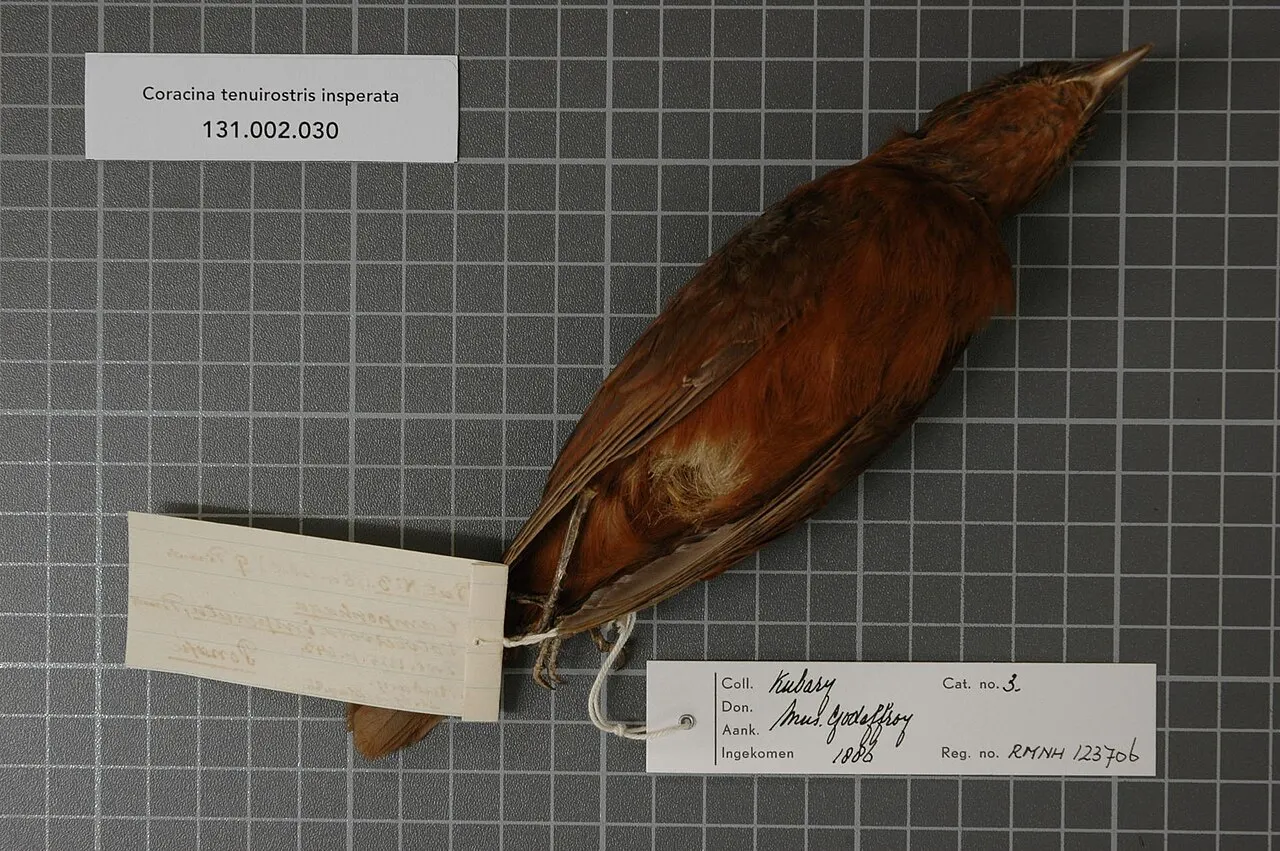
The Pohnpei cicadabird belongs to the cuckooshrikes, a family of mostly tree-living insect eaters. The sexes look quite different. Males are mostly slate grey with black on the head, wings and tail, while females are a rich rufous-brown or chestnut, reportedly with a grey cap. Adults measure around 25 centimetres.
Until fairly recently it was lumped in with the common cicadabird, which is now treated as a separate species. The Pohnpei bird was described by the German naturalist Otto Finsch in the mid 1870s (sources give 1875 and 1876).
Where it lives
This is a single-island species. The Red List records it from the Federated States of Micronesia only, and it treats all the birds as one subpopulation. Its extent of occurrence is put at about 1,700 square kilometres, and the area it actually occupies at about 576 square kilometres. A bird database gives a smaller range figure of about 356 square kilometres. The assessment counts 6 to 10 locations, with birds found up to about 800 metres above sea level.
It lives in moist forest, both lowland and montane, and has also been recorded in mangroves. It doesn't migrate. A bird database reports that it feeds mainly on invertebrates and lays a single egg (general database details, not field studies).
Pins are Wikidata “endemic to” fields. Orange dots, when present, are GBIF occurrence tiles — survey bias included.
Why it is in trouble
The 2021 assessment gives the population as 1,000 to 2,499 birds and decreasing, with the area it occupies also shrinking. The listed pressures are forest clearing for shifting agriculture, small-scale harvest of forest products, dam building and the development of tourism and recreation areas. All of them mean less forest or poorer forest.
It qualifies as Endangered under criterion C2a(ii): a small population, a continuing decline, and nearly all mature birds belonging to one subpopulation. With so few birds on one island, anything that changes the forest matters.
What is being done
The Red List lists site protection and site management as conservation actions. Important sites have been identified over part of the range, but the assessment records that the species is not known from any protected area, and that there is no recovery plan, no systematic monitoring scheme and no captive breeding.
The population figure is a rough estimate. Surveys to update it and monitoring of the forest it depends on are the obvious next steps.
Sources
Written for this catalog in our own words from the sources below, checked against them on 12 November 2026. Population figures are estimates and carry the year they were made. Status and assessment year: IUCN. 2026. The IUCN Red List of Threatened Species. Version 2026-1. iucnredlist.org.




