Endangered
Abbott's starling
Poeoptera femoralis
Abbott's starling is the smallest starling in the world, a black-and-white bird of the high montane forests of Kenya and Tanzania. The IUCN Red List uplisted it to Endangered in 2021. Only about 1,000 to 2,500 are thought to remain, and its forest is still being cleared.
How to recognise it
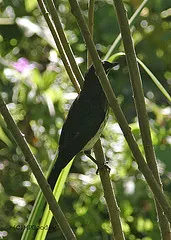
At 16 to 18 cm it is the smallest of all starlings. The head and breast are black (Nature Kenya describes the plumage as blue-black and creamy white), the underparts are white, and the eye is bright orange or yellow depending on the description. Its call is a musical, whistled phrase that runs up and down the scale, followed by a short, high-pitched song.
It is easy to muddle with the magpie starling, but that bird has clear white wing patches and lives in much drier woodland.
Where it lives
It is an East African mountain specialist, found only in moist montane forest in Kenya and Tanzania. The Red List gives an elevation band of about 1,800 to 2,600 m and an extent of occurrence of roughly 42,600 square km.
In Kenya, good places to look are the forests of Mount Kenya above Naro Moru and Embu, and Kerita (Gatamaiyu) in the Kikuyu Escarpment Forest near Nairobi. Castle Forest, on the southern slopes of Mount Kenya, is another known site.
Pins are Wikidata “endemic to” fields. Orange dots, when present, are GBIF occurrence tiles — survey bias included.
How it lives
It eats fruit and insects, reportedly including the fruit of the tree Cornus volkensii. Outside the breeding season it is gregarious. It nests in tree cavities, and at Castle Forest it prefers splits in dead trees. There it is often seen alongside Waller's starling.
Local birders and guides give the best viewing times as early morning, between about 7 and 10, and late afternoon, between 3 and 5.
Why it is in trouble
The cause is the loss and degradation of highland forest. Illegal logging and clearing for farmland are the main pressures named for the species, and the Red List also names small-holder farming, more frequent fire, and unintended harvest by local people. It treats the population as a single group, decreasing, with a small fall in its habitat in the past and expected in the future.
Population estimates are rough. The 2021 assessment gives 1,000 to 2,499 individuals, and an earlier BirdLife estimate for the species was 2,500 to 9,999.
What is being done
The species occurs in at least one protected area, and the Red List lists site and area management as the action in place. At the time of the 2021 assessment there was no recovery plan or systematic monitoring scheme.
In 2021, Nature Kenya, the Mount Kenya Biodiversity Conservation and Environmental Organization (Mt. KEBIO), the Castle Community Forest Association and Kenya Forest Service officers surveyed the birds in Castle Forest on four days in August, September and December. Mt. KEBIO plans to make monitoring there a regular activity.
Sources
Written for this catalog in our own words from the sources below, checked against them on 12 November 2026. Population figures are estimates and carry the year they were made. Status and assessment year: IUCN. 2026. The IUCN Red List of Threatened Species. Version 2026-1. iucnredlist.org.




