Endangered
Pleurodeles poireti
Pleurodeles poireti
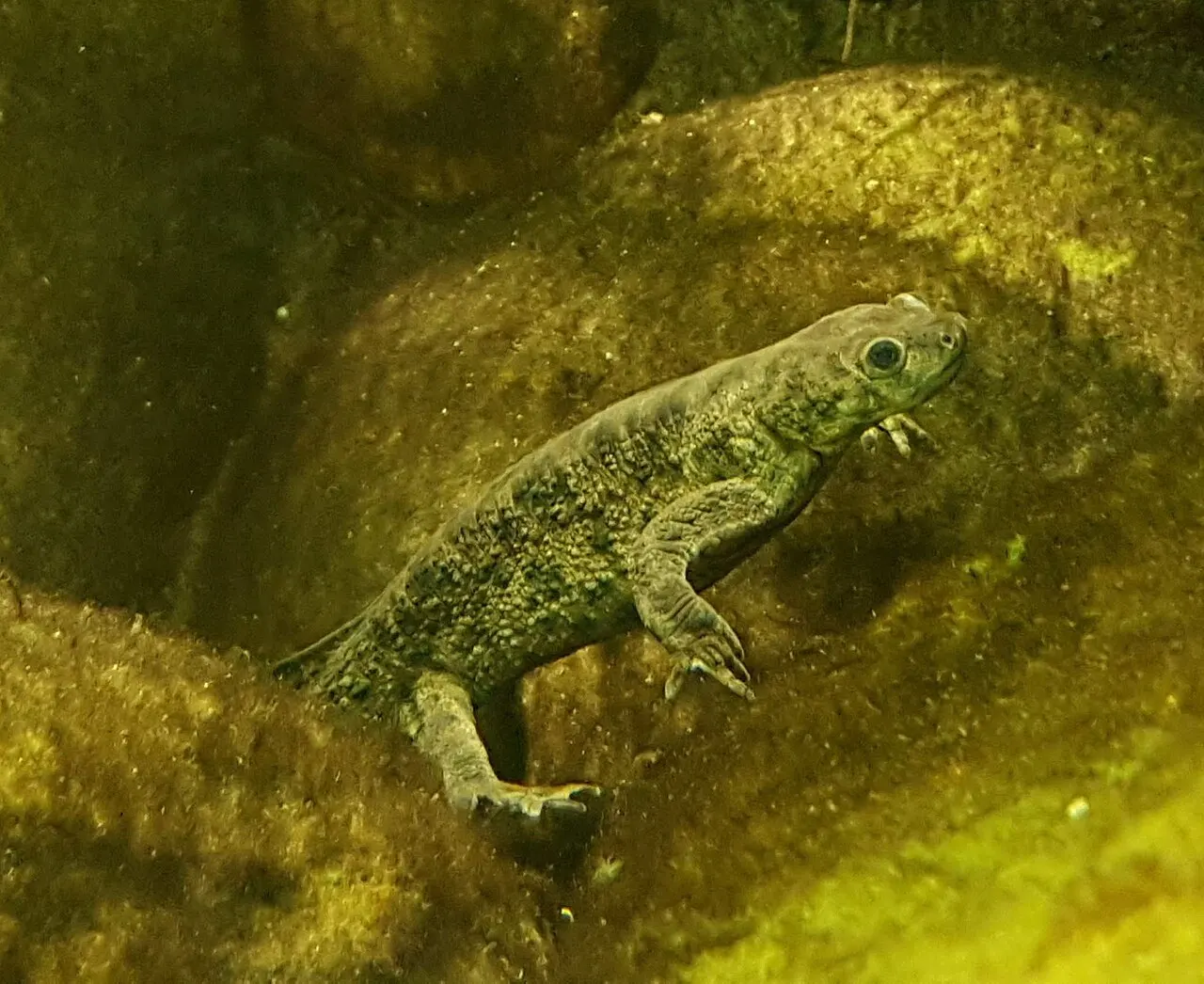
The Edough ribbed newt, Pleurodeles poireti, is a salamander found only on the Edough Peninsula in north-eastern Algeria, near Annaba. The IUCN Red List assessed it as Endangered in 2021 and records a decreasing population. It is reportedly one of only four salamander species in Africa.
A species once confused with another
Gervais described the newt in the 1830s, and for a long time the name was applied to ribbed newts across much of North Africa. A 2004 genetic study by Carranza and Wade showed that most of those animals belong to a different, widespread species, the Algerian ribbed newt (Pleurodeles nebulosus). True Pleurodeles poireti is restricted to the Edough Peninsula. Specialist keepers believe captive newts once sold under the poireti name are really nebulosus.
Where it lives
The IUCN estimates its extent of occurrence at about 2,360 square kilometres and the area it actually occupies at about 92 square kilometres, in five locations at elevations up to 300 m. It is not a migrant.
It is mainly aquatic and uses rivers and seasonal streams, marshes and swamps, small permanent and seasonal pools, ponds, and cisterns. The IUCN also lists farmland, temperate shrubland and temperate forest among its habitats. A 2016 survey in the African Journal of Herpetology found it widely spread across the peninsula, breeding mostly in medium to large water bodies thickly covered with emergent plants. Water chemistry mattered little, except that occupied sites tended to have high dissolved oxygen and turbidity. At a broad scale it was linked to lowlands in farmed landscapes, but it also occurs in cork oak forest.
Pins are Wikidata “endemic to” fields. Orange dots, when present, are GBIF occurrence tiles — survey bias included.
Why it is in trouble
The 2021 assessment uses criterion B1ab(ii,iii,iv)+2ab(ii,iii,iv), recording a continuing decline in the area it occupies and in its subpopulations. The overall trend is decreasing. The IUCN lists housing, roads, small-holder farming, taking of surface water for household and farm use, and problem native species among the threats, each scored as low impact. Hybridisation and reduced breeding success appear among the stresses.
A 2016 survey found that populations near villages could vanish because of habitat destruction combined with introduced fish.
The species has moved up the Red List over time. It was Near Threatened in 2004, then Endangered in 2006, and stayed Endangered in 2021.
What is being done
The 2021 assessment says the newt does not occur in a protected area. It lists site management, habitat restoration and captive breeding among conservation actions. A 2006 IUCN summary said nothing was known about the abundance of the species, and the current assessment still gives no population size.
Sources
Written for this catalog in our own words from the sources below, checked against them on 12 November 2026. Population figures are estimates and carry the year they were made. Status and assessment year: IUCN. 2026. The IUCN Red List of Threatened Species. Version 2026-1. iucnredlist.org.




