Endangered
Pleuractis paumotensis
Pleuractis paumotensis
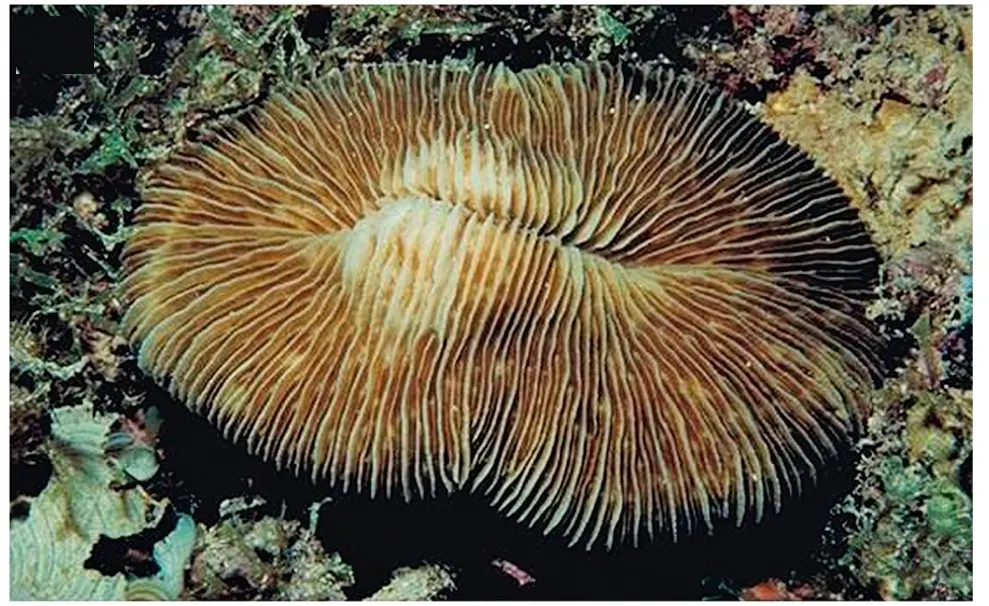
Pleuractis paumotensis, the elongate mushroom coral or plate coral, is a free-living stony coral that lies loose on reef sand across the Indo-West Pacific. A single large polyp builds each skeleton. The IUCN Red List moved it from Least Concern to Endangered in 2024.
How to recognise it
A mushroom coral isn't a colony. Each one is a single animal, one very large polyp sitting in a skeleton shaped like an oval plate. This species is elongate, thick and heavy, with a strong arch along the middle, and it can reach about 25 centimetres in length. Narrow ridges run outward from the central mouth, and the outer surface carries fine, straight ribs with small spines.
It is usually brown, and scars from an early attached stage show only on young specimens.
Where it lives
It has a very wide range. The IUCN lists about 58 countries, territories and island groups, from the Red Sea, the coast of East Africa and Oman, through Indonesia, the Philippines, Australia and Japan, to Fiji, Tonga, Samoa and French Polynesia. The type locality is the Tuamotu and Society Islands.
It lies on sand or rubble on the upper reef slope, where waves keep the water moving, and in lagoons. The IUCN gives a depth range of 1 to 60 metres. GBIF holds about 1,050 occurrence records, more than half of them from Indonesia and Australia.
Pins are Wikidata “endemic to” fields. Orange dots, when present, are GBIF occurrence tiles — survey bias included.
How it lives
Like most reef-building corals, it carries symbiotic algae (zooxanthellae) in its tissue and gets part of its energy from light. It also feeds on plankton. The IUCN estimates a generation at about 10 years.
Why it is in trouble
The 2024 assessment (based on data from 2022) lists the coral as Endangered under criterion A3c, which covers a projected population decline driven by loss of habitat. It records a decreasing population with a continuing loss of reef area, and a projected reduction of about 63 percent. Earlier assessments in 2008 and 2014 had rated it Least Concern.
The threats named are storms and flooding, extreme temperatures, soil erosion and sediment washing onto reefs, coastal development, shipping lanes, tourism and recreation, and small-scale harvest. Each is scored as low impact on its own, but they act together across the whole range. The IUCN also records international trade as a pet or display animal and for handicrafts and jewellery. Reeflex lists it on CITES Appendix II, which regulates international trade.
What is being done
The IUCN lists site protection and management, habitat restoration, species recovery, captive propagation and a genome resource bank among the actions relevant to the species. Whether the coral occurs in a protected area is recorded as unknown. Hobbyists keep it in reef aquariums, where a German care database rates it average difficulty and advises a tank of about 200 litres or more at 24 to 27 degrees Celsius.
Sources
Written for this catalog in our own words from the sources below, checked against them on 12 November 2026. Population figures are estimates and carry the year they were made. Status and assessment year: IUCN. 2026. The IUCN Red List of Threatened Species. Version 2026-1. iucnredlist.org.




