Endangered
Plain-flanked Rail
Rallus wetmorei
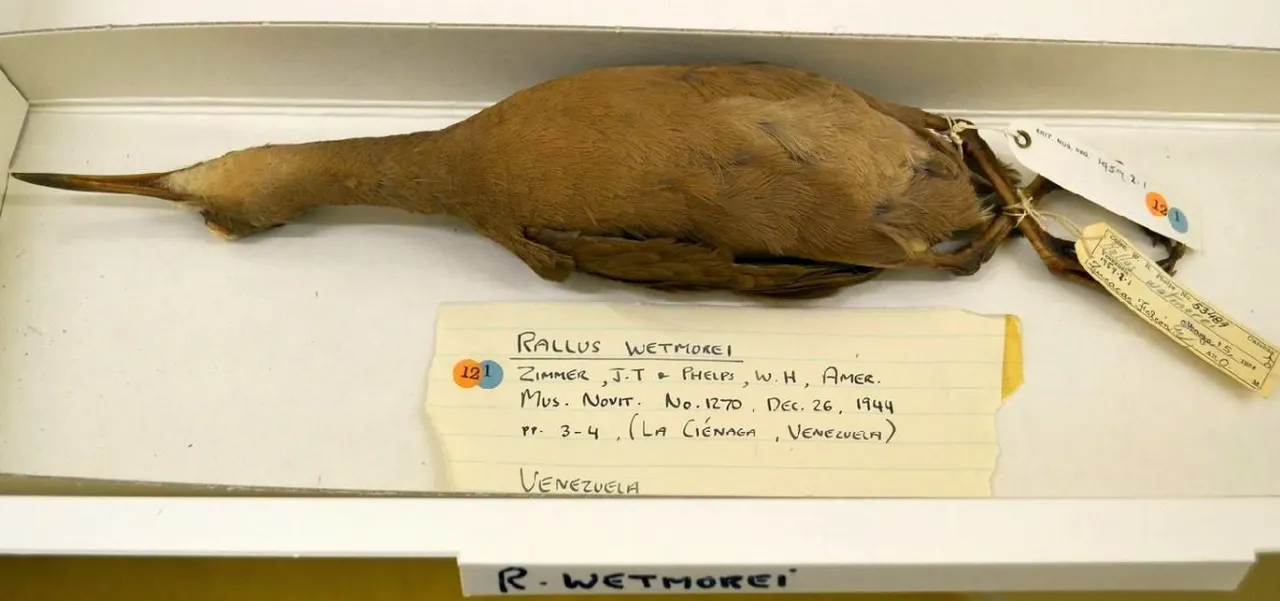
The plain-flanked rail (Rallus wetmorei) is a large, secretive marsh bird found only in a few mangrove patches on Venezuela's Caribbean coast. The IUCN Red List has listed it as Endangered since 1994, and the 2025 assessment puts its numbers at 200 to 1,000 birds and still falling.
How to recognise it
It's a big rail, about 31 to 35 cm long in males and 27 to 31 cm in females, with males weighing roughly 180 to 255 g. Two colour forms live side by side. The pale form is olive-brown with dark streaking, while the dark form is brown to almost sooty.
You're far more likely to hear it than see it. The advertising call is a rapid run of harsh "kek" notes, and pairs often answer each other from neighbouring territories.
Where it lives
The species is endemic to Venezuela and known from only a handful of sites along the coast between eastern Falcon and western Aragua. The 2025 Red List assessment counts three to ten locations and an extent of occurrence of roughly 1,120 to 2,100 square kilometres.
It lives almost entirely in mangroves, with some use of reeds and other emergent plants around brackish lagoons and marshes. It stays low, between sea level and about 150 m, and doesn't migrate.
Pins are Wikidata “endemic to” fields. Orange dots, when present, are GBIF occurrence tiles — survey bias included.
How it lives
Rails of this kind forage low in the mangroves or along their edges near mudflats. At low tide the plain-flanked rail walks out onto the mud and probes fiddler crab burrows, and fiddler crabs are a documented prey item. Other aquatic invertebrates are probably eaten too.
Breeding is thought to run from about February to May. The nest is reportedly a platform of twigs and leaves placed on mangrove roots or in the trees, holding four to seven buffy-white, spotted eggs. Both parents have been seen incubating.
Why it is in trouble
Everything depends on a thin strip of coastal mangrove, and that strip keeps shrinking. The Red List names housing, roads, tourism and commercial development, rubbish dumping and pesticide use among the threats, and it records a continuing decline in the bird's habitat.
A 2025 study in Memoria de la Fundacion La Salle backs that up for Morrocoy National Park. Satellite images from 2015 to 2025 showed red mangrove cover down by about 15 percent and black mangrove cover down by about 25 percent, while bare ground grew by 73 percent. The same team counted 111 rails at 51 count points over eight visits between June 2019 and May 2021, with the most birds where black mangrove dominates. None were found in five of the 13 sectors surveyed.
A 2015 genetic study in Revista Venezolana de Ornitologia sampled 19 birds from four sites and found no clear split between populations, which suggests birds still move between patches. The Red List assessment also lists inbreeding among the stresses on such a small population.
What is being done
The rail occurs in at least one protected area, and the Red List records conservation sites over part of its range. It has no recovery plan and no systematic monitoring scheme. The Morrocoy researchers call for urgent mangrove restoration, policies aimed at the threats, continuous monitoring and environmental education.
Sources
Written for this catalog in our own words from the sources below, checked against them on 12 November 2026. Population figures are estimates and carry the year they were made. Status and assessment year: IUCN. 2026. The IUCN Red List of Threatened Species. Version 2026-1. iucnredlist.org.




