Critically Endangered
Pink-headed Duck
Rhodonessa caryophyllacea
The pink-headed duck (Rhodonessa caryophyllacea) was a large, long-necked duck of the lowland wetlands of northern India, Bangladesh, Nepal and Myanmar. The Red List (2025) still lists it as Critically Endangered, though it is probably extinct, with no confirmed wild record since the late 1940s.
How to recognise it
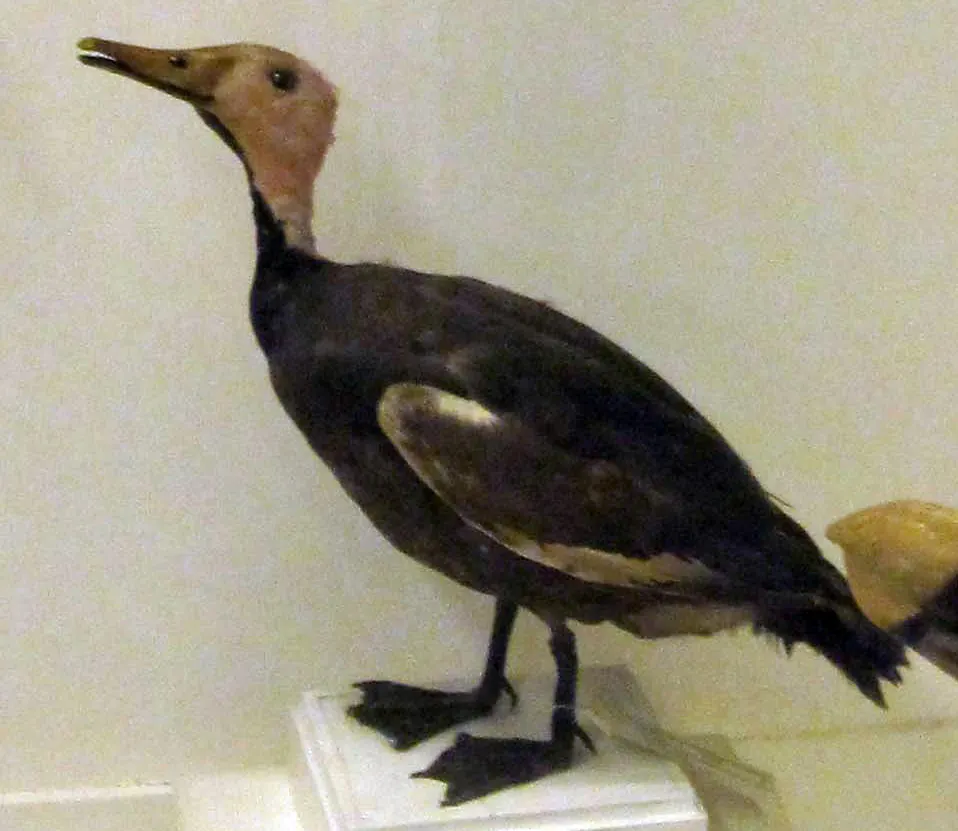
Nothing else looks quite like it. Males had a deep pink head and neck and a rosy bill, set against a blackish-brown body. Females were duller and browner, with a pale greyish-pink head and a duller bill, and young birds had an almost whitish head with no pink at all. The bird stood about 60 centimetres long by the Red List's measure, though other summaries give 41 to 43.
The wings carried a pale pinkish-beige patch (the speculum) that stood out against the darker feathers. The pink comes from a carotenoid pigment, which is unusual in ducks. The eggs were nearly round and creamy white, in clutches of about six or seven.
Where it belongs in the duck family tree has never been settled. Some authors have put it close to the red-crested pochard, and others have kept it in a genus of its own.
Where it lived
Records come mostly from the Gangetic plain of eastern India, especially north of the Ganges and west of the Brahmaputra, in Bihar and neighbouring regions. There are also records from Bangladesh, Nepal and northern Myanmar, and scattered ones from places such as Manipur and Delhi.
It used lowland marshes, pools and lakes with tall grass and moist forest around them, and nested among grass. Myanmar has only two specimens, and the last record there dates to 1910.
Pins are Wikidata “endemic to” fields. Orange dots, when present, are GBIF occurrence tiles — survey bias included.
How it lived
Birds were usually seen alone or in pairs, rarely in small groups. They are thought to have fed on water plants and molluscs, reportedly dabbling or up-ending in shallow water rather than diving. A soft two-note call has been attributed to the species. Captive males displayed often, but the species never bred in captivity.
The last known captive birds lived in private aviaries in France and England. The only known photographs show these captives.
Why it vanished
The Red List names hunting and industrial-scale farming as threats. Loss of the wetlands it needed is thought the most likely cause of decline. Colonial-era sportsmen also shot it, and it was later prized as an ornamental bird for its colour.
Dates for the last record differ. One account gives a specimen and sighting in Darbhanga district, Bihar, in 1935, and Indian reports continued into the early 1960s. A 2008 review in Bird Conservation International gives 1948 to 1949 as the last confirmed wild record.
The search goes on
From 2003 to 2005, BirdLife International and a Myanmar conservation group surveyed wetlands in the Kachin lowlands. They found no confirmed birds but recorded two possible sightings, and judged that a shy, rare bird in dense habitat could easily be missed.
A Global Wildlife Conservation (now Re:wild) expedition to Kachin State in late 2017 also failed to find one. Local accounts suggested the duck had visited Indawgyi Lake more recently than 1910, but none of these reports has been verified.
The 2025 Red List assessment puts the population at 0 to 49 birds if any survive. The species is on CITES Appendix I, and the assessment records no recovery plan, monitoring scheme or captive population.
Sources
Written for this catalog in our own words from the sources below, checked against them on 12 November 2026. Population figures are estimates and carry the year they were made. Status and assessment year: IUCN. 2026. The IUCN Red List of Threatened Species. Version 2026-1. iucnredlist.org.




