Endangered
Pimelodella kronei
Pimelodella kronei
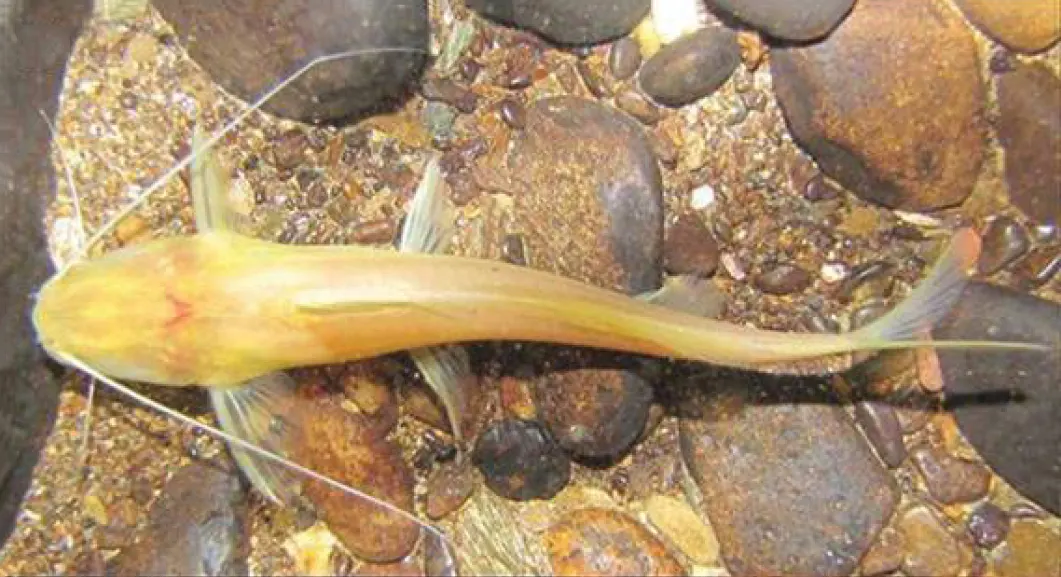
The Iporanga blind catfish (Pimelodella kronei) is a pale, nearly eyeless catfish that lives only in cave streams in the Alto Ribeira region of São Paulo state, Brazil. The IUCN Red List classes it as Endangered (assessed 2022). It was the first cave fish ever described from Brazil.
How to recognise it
This is a three-barbeled catfish that has lost its colour. It has no pigment, and its eyes are often shrunken, hidden under the skin, or missing altogether. It grows to about 20 cm long, and the population's average lifespan has been estimated at 15 to 20 years.
Its closest relative, Pimelodella transitoria, is common in surface streams in the same area and also lives in caves. Only P. kronei is restricted to caves.
Where it lives
The fish is found nowhere else on Earth. It lives in streams inside limestone caves along the Betari River, a tributary of the upper Ribeira de Iguape, near Iporanga. It is recorded from seven caves, which the Red List treats as two locations, and its area of occupancy is about 20 square kilometres.
Most of those caves lie inside the Alto Ribeira Tourist State Park (PETAR), created in 1958. The type locality is the Areias de Cima cave, which still holds the largest population in the park. The fish is so tied to the place that it appears on the park's logo.
Pins are Wikidata “endemic to” fields. Orange dots, when present, are GBIF occurrence tiles — survey bias included.
How it lives
Food is scarce in a cave because nothing grows without light. The catfish is an opportunist and eats whatever turns up, including organic debris washed in by streams, bat guano and dead animals. It doesn't seem to rely on sight to find food, and smell is thought to help it find mates. A slow metabolism lets it get through long lean periods.
Growth is reportedly less than 1 mm a month, and reproduction is slow, so a population that has been knocked down takes a long time to come back.
Why it is in trouble
The Red List assessment, published in 2022 under criterion B2ab(ii,iii), lists tourism and recreation, run-off, sediment, nutrient loads and garbage as threats to the cave streams, along with collection of the fish. The population trend is recorded as unknown.
An earlier assessment, from 2011, pointed to domestic sewage and soap at one location and heavy metals left by old mining at the other. The catfish no longer occurs in Alambari de Cima or Córrego Seco caves. Fish had not been seen for about 15 years (by that older record) in Gurutuva and Alambari de Cima, perhaps after pollution events in the mid-1980s.
What is being done
Access to Areias de Cima has been restricted since the 1980s, and caves with the blind catfish are closed to visitors, although other PETAR caves are open for tourism. The Red List names site protection and site management as conservation actions and lists research on taxonomy, population trends and habitat trends.
A mark and recapture study in Areias de Cima from October 2008 to May 2010, by Guil and Trajano (published 2013), was described by its authors as the first long-term monitoring of a Brazilian cave fish.
Sources
Written for this catalog in our own words from the sources below, checked against them on 12 November 2026. Population figures are estimates and carry the year they were made. Status and assessment year: IUCN. 2026. The IUCN Red List of Threatened Species. Version 2026-1. iucnredlist.org.




