Critically Endangered
Phyllomedusa rustica
Phyllomedusa rustica
The rustic tree frog (Pithecopus rusticus, first named Phyllomedusa rustica) is a small green leaf frog known from a single highland wetland in southern Brazil. The IUCN Red List rated it Critically Endangered in 2023, and a zoo breeding programme now holds a few of its animals.
How to recognise it
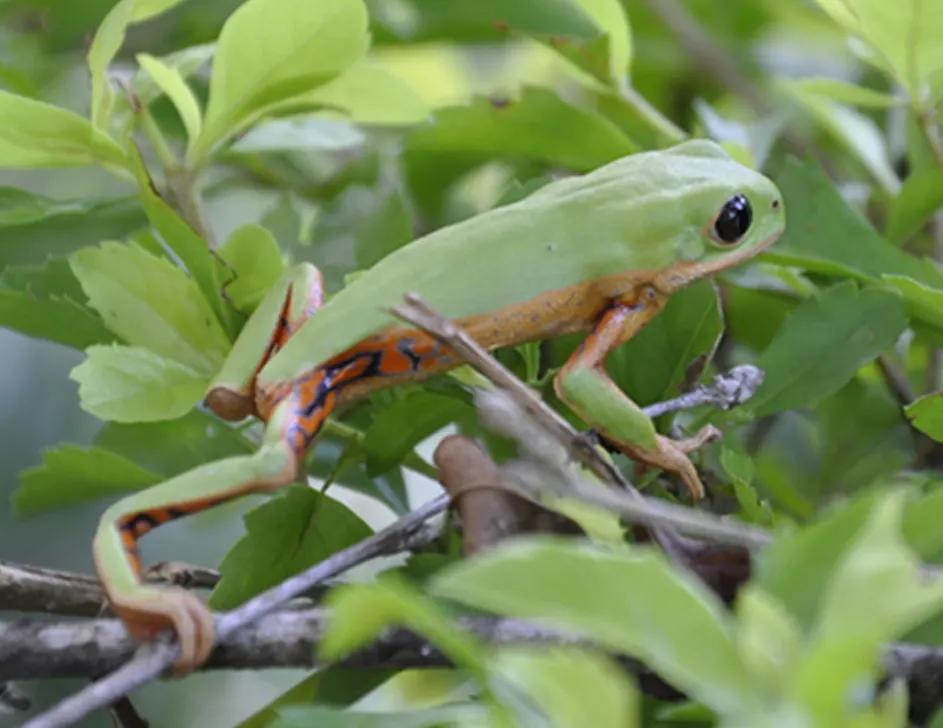
This is a small, slender frog. The 11 males in the type series, described in 2014, measured 33.9 to 37.1 mm from snout to vent, about the length of a thumb. The back is plain and spotless, light green to olive or brownish green.
The hidden surfaces change the picture. Flanks and the insides of the limbs are cream to reddish orange, netted with black or dark blue lines around large reddish-orange blotches, a pattern that shows when the frog moves. The throat and belly are whitish to creamy orange.
Where it lives
Everything known about the species comes from one site in the municipality of Água Doce, in the Brazilian state of Santa Catarina, at about 1,330 m above sea level. The area is natural grassland on a high plateau, in a zone known as the Campos de Palmas, within an Atlantic Forest mosaic of Araucaria forest and open grass.
The IUCN counts it as a single location. When researchers sampled water in a nearby wildlife refuge in December 2020, they found no trace of the frog, so no second population has been shown.
Pins are Wikidata “endemic to” fields. Orange dots, when present, are GBIF occurrence tiles — survey bias included.
How it lives
Males call from low herbaceous plants at the margins of ponds. Like other leaf frogs, the species is believed to lay eggs on leaves over the water, so that the tadpoles drop into the pond after hatching. A 2019 paper in Biota Neotropica, using eggs from two spawns hatched in a laboratory, placed the tadpoles in the suspension-rasper feeding group. Adult biology beyond this is thinly documented.
The first frogs were collected at the site in January 2009 and identified at the time as another leaf frog, the azure monkey frog. A 2014 paper in PLOS ONE described them as a new species.
Why it is in trouble
The whole known population lives in a wetland on a privately owned cattle ranch, near a road and wind turbines. Rewild, a conservation charity, reports that as few as 40 animals have been recorded there. It says that in 2018 the landowner buried the vegetation where the frogs laid eggs and dug out the spot for a cattle trough. According to Rewild, the remaining frogs moved to another part of the wetland, where cattle still trample the ground.
Other accounts differ on what followed. A reference-work account says the frog was seen on the property in 2019 and could not be found again after the owner cleared the grassy areas. Which version is right is not settled in the sources.
The IUCN lists small-scale and industrial farming, grazing, renewable energy development and collection for the pet and display trade as threats. Rewild adds pesticide use in nearby soybean and potato fields and worsening drought. Chytrid fungus has been suggested as a possible factor too.
Invasive American bullfrogs are another risk. In December 2020 researchers took 24 water samples in the Campos de Palmas wildlife refuge, about 2 km from the original site and cut off from it by a highway. They found bullfrog DNA but no DNA from the rustic tree frog.
What is being done
In 2022, scientists took two males and a female by helicopter to Parque das Aves, a zoological park in southern Brazil, which replicated the wetland's conditions to start the first conservation breeding programme for the species. The aim is to support the wild group and release frogs once secure conditions return to the wild.
A national strategic plan for conserving the frog was drawn up by about 30 specialists between August and October 2022 and announced in November 2023. The species is among Brazilian amphibians given high priority because of short-term extinction risk. The IUCN records that it does not occur in a protected area.
Sources
Written for this catalog in our own words from the sources below, checked against them on 12 November 2026. Population figures are estimates and carry the year they were made. Status and assessment year: IUCN. 2026. The IUCN Red List of Threatened Species. Version 2026-1. iucnredlist.org.
- IUCN Red List assessment, Pithecopus rusticus (2023)
- Bruschi et al. 2014, PLoS One (original description)
- Bastiani et al. 2019, Biota Neotropica, tadpole description
- Rewild, Brazil's battle for beef pushes Critically Endangered frog from its wetland home
- Science News, American bullfrogs may be threatening a rare frog species in Brazil
- IUCN SSC Amphibian Specialist Group, strategic plan announcement (2023)
- Pithecopus rusticus (encyclopedia article)




