Endangered
Phricotelphusa gracilipes
Phricotelphusa gracilipes
Phricotelphusa gracilipes is a small purplish freshwater crab known only from Pulau Langkawi, an island off north-western Peninsular Malaysia. The IUCN Red List rated it Endangered in 2008 because it occupies a very small area. It lives in the island's highlands, in shaded spots beside fast streams and waterfalls.
How to recognise it
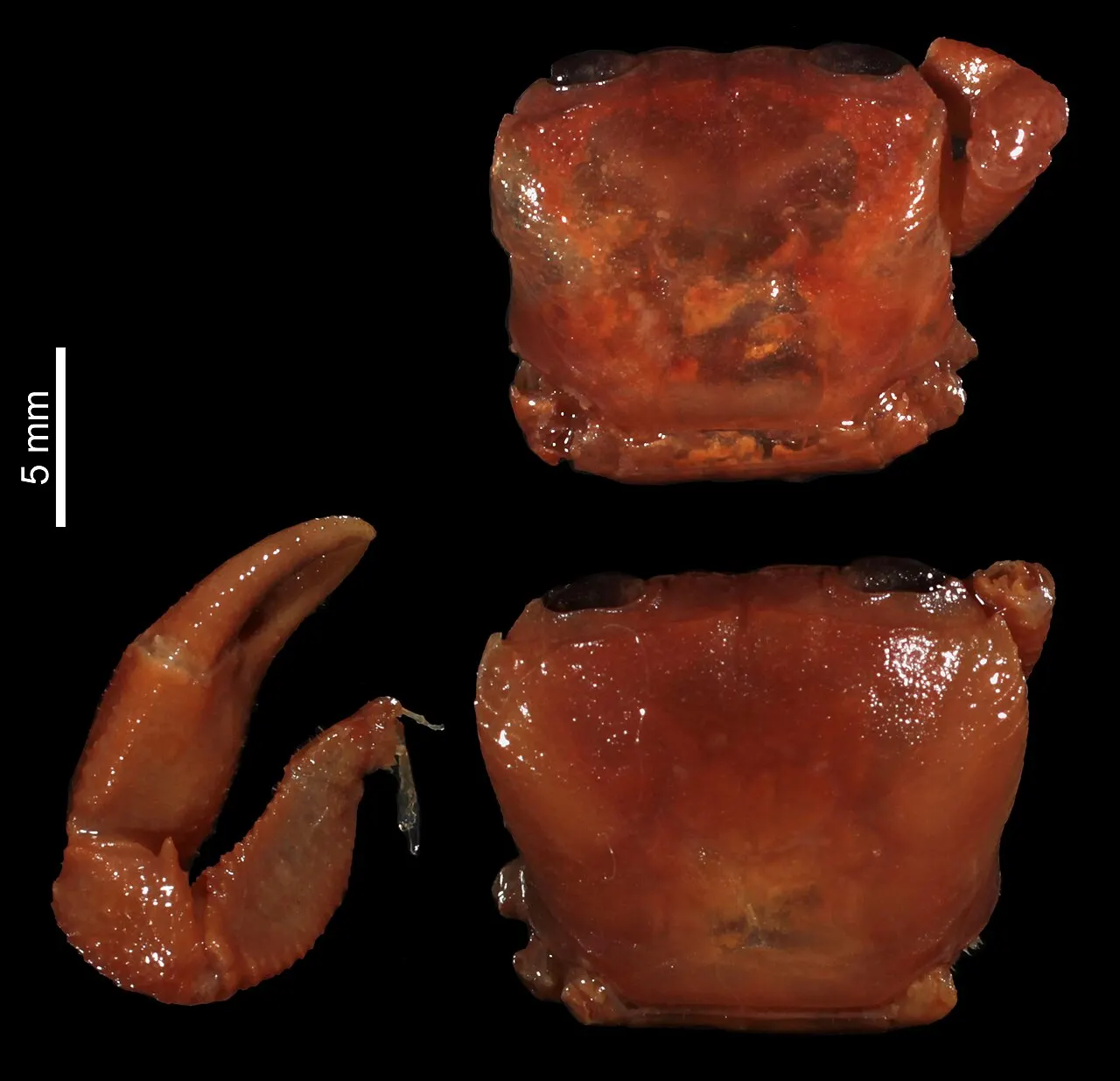
This is a small, squarish crab. The male used to describe the species had a shell 17.1 mm wide and 14.3 mm long. The shell surface is slightly rough and granular, with sharp ridges behind the eyes and a strong, pointed tooth near each side. Adult males carry claws of unequal size, and the larger one is covered in small sharp granules.
The legs are long and slender, which gives the species its name (from the Latin for slim foot). Live crabs are brownish-purple to purplish-red. In a related crab from Perak the colour of young animals and females varies, but in this species even juveniles and females look much like the males.
Where it lives
Peter Ng and H. P. Ng described the crab in 1987 in the Malaysian Journal of Science, from animals collected that June at Durian Perangin Waterfall and Air Telaga Tujoh (Seven Wells) Waterfall on Langkawi. The island lies about 25 km northwest of the Malaysian mainland and belongs to the state of Kedah. It was one of two new crabs in that paper, which brought the island's true freshwater crabs to five species.
Phricotelphusa had 11 known species by 2012, when a new cave species from Perlis brought the number found in Malaysia to four. This crab is known only from Langkawi. The IUCN counts four locations and gives both its extent of occurrence and its area of occupancy as about 500 (square kilometres).
Pins are Wikidata “endemic to” fields. Orange dots, when present, are GBIF occurrence tiles — survey bias included.
How it lives
Ng and Ng found the crab common across Langkawi's highlands in 1987. It favoured shaded ground under leaf litter and rocks beside fast-flowing streams, and it is not strictly aquatic. Several specimens, including the first male described, came from wet banks beside the water. It was not found in the lower stretches of the streams, and the IUCN lists permanent rivers and streams (including waterfalls) as its habitat.
At Durian Perangin it shared its waterfall with another freshwater crab, Stoliczia bella. Two females carrying young were collected in 1987. Beyond that, its diet, breeding season and lifespan are still undocumented.
Why it is in trouble
The Endangered listing rests on criteria B1ab(iii)+2ab(iii). These describe a small range, only a handful of locations and an inferred continuing decline in the quality of its habitat. The IUCN records the population trend as unknown, gives no population estimate, and does not describe the population as severely fragmented.
The assessment lists no individual threats, so what is driving any change in the highland streams is not documented.
What is being done
The assessment calls for site and area management, and for research on the crab's population and distribution, its life history, harvest and use, and threats. No recovery plan or species-specific programme is recorded. The assessment dates from 2008, and the 1987 description remains the main account of how the crab lives.
Sources
Written for this catalog in our own words from the sources below, checked against them on 12 November 2026. Population figures are estimates and carry the year they were made. Status and assessment year: IUCN. 2026. The IUCN Red List of Threatened Species. Version 2026-1. iucnredlist.org.




