Endangered
Phoxinellus alepidotus
Phoxinellus alepidotus
The Dinaric minnow (Phoxinellus alepidotus) is a small freshwater fish of the karst country of Bosnia and Herzegovina, with a doubtful foothold in Croatia. It is listed as Endangered (assessed 2024). It is nearly scaleless and spends dry spells and winters in underground water.
How to recognise it
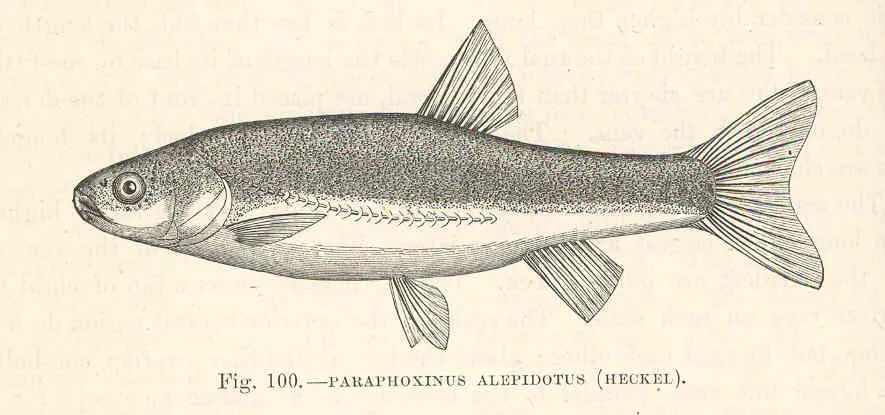
This is a slim minnow that reaches about 14.5 cm in standard length. The species name means "without scales", and it fits: the body is mostly bare, apart from a line of pored scales along the side. Counts of those scales run from 11 to 42, and the lateral line stops between the pelvic and anal fins. The mouth sits slightly underneath the snout and the tail is forked.
Heckel described it in 1843 from Livno in Bosnia and Herzegovina. It is the type species of its genus. Two close relatives, the Dalmatian minnow (described in 2000) and the Mostar minnow (2003), complete the genus, and a 2024 genetic and anatomical study in Ecology and Evolution clearly separated all three species.
Where it lives
The IUCN lists the species as present in Bosnia and Herzegovina and as possibly extinct in Croatia, where its origin is uncertain. It is known from about four locations. Earlier summaries tie it to the Cetina drainage and to the karst fields (poljes) of Livno, Glamoč and Grahovo, and a 2006 IUCN summary noted it might already be gone from the Cetina basin itself. GBIF records cluster around streams in the Glamoč and Bosansko Grahovo area and the Kazanci site. Some populations were introduced, for example in Lake Blidinje and the upper Unac River.
Its habitats are permanent and seasonal streams, springs, lakes, reservoirs and karst underground waters, all freshwater.
Pins are Wikidata “endemic to” fields. Orange dots, when present, are GBIF occurrence tiles — survey bias included.
How it lives
Fish of this genus can spend up to several months underground, but need surface water to spawn. The Dinaric minnow is classed as a basic stygophile, meaning it can use underground water but is not a dedicated cave animal. It reportedly retreats into the karst in winter and during droughts.
The IUCN records it as a congregatory fish, living in groups year-round, and not a migrant.
Why it is in trouble
The IUCN lists the population as decreasing, with a continuing decline in the area it occupies, from four locations. A survey series spanning 20 years, reported in 2024, found falling numbers and shrinking ranges across the three Phoxinellus species.
The pressures are mostly about water. They include water taken for farms, homes and business, small and large dams, fertiliser and sewage, and renewable energy schemes. Introduced fish are a further threat. The IUCN names mosquitofish, European chub, common carp, topmouth gudgeon, wels catfish, pumpkinseed, zander and rainbow trout.
What is being done
Conservation sites have been identified over part of its range, and it occurs in at least one protected area. There is no recovery plan, no systematic monitoring scheme, no invasive species control and no captive breeding. The IUCN calls for research on its threats, ecology, population size and distribution.
Sources
Written for this catalog in our own words from the sources below, checked against them on 12 November 2026. Population figures are estimates and carry the year they were made. Status and assessment year: IUCN. 2026. The IUCN Red List of Threatened Species. Version 2026-1. iucnredlist.org.




