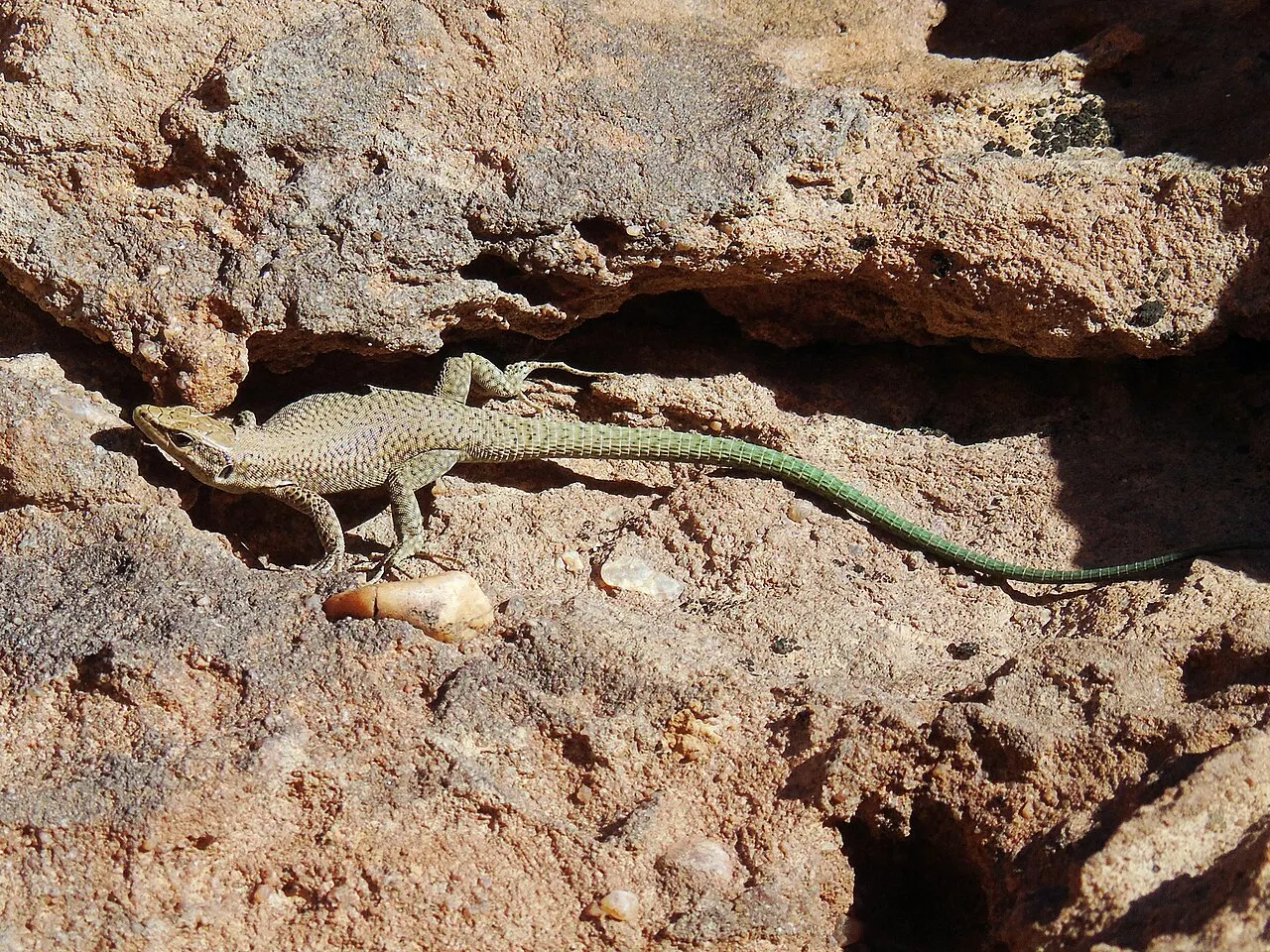
Endangered
Phoenicolacerta kulzeri
Phoenicolacerta kulzeri
Kulzer's rock lizard (Phoenicolacerta kulzeri), also called the Petra lizard, is a lacertid that lives on rocky ground in Lebanon, Syria and Jordan, with records from Israel too. The IUCN rated it Endangered in 2006, with a decreasing population. Three subspecies are recognised, one confined to Wadi Ramm in southern Jordan.
What it is
This is an egg-laying lizard in the family Lacertidae, described in 1932 by L. Müller and Wettstein as Lacerta kulzeri. Its name honours the German beetle specialist Hans Kulzer, who collected the type specimen. In 2007 Arnold and colleagues moved it into the genus Phoenicolacerta.
Three subspecies are accepted. The nominate form comes from the Lebanon mountains, with the type locality in a cedar forest near Bcharré. P. k. petraea is the form from the Petra area, and P. k. khazaliensis was described in 2013 from Wadi Ramm in Jordan. The spelling of the last name varies between sources.
Where it lives
The range is fragmented across the Levant. The IUCN places it on Mount Hermon, in the Lebanon and Anti-Lebanon mountains, in the Jabal al-Arab (Druze mountains) of southern Syria, and in western Jordan from Al Karak south to Petra. It lives at roughly 1,350 to at least 2,000 metres, and on Mount Hermon only above 1,500 metres. The Reptile Database also lists Israel.
Its habitat is rocky ground, mainly boulders and rock piles in cedar and oak forest, and it sometimes uses abandoned buildings. The IUCN puts its total area of occupancy at probably under 500 square kilometres and notes it occurs in at least one protected area. Older records may be unreliable, because many authors did not separate it from Lacerta laevis.
Pins are Wikidata “endemic to” fields. Orange dots, when present, are GBIF occurrence tiles — survey bias included.
Why it is in trouble
The IUCN assessment, dating from 2006, scores the pressures as modest. Nomadic grazing and commercial and industrial development are ongoing at low impact. Tourism development and shifting habitat are listed as future pressures with negligible expected impact.
The text of the assessment adds specifics: tourism development in southern Jordan, military use of habitat on Mount Hermon, a possible ski industry there, overgrazing in parts of the range and potential climate effects.
The population is recorded as decreasing, and the Endangered rating rests on criteria B2ab(iii), which concern a restricted area of occupancy and habitat decline. The assessment lists site and area management as a conservation action, with no detail given. No population figure is published.
Sources
Written for this catalog in our own words from the sources below, checked against them on 12 November 2026. Population figures are estimates and carry the year they were made. Status and assessment year: IUCN. 2026. The IUCN Red List of Threatened Species. Version 2026-1. iucnredlist.org.




