Endangered
Apolo cotinga
Phibalura boliviana
The palkachupa cotinga, also called the Apolo cotinga, is a boldly patterned yellow and black bird with a long forked tail. It lives only in the Andean foothills around Apolo in western Bolivia. The IUCN lists it as Endangered (assessed 2022), with a few hundred mature birds and habitat still shrinking.
How to recognise it
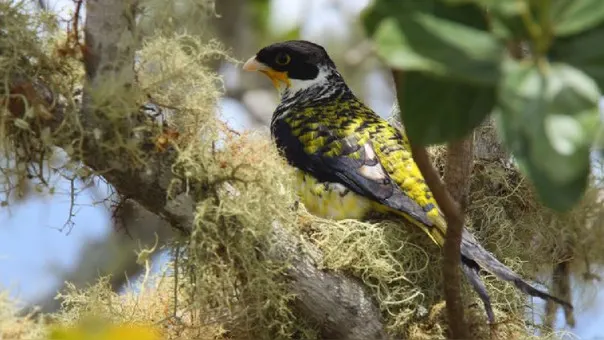
This is a medium-sized cotinga, roughly 18 to 22 cm long depending on the source, with a long, forked, blackish tail that is often held open in a V. The male has a dark head with a blue sheen and a small red crown patch, a golden-yellow throat and cheeks, and a white stripe behind the ear that runs into a heavily barred breast. The rest of the underparts are yellow.
The upperparts are yellowish olive with coarse black bars, and the wings are blackish. The eye is mustard-yellow with bare reddish skin around it. Females are duller, greyer on the head, with a shorter tail. The contact call is a harsh, weak note repeated many times in a row.
Where it lives
The palkachupa cotinga is found only around Apolo in northern La Paz department, Bolivia, with most birds in the Apolo valley. The first specimen was collected in 1902, and the bird went unrecorded for 98 years until it was found again in September 2000 at the edge of a forest fragment near Pata, in Madidi National Park.
It lives in the eastern Andean foothills at about 1,400 to 2,040 metres, at the edges of semi-humid montane forest, in patches of moist savanna and in heavily degraded former forest. It also perches in open woodland and gardens. The IUCN estimates its extent of occurrence at about 1,600 square kilometres and its area of occupancy at 984 square kilometres, across 6 to 10 locations. It does not migrate.
Pins are Wikidata “endemic to” fields. Orange dots, when present, are GBIF occurrence tiles — survey bias included.
How it lives
It eats fruit and insects, foraging in the canopy of forest remnants and of isolated trees in the savanna, and it gathers in flocks outside the breeding season. It perches still for long periods, and takes insects in short flights out from its perch.
Breeding takes place in loose colonies of up to five pairs, from about August or September to March. Unusually for a cotinga, the pairs are monogamous and both parents incubate. The nest is a shallow cup of lichen and a few twigs, placed in trees along forest edges, in isolated savanna trees or on rocks. The clutch is reportedly two eggs, which hatch after about 17 to 19 days.
Why it is in trouble
The IUCN gives 400 to 530 mature individuals, all in a single subpopulation, with a decreasing trend. That figure comes from a 2011 estimate of 600 to 800 birds, and the IUCN says a newer survey is urgently needed. A 2025 report from American Bird Conservancy gives about 1,900 birds, so counts vary with method and with what is included.
Habitat loss is the main driver. Forest cover around Apolo has fallen sharply over the past century, and clearance and burning for cattle ranching and farming continue. The bird is almost absent from heavily disturbed areas, and parts of its former range are now treeless. Nesting success is low, at about 20 percent, with nest predation and heavy rain behind many failures. Fires are increasingly common in the grasslands it relies on, and livestock wander into protected habitat.
What is being done
The species occurs in at least one protected area, and conservation sites have been identified over its entire range. According to American Bird Conservancy, the Leco indigenous people and two Quechua communities have declared more than 1,888 hectares of Community Protection Areas, covering almost a quarter of its reproductive habitat. Conservationists say about 17,890 hectares need protection.
Local partner Asociación Armonía and the communities have produced nearly 25,000 native seedlings, fenced 165.5 hectares, and trained 200 soldiers and more than 70 other people in fire control. The IUCN records no formal recovery plan, no systematic monitoring scheme and no captive population, and recommends expanding formal protection and fencing nesting trees.
Sources
Written for this catalog in our own words from the sources below, checked against them on 12 November 2026. Population figures are estimates and carry the year they were made. Status and assessment year: IUCN. 2026. The IUCN Red List of Threatened Species. Version 2026-1. iucnredlist.org.




