Endangered
White-bellied pangolin
Phataginus tricuspis
The white-bellied pangolin (Phataginus tricuspis), also called the tree pangolin, is a scaly, ant-eating mammal of West and Central African forests. The IUCN Red List rated it Endangered in 2019. It is the most frequently encountered African pangolin, and hunting for meat and medicine is driving its decline.
How to recognise it
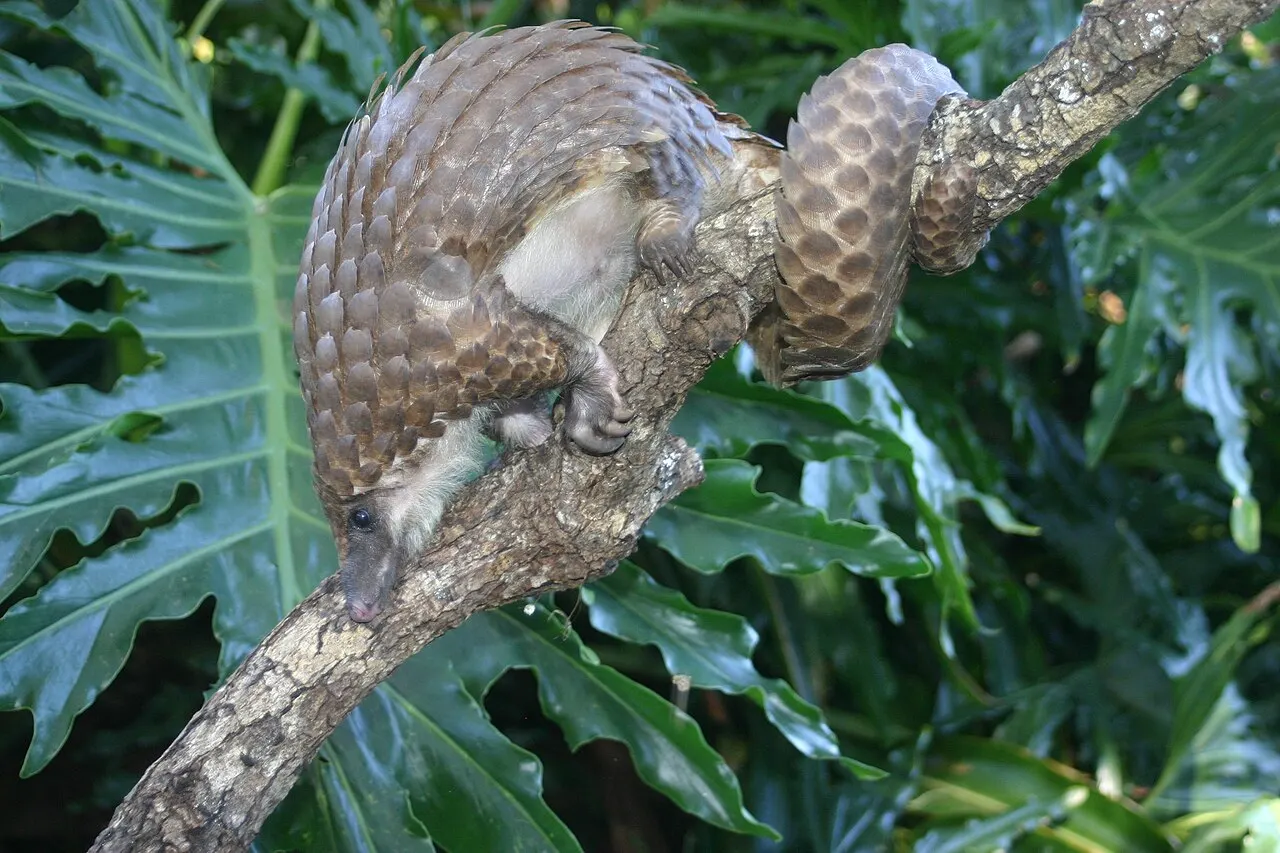
It's a slender pangolin covered in overlapping keratin scales, dark brown to yellowish, each with three small points (the species name tricuspis refers to this). The face, underside and inner legs lack scales. Head and body run about 33 to 43 cm, and the tail adds another 49 to 62 cm.
It has a small head, a long snout, no teeth and five curved claws on each foot. Compared with Africa's ground-dwelling pangolins it is smaller and has larger eyes, and its prehensile tail has pads that help it climb. The tail is shorter than that of the black-bellied pangolin, the other tree-dwelling species.
Where it lives
The IUCN lists more than 20 countries, from Sierra Leone and Guinea east through Ghana, Nigeria, Cameroon, Gabon and the Congo basin to Uganda, plus Bioko island. Records also reach Kenya, Tanzania, Angola and Zambia.
Lowland moist forest, moist savanna and degraded former forest are the habitats the IUCN rates as most important. It also uses swamp forest, dry forest, dry savanna, mangrove, rural gardens and plantations.
Pins are Wikidata “endemic to” fields. Orange dots, when present, are GBIF occurrence tiles — survey bias included.
How it lives
It is semi-arboreal and mostly nocturnal, climbing trees but also walking on the ground. It eats ants and termites, about 150 to 200 g of insects a day, using a long, sticky tongue. A strong sense of smell makes up for poor eyesight.
When threatened it rolls into a ball, and a mother curls around her young. Females hold small territories, under 4 ha, while males hold up to 24 ha that overlap several females. Gestation lasts about 150 days and one young is normal. The baby rides on its mother's tail and stays with her for around five months.
Why it is in trouble
Hunting for meat and traditional medicine is the main threat. The IUCN rates the intentional take as affecting most of the population and causing slow, significant declines, with shifting agriculture, small-holder farming and mining adding losses. The assessment points to a decline over three generations, which it puts at about 21 years in all. An older conservationist estimate suggested a 20 to 25 percent fall from 1993 to 2008.
Markets draw animals from far away. A 2024 genetic study in Ecology and Evolution sampled 116 pangolins from markets in Cote d'Ivoire, Ghana and Guinea. Vendors in Abidjan's Yopougon market named sources 62 to 459 km away. The study's models pointed to a fall in effective population size of 85 to 98 percent, between roughly 3,200 and 400 years ago, from about 10,000 to about 500 to 600. Those figures describe genetic history in that region, not a recent count of animals. The paper also cites an estimate that more than 400,000 African pangolins were bound for Asia between 2015 and 2019, for all species combined.
What is being done
All pangolins are listed on CITES Appendix I, under which commercial international trade in wild-sourced specimens is not permitted. The IUCN says the species occurs in protected areas and that a recovery plan exists, though no harvest management plan or systematic monitoring is in place.
Conservation actions the IUCN lists include harvest and trade management, site management, training, awareness and education, habitat restoration, private sector standards and livelihood alternatives.
Sources
Written for this catalog in our own words from the sources below, checked against them on 12 November 2026. Population figures are estimates and carry the year they were made. Status and assessment year: IUCN. 2026. The IUCN Red List of Threatened Species. Version 2026-1. iucnredlist.org.




