Critically Endangered
Mahé boulder cricket
Phalangacris alluaudi
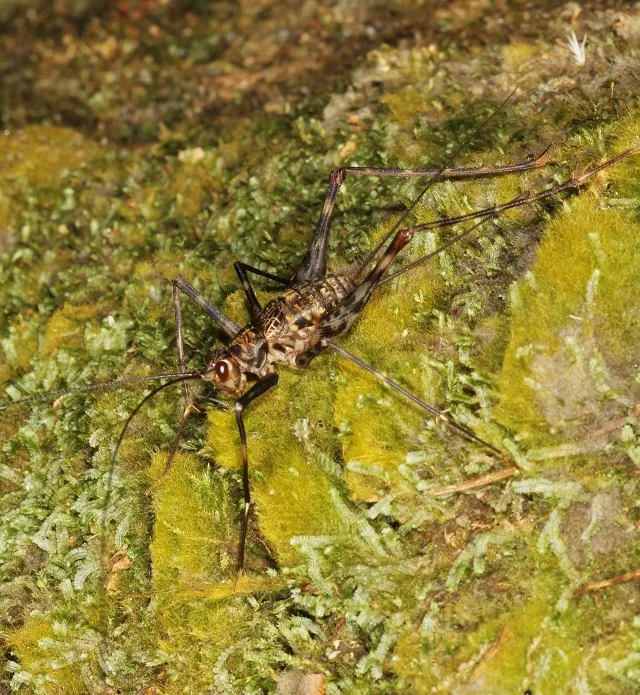
The Mahé boulder cricket is a flightless cricket known only from Mahé, the main island of Seychelles. Unrecorded for more than a century, it was rediscovered in 2014. The IUCN rated it Critically Endangered in 2015, and no one knows how many individuals are left.
A cricket that went missing
The species was described by Ignacio Bolívar in 1895 from material collected on Charles Alluaud's scientific mission to Seychelles. After a record in 1909 it dropped out of the scientific record for 105 years, until it turned up again in 2014.
A male was later collected at La Réserve on Mahé on 11 May 2016 by the entomologist Axel Hochkirch, and a 2021 revision of the Seychelles Phalangopsidae crickets (a Zootaxa paper by Hugel, Warren and Desutter-Grandcolas) lists that specimen.
Where it lives
Only two sites are known, both on Mahé: Morne Seychellois National Park and La Réserve. The IUCN gives its area of occupancy as under 10 square kilometres and describes the population as severely fragmented. The assessment records an elevation range of about 350 to 600 metres, in lowland and montane moist forest.
It cannot fly. It is found only in caves and under large boulders.
Pins are Wikidata “endemic to” fields. Orange dots, when present, are GBIF occurrence tiles — survey bias included.
Why it is in trouble
The assessment records a decreasing population and a shrinking habitat. Invasive plants, including cinnamon (Cinnamomum verum) and Clidemia hirta, spread through Mahé's forests and degrade them. Small-holder farming and droughts are also listed as threats.
Numbers are unknown. Axel Hochkirch, co-chair of the IUCN Grasshopper Specialist Group, has said, "We have no idea how many individuals exist in total."
What is being done
Conservation steps recorded for the species are habitat protection, management of the sites where it lives, and control of invasive species. The IUCN assessment records no recovery plan and no systematic monitoring scheme. The IUCN specialist group has said it intends to publish a field guide to the Orthoptera of Seychelles for local conservationists.
Sources
Written for this catalog in our own words from the sources below, checked against them on 12 November 2026. Population figures are estimates and carry the year they were made. Status and assessment year: IUCN. 2026. The IUCN Red List of Threatened Species. Version 2026-1. iucnredlist.org.




