Endangered
Pernambuco Foliage-gleaner
Automolus lammi
The Pernambuco foliage-gleaner (Automolus lammi) is a brown and rufous ovenbird that lives in the lowland Atlantic Forest of north-eastern Brazil, found nowhere else. The IUCN Red List classed it as Endangered in 2017, after it was rated Vulnerable in 2014. Only an estimated 1,000 to 2,499 mature birds remain.
How to recognise it
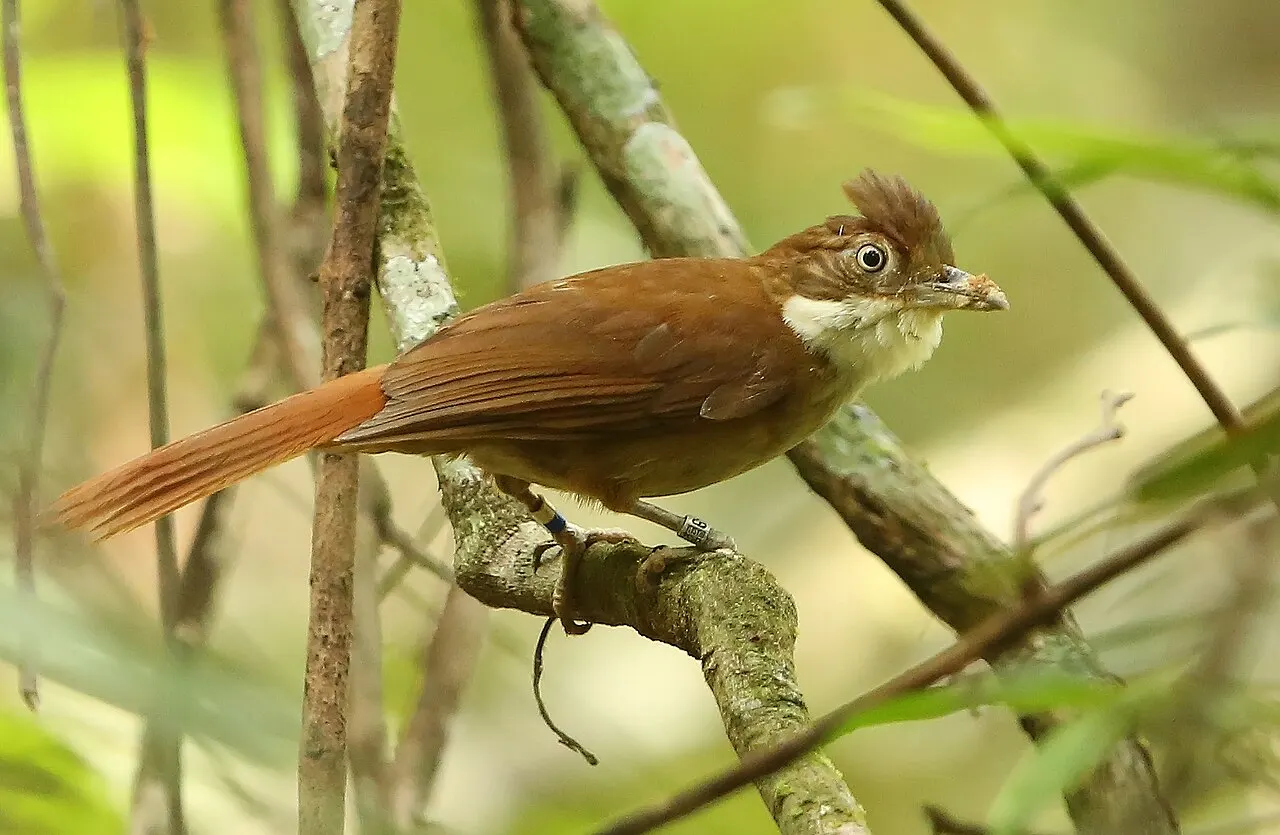
It's a fairly large foliage-gleaner, 19 to 20 cm long, with a heavy bill, pale whitish eyes and grayish legs. The crown and back are dark brown, the wings dark rufous and the tail bright rufous. The throat is white with a yellowish tinge, and the breast and belly are creamy olive-buff. Males and females look alike.
Its voice is the surest way to tell it from the white-eyed foliage-gleaner, which it closely resembles. The song is a harsh, grating series of closely spaced notes or doublets, and the calls include a loud, repeated 'weck'.
Where it lives
The species is restricted to Brazil's Pernambuco Centre of Endemism, a strip of coastal forest in the states of Paraiba, Pernambuco, Alagoas and Sergipe. It inhabits tropical evergreen forest and mature secondary forest from near sea level to about 550 m. The IUCN puts its extent of occurrence at roughly 80,600 square kilometres, and that area is shrinking.
It stays in its home forest all year and doesn't migrate. The IUCN also lists heavily degraded former forest as suitable habitat, but forest is the habitat that matters most to it.
Pins are Wikidata “endemic to” fields. Orange dots, when present, are GBIF occurrence tiles — survey bias included.
How it lives
It eats arthropods, though detailed diet records are lacking. It usually forages low in dense understory growth, often with mixed-species flocks, picking prey from dead leaves, debris and epiphytes. Nothing is known about its breeding.
Why it is in trouble
Most of the original forest in its range has gone, reportedly largely to sugarcane, and what is left is mostly small fragments. The 2017 assessment estimates 1,000 to 2,499 mature individuals, spread across a severely fragmented population that is still declining. Even the largest subpopulation is put at only 51 to 250 mature birds. The IUCN lists agro-industry farming, herbicides and pesticides, and small-scale harvesting among the pressures.
Some protected areas hold the bird, but they aren't fully safe. Illegal logging is reported in at least one of them, Murici Ecological Reserve.
What is being done
Conservation sites have been identified across its whole range, and it occurs in at least one protected area. There is no species recovery plan or systematic monitoring scheme. The IUCN recommends working with sugarcane mill owners to protect forest fragments on their land, expanding effectively protected habitat, surveying the total population and tracking habitat loss by satellite.
Sources
Written for this catalog in our own words from the sources below, checked against them on 12 November 2026. Population figures are estimates and carry the year they were made. Status and assessment year: IUCN. 2026. The IUCN Red List of Threatened Species. Version 2026-1. iucnredlist.org.




