Endangered
Perijá Thistletail
Asthenes perijana
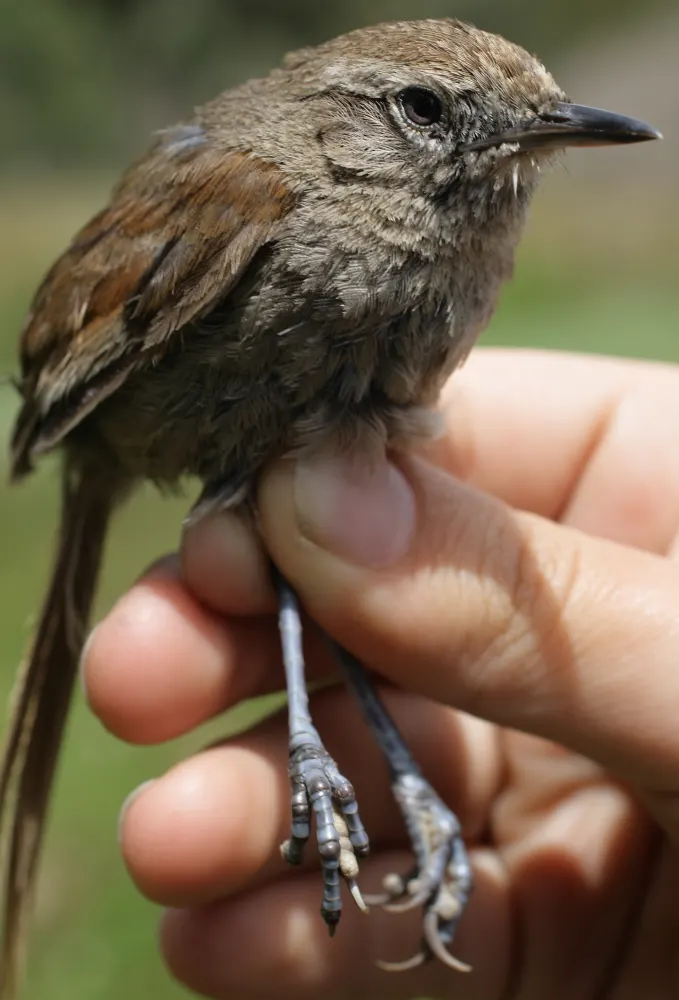
The Perijá thistletail (Asthenes perijana) is a small, long-tailed ovenbird found only in the Serranía de Perijá, a mountain range on the border of Colombia and Venezuela. It lives high on the slopes near the treeline. The Red List rated it Endangered in 2021, estimating 150 to 700 mature birds.
How to recognise it
It measures 19 to 22 cm and weighs 16 to 21 g. The head, back and tail are olive-brown, with a faint grey stripe over the eye. The wing coverts and the bases of the flight feathers are chestnut. The chin has a cinnamon-buff patch, and the rest of the underparts are brownish grey.
The tail is long and deeply forked, with few barbs at the tips, so it looks ragged. Males and females look alike. The song is three to five drawn-out, high-pitched notes followed by a short, dry, descending trill.
Where it lives
The species is endemic to the Serranía de Perijá, on the Colombia and Venezuela border. It lives in páramo grassland, in high-altitude shrubland, and at the upper edge of cloud forest, where dense undergrowth meets the treeline. The Red List assessment gives an elevation of about 3,000 to 3,400 m.
Its area of occupancy is reportedly only about 110 square kilometres, and the assessment counts two to five locations. It was long treated as a race of the white-chinned thistletail before being recognised as a species of its own.
Pins are Wikidata “endemic to” fields. Orange dots, when present, are GBIF occurrence tiles — survey bias included.
How it lives
It is thought to stay in its mountains all year. It feeds mostly on arthropods, with the occasional berry, searching through undergrowth alone or in pairs and probably picking prey off leaves and twigs. Its breeding season is poorly defined, though it includes July, and little else is known about how it nests.
Why it is in trouble
The 2021 assessment estimates 150 to 700 mature birds and a declining population. Its recorded ongoing threats are farming and ranching, housing, and mining and quarrying, each affecting a minority of its range and causing slow declines. It also lists habitat shifting and alteration as a future threat affecting the whole range, which fits a bird already confined to the highest ground.
Habitat on the lower slopes (below 2,000 m) is reportedly under pressure from drug-crop cultivation, uncontrolled settlement, cattle ranching and mineral extraction. A 2014 conservation announcement said 98 percent of the range's rainforests had already been destroyed.
What is being done
In 2014 the Colombian group ProAves, with Rainforest Trust and Global Wildlife Conservation, created the Chamicero de Perijá Nature Reserve from 11 adjoining properties, about 1,850 acres (roughly 750 hectares). It was described as the first protected area in the Colombian part of the range, and it shelters this bird along with the Perijá metaltail and the Perijá brush-finch.
On the Venezuelan side, protection inside Sierra de Perijá National Park is reportedly only nominal. The Red List assessment records that the bird occurs in at least one protected area, but lists no recovery plan or systematic monitoring scheme.
Sources
Written for this catalog in our own words from the sources below, checked against them on 12 November 2026. Population figures are estimates and carry the year they were made. Status and assessment year: IUCN. 2026. The IUCN Red List of Threatened Species. Version 2026-1. iucnredlist.org.




