Critically Endangered
Percichthys melanops
Percichthys melanops
Percichthys melanops, known in Chile as the trucha negra, is a small temperate perch found only in central Chile. The IUCN Red List assessed it as Critically Endangered in 2023, after an estimated 90 per cent population decline between 2011 and 2021 driven by habitat loss, water use and introduced species.
How to recognise it
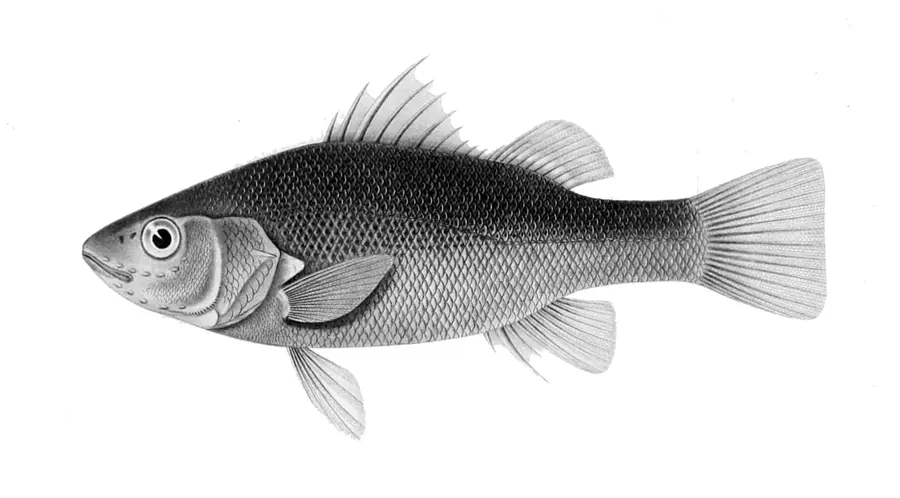
This is a slightly stout, elongated fish, mostly grey and blue with dark mottling. FishBase gives a maximum length of about 20 cm, while Chilean fisheries documents report a fish of 24 cm and 150 g from the Biobio River, so adults are small by perch standards.
It is hard to tell from its relative Percichthys trucha, because many body features overlap, including fin ray and scale counts. The back edge of the upper jaw bone (maxilla) is irregularly serrated, and the lateral line carries 57 to 64 scales.
Where it lives
The trucha negra is endemic to Chile and has a restricted range in the pre-Andean streams of the central zone. One fisheries sheet gives Santiago south to Concepcion, while a 2011 fisheries report lists Valparaiso to Los Rios, so the limits are not firmly fixed. P. trucha, by contrast, ranges from about 33 degrees south to Tierra del Fuego and into Argentina.
Records describe it only in the lower, slow reaches of rivers, close to the bank and near aquatic plants. It has not been reported from reservoirs or lakes. The IUCN estimates the area it occupies at about 5,008 square kilometres inside a range of about 10,716 square kilometres.
Pins are Wikidata “endemic to” fields. Orange dots, when present, are GBIF occurrence tiles — survey bias included.
How it lives
Little is known. In the Biobio River, the main stomach contents were larvae of aquatic insects, including stoneflies, mayflies, midges and beetles. Mature males and females turned up in winter and spring, but the breeding season has never been pinned down.
Why it is in trouble
The IUCN links the 90 per cent decline between 2011 and 2021 to shrinking habitat and introduced species. Listed pressures include drought, water taken from rivers for homes, farms and industry, small and large dams, seepage from mining, quarrying, nutrient pollution, and soil washed into streams.
It is reportedly gone from the Aconcagua River basin, and Chile classified it as endangered in 1998. The Red List treats the population as still decreasing.
What is being done
A Chilean decree of 23 February 2006 banned taking the species for five years across its whole range. When that ban lapsed in 2011, a fisheries technical report argued for a new extraction ban for threatened native freshwater fish, including the trucha negra.
The 2023 assessment records no recovery plan, no systematic monitoring and no captive population.
Sources
Written for this catalog in our own words from the sources below, checked against them on 12 November 2026. Population figures are estimates and carry the year they were made. Status and assessment year: IUCN. 2026. The IUCN Red List of Threatened Species. Version 2026-1. iucnredlist.org.




