Endangered
Porkchop coral
Porkchop coral
Porkchop coral builds massive grey to brownish colonies on shallow reefs from the Red Sea and East Africa across the Indo-Pacific to Hawaii and the tropical eastern Pacific. It is uncommon almost everywhere. The IUCN Red List moved it from Least Concern to Endangered in its 2024 assessment.
How to recognise it
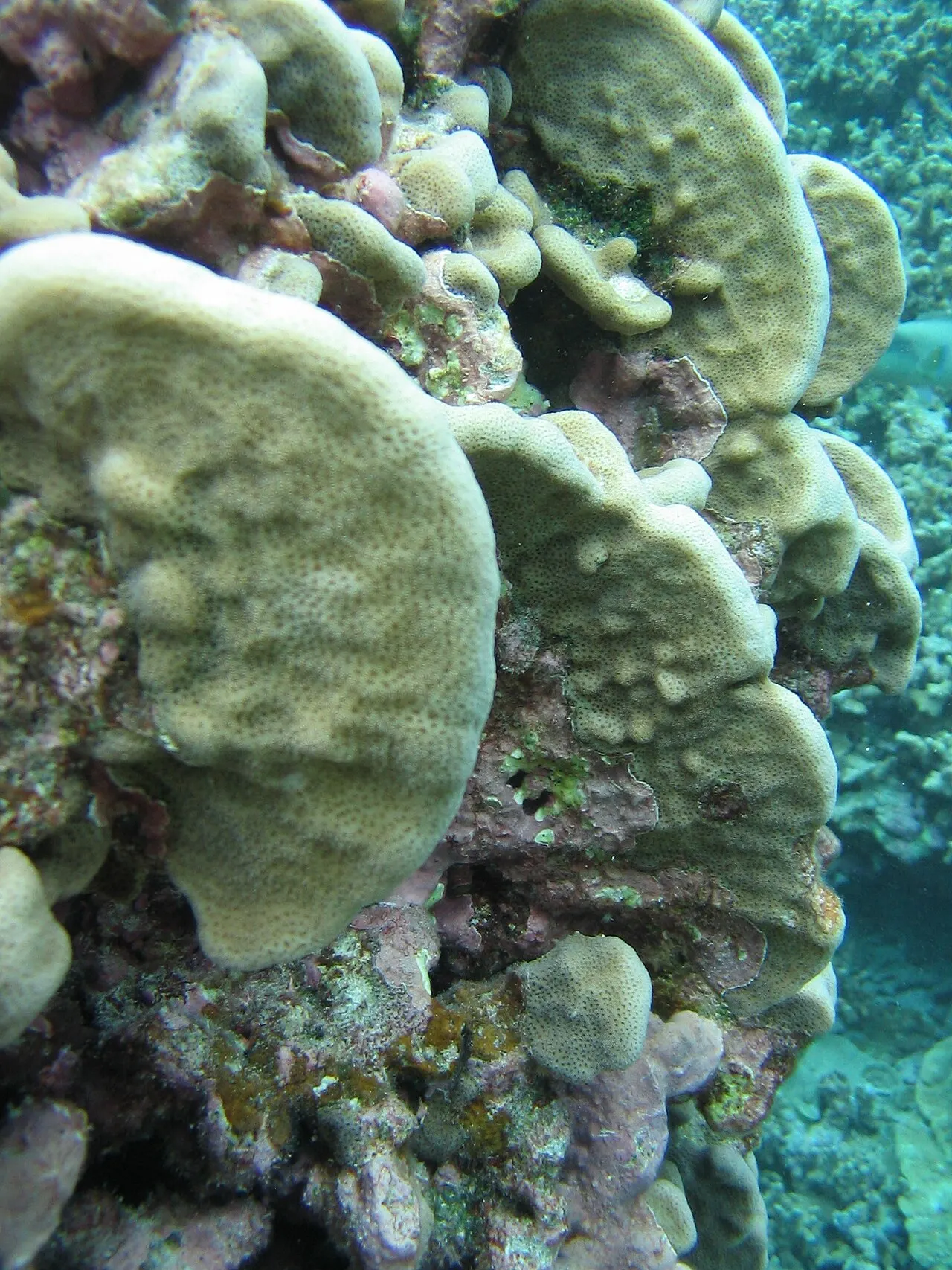
Colonies are massive, solid mounds or thick, blade-like plates, with a surface broken into low ridges or rounded hillocks. The colour is usually a plain grey, sometimes brown, with yellow or tan tones that come from the algae living in the coral's tissue. The polyps sit in very small cups (corallites), so the surface looks smooth.
It makes some of the largest massive colonies of any coral, yet the skeleton is dense, which points to slow growth. Colonies in northern Maluku, Indonesia, have been described as 1 to 1.5 m tall and 1 to 3 m across, and another account gives typical colonies above 1.5 m high and 3 m wide. It can be mistaken for Pavona clavus and Pavona minuta, and corallite size helps tell them apart.
Where it lives
The IUCN lists it from more than 70 countries and territories, from the Red Sea and East Africa through the Indian Ocean and Southeast Asia to Hawaii, the central Pacific, Mexico, Panama, Colombia and Ecuador. It is uncommon but conspicuous where it occurs and rare in the Red Sea.
It lives on coral reef from the surface down to about 38 m. One account puts it from about 5 m with most colonies at 9 to 10 m, and another found large ones at 10 to 15 m. Thick plate-forms are common in shallow water exposed to surge. Large groups are reported from the Gulf of Panama, Colima in Mexico, Koh Tao in Thailand, Johnston Atoll and the Hawaiian chain.
Pins are Wikidata “endemic to” fields. Orange dots, when present, are GBIF occurrence tiles — survey bias included.
How it lives
Like most reef corals, it reportedly releases eggs and sperm into the water at the same time. Fertilised eggs become drifting larvae that settle on the reef and grow into new polyps. The IUCN estimates a generation at about 10 years.
Why it is in trouble
The 2024 Red List assessment records a decreasing population and a continuing decline in reef area, and projects a further reduction of 62 percent. Its threat list covers ocean warming (temperature extremes), storms and flooding, silt washed onto reefs, coastal housing and industry, tourism and recreation, shipping lanes and small-scale harvest.
Coral disease adds to the pressure. White plague, which kills living tissue, has reportedly caused heavy losses of this species off Thailand. The species was rated Least Concern in 2008 and 2014 before the 2024 change. More widely, an IUCN reassessment of 892 reef-building coral species, announced in October 2026, found that 44 percent of the 774 with enough data are threatened, with climate change the main driver.
What is being done
Whether it grows in any protected area is listed as unknown. The assessment lists site protection and management, habitat restoration, captive propagation, a genome resource bank and species recovery among the actions that would help, with no species-specific programme described.
Sources
Written for this catalog in our own words from the sources below, checked against them on 12 November 2026. Population figures are estimates and carry the year they were made. Status and assessment year: IUCN. 2026. The IUCN Red List of Threatened Species. Version 2026-1. iucnredlist.org.




