Endangered
Papilio aristophontes
Papilio aristophontes
Papilio aristophontes is a swallowtail butterfly found nowhere except the Comoro Islands, between Mozambique and Madagascar. Males flash iridescent blue on black wings. The IUCN Red List lists it as Endangered, but the assessment dates from 1996 and has not been updated since, so its present status is poorly documented.
How to recognise it
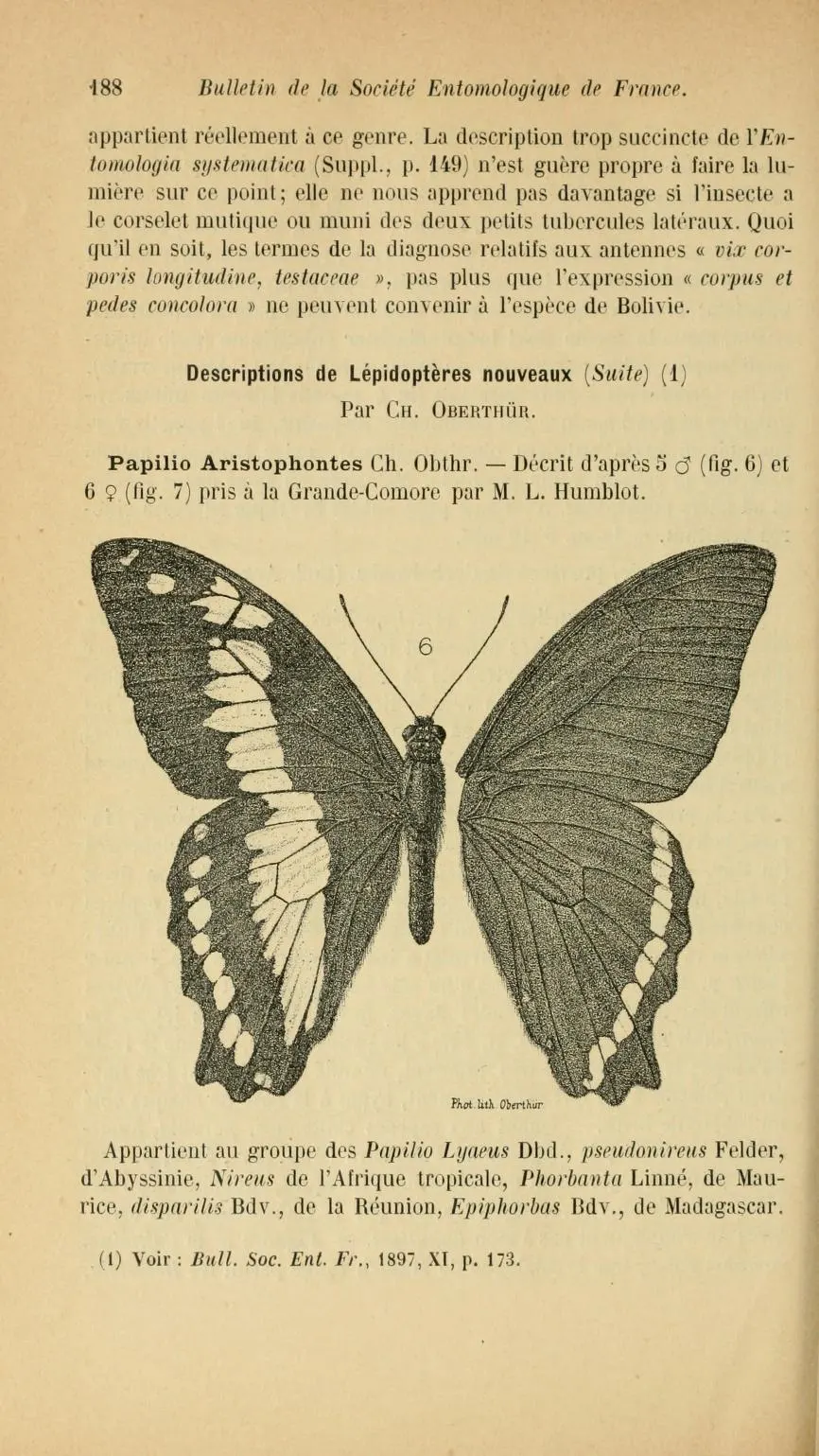
The sexes look quite different. The male's upper forewing is black with iridescent blue bands and five blue spots, and the hindwing has a scalloped edge and no tail. The female is olive-green and brown, with a dull olive band across the wing and yellowish-olive crescents along the margin.
It belongs to the African nireus group of swallowtails and was described by Charles Oberthür in 1897. Some older works treated it as a subspecies of the widespread Papilio nireus, but D'Abrera, following Carcasson, reportedly restored it to full species rank.
Where it lives
The butterfly is endemic to the forests of the Comoros. Grande Comore is the main stronghold, with smaller populations on Moheli and Anjouan. Forest there grows on the flanks of two uplands, La Grille in the north and the active volcano Karthala in the south, up to about 1,900 m.
It was recorded in 1980 and 1983 on La Grille, at Nioumbadjou (550 m), and on Karthala at sites from about 1,000 m up to 1,700 m. It may be locally common along forest clearings and paths.
Pins are Wikidata “endemic to” fields. Orange dots, when present, are GBIF occurrence tiles — survey bias included.
How it lives
Sources disagree a little on the caterpillar's food. One reports eggs laid on Toddalia asiatica, a plant in the citrus family (Rutaceae). The Red Data Book account says larval feeding was undocumented and probably involves wild Rutaceae. Caterpillars have been reared in captivity on other Rutaceae, and have been reported on lemon trees growing wild.
Little else has been written about its life cycle. The Red Data Book account, whose latest references date to 1983, called for studies of its distribution and breeding biology.
Why it is in trouble
Forest loss is the main problem. Banana planting stops forest from regenerating, especially on La Grille, and farming has reached up the slopes to about 1,200 m. The Red Data Book account judged the butterfly more seriously threatened on Moheli and Anjouan, with farmland conversion and intensification a serious problem on Moheli.
That account also noted that the butterfly still survived in good numbers on La Grille and Karthala. The 1996 Red List entry gives no population trend and no numbers, and no newer figure has been published.
What is being done
When the Red Data Book account was written, the Comoros had no protected areas, and it proposed protecting all land above 1,200 m on Karthala. No current conservation programme specific to this butterfly appears in the published sources.
Sources
Written for this catalog in our own words from the sources below, checked against them on 12 November 2026. Population figures are estimates and carry the year they were made. Status and assessment year: IUCN. 2026. The IUCN Red List of Threatened Species. Version 2026-1. iucnredlist.org.