Endangered
Panaqolus albivermis
Panaqolus albivermis
Panaqolus albivermis, better known to aquarists as the flash pleco or L204, is a small armoured catfish from the San Alejandro River in Peru. The IUCN Red List rated it Endangered in 2016. It has one known location, and harvest for the aquarium trade is the listed threat.
How to recognise it
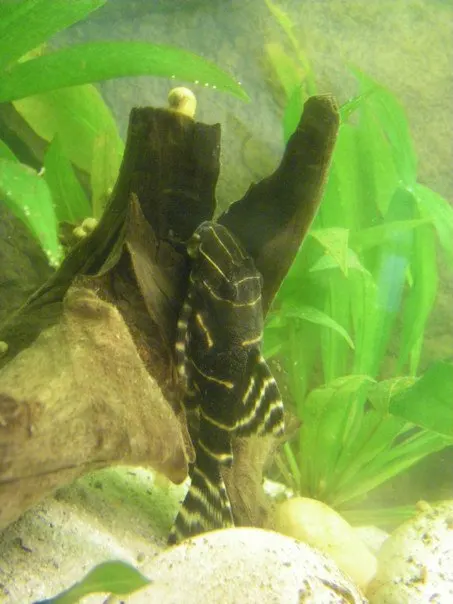
Young fish have bold light stripes on a black body. As they mature the stripes break into spots and thinner lines, and adults are dark brown with thin yellow vertical lines. The scientific name means roughly white worm, a nod to the pale, wormlike markings.
It is a small fish. FishBase gives a maximum standard length of 9.6 cm, while an aquarium factsheet quotes up to 14 cm without saying how it was measured. Males have a broader head and longer odontodes (small bony spines) behind the gill covers and on the pectoral spines. Its nearest relative, Panaqolus maccus, has a brown base colour, while P. albivermis is black.
Where it lives
It is known only from the San Alejandro River, a tributary in the upper Ucayali drainage of the western Amazon basin in Peru. The IUCN assessment gives its range as about 2,700 sq km, treats it as one location and lists permanent rivers and streams as its habitat. It was not recorded in any protected area at the time of the assessment.
Pins are Wikidata “endemic to” fields. Orange dots, when present, are GBIF occurrence tiles — survey bias included.
How it lives
Related wood-eating catfish need driftwood, and keepers give this one wood to chew. They also feed vegetables such as cucumber and courgette, plus sinking tablets. In captivity the male takes a cave, the female lays up to 70 eggs in it, and the male then drives her off and guards the eggs. Frequent water changes seem to trigger spawning. Behaviour in the wild has not been described in the sources consulted.
Why it is in trouble
The aquarium magazine DATZ listed the fish in February 1996 under the code L204, years before it received a scientific name in 2013 from Lujan, Steele and Velasquez. The IUCN lists small-scale harvest as the threat and records the population as decreasing, and an aquarium factsheet reports that the fish is collected intensively for the ornamental trade. A tiny range combined with heavy collection is what puts it at risk.
What is being done
The 2016 assessment recorded no conservation sites identified for the species, no protected area covering it and no conservation actions in place. Hobbyists do breed it in aquaria, but nothing in the sources says how much of the trade now comes from captive stock.
Sources
Written for this catalog in our own words from the sources below, checked against them on 12 November 2026. Population figures are estimates and carry the year they were made. Status and assessment year: IUCN. 2026. The IUCN Red List of Threatened Species. Version 2026-1. iucnredlist.org.




