Endangered
Java sparrow
Padda oryzivora
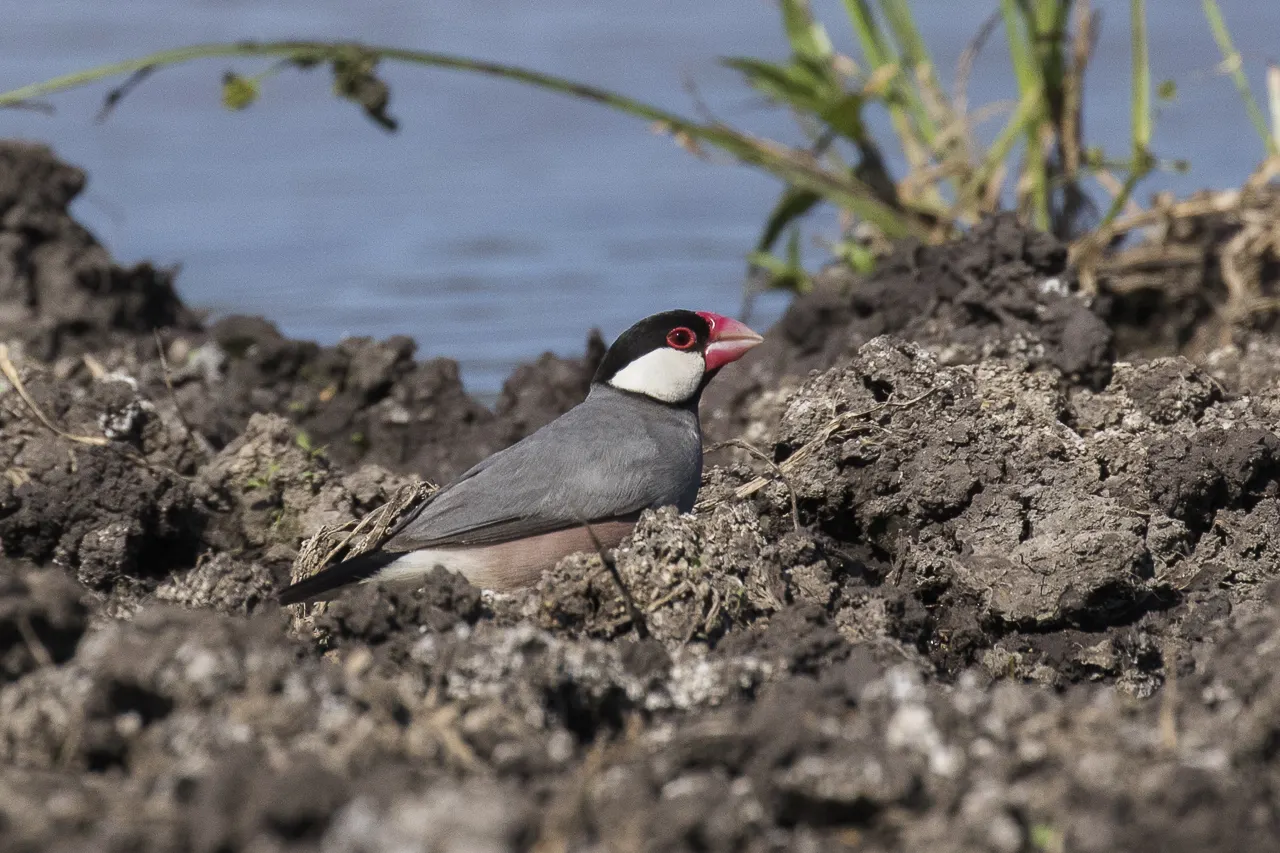
The Java sparrow is a pearl-grey finch with a black head, white cheeks and a heavy pink bill. It is native to Java and Bali in Indonesia, where trapping for the cage-bird trade has left few wild birds. The IUCN Red List rates it Endangered (2021 assessment).
How to recognise it
Adults measure about 14 to 17 cm from bill to tail tip, depending on the source, and average around 25 g. The upperparts and breast are pearl grey, turning pinkish on the belly and whitish toward the vent. A black head with big white cheek patches, a red eye-ring, a black rump and tail, and a massive pink bill make it hard to confuse with anything else.
Males and females look alike. Young birds are brown above and pale brown below with a plain head, and very young ones have a black bill with a pink base. The song starts with bell-like single notes and speeds up into a run of trills and clucks.
Where it lives
In the wild it is a resident of Java and Bali, and reportedly the small island of Bawean. It keeps to open country from sea level to about 500 m: dry grassland and savanna, dry shrubland, farmland, village gardens and towns.
Escaped and released cage birds have started populations elsewhere. Birds breed on several Hawaiian islands, mostly Oahu, where the Honolulu Christmas Bird Count rose from 4 birds in 1969 to 1,096 in 1995. They are also established near San Juan, Puerto Rico, and have been introduced to Christmas Island in the Indian Ocean. A Florida population, first recorded in the mid-1950s, died out in the 1970s.
Pins are Wikidata “endemic to” fields. Orange dots, when present, are GBIF occurrence tiles — survey bias included.
How it lives
Java sparrows are sociable and move about in flocks. They eat mostly grain and other seeds, and they were once a pest of rice fields. Nests are built in a tree or a building, and a clutch can hold up to eight eggs.
Fieldwork in the Gunung Sewu karst of Yogyakarta, Java, found birds using caves and cliffs. At one site in May 2018 observers counted four pairs at nest holes and at least 10 newly fledged young.
Why it is in trouble
The main cause is capture for the pet trade. The bird has been a cage bird in Asia for centuries, and it is still easy to find in Javan bird markets, where one survey reported 30 to 50 birds in each market. The IUCN also records use as food and for specimen collecting. Persecution as a rice pest is rated as past and unlikely to return.
Counts have been grim for a long time. A 2001 survey of 64 former sites, cited in a 2019 BirdingASIA paper, found 109 birds at only 17 of them. Pramana Yuda's PhD work, based on roost counts at six sites in Central and East Java in 2004 and 2005, put the regional total at no more than about 1,000 birds, with an average of 59 percent of estimated numbers trapped during the study. Surveys in 2017 and 2018 in Gunung Sewu found birds at five locations, an estimated 80 to 123 birds in all, and none at nine other places that once held them.
The 2021 Red List assessment estimates 1,000 to 2,499 mature individuals in the wild, split into many small groups (the largest holds an estimated 51 to 250 mature birds), and still declining. Yuda's thesis argued for moving the species from Vulnerable to Endangered. The Red List had it as Vulnerable until 2017 and Endangered from 2018.
What is being done
The species is on Appendix II of CITES, which controls international trade, and some wild birds live inside protected areas, including Paliyan Nature Reserve in Yogyakarta. Captive populations exist, and the species is bred widely in aviaries.
The IUCN lists no species recovery plan and no systematic monitoring scheme in place. It calls for stricter control of the trade in wild birds, supplying the market from captive breeding, and programmes to protect remaining birds inside and outside reserves. In 2017 and 2018 the Gunung Sewu survey team also held awareness meetings with villagers near active sites.
Sources
Written for this catalog in our own words from the sources below, checked against them on 12 November 2026. Population figures are estimates and carry the year they were made. Status and assessment year: IUCN. 2026. The IUCN Red List of Threatened Species. Version 2026-1. iucnredlist.org.




