Critically Endangered
MacGillivray's prion
Pachyptila macgillivrayi
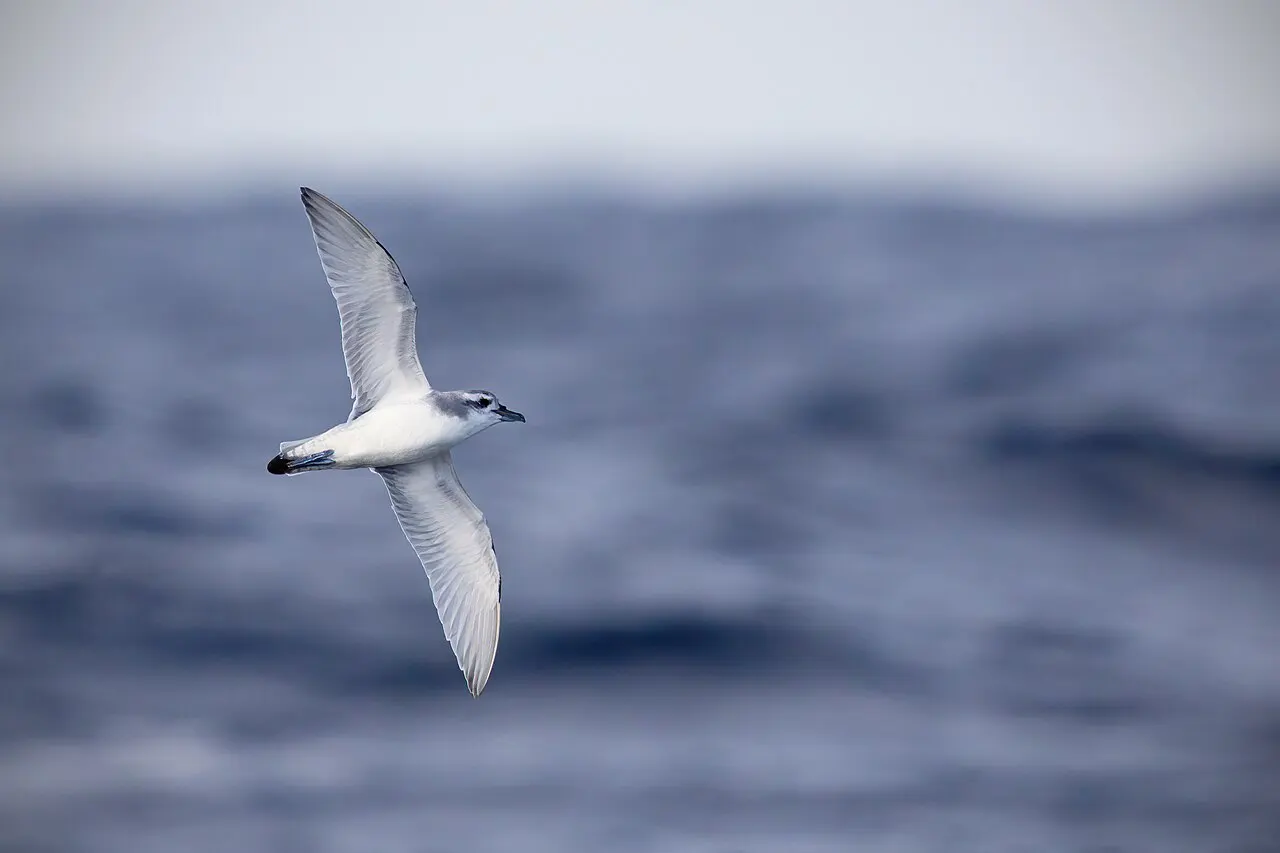
MacGillivray's prion (Pachyptila macgillivrayi) is a small blue-grey seabird that nests in burrows and caves on Gough Island in the South Atlantic and on St Paul Island and its offshore rock in the southern Indian Ocean. The IUCN Red List rated it Critically Endangered in 2022, mainly because of mice on Gough.
How to recognise it
It is blue-grey above and white below, with a dark M across the back, a black tip to the upper tail, a blue-grey bill and blue legs. That pattern is very close to Salvin's prion, and bill size is the main guide: width is 16 to 20 mm against 14 to 18 mm in Salvin's. Bills are longer on Gough (33 to 36 mm) than on St Paul (29 to 34 mm).
At sea it rarely calls. At night in the colonies it gives harsh chattering calls and softer, dove-like crooning.
Where it lives
The species was long thought to breed only on La Roche Quille, a rock stack of under one hectare beside St Paul Island, about 3,000 km south-west of Australia. St Paul itself (820 ha) has since been recolonised. Around 2014 a large breeding population was recognised on Gough Island (6,500 ha), where the birds nest among hundreds of thousands of broad-billed prions but breed about three months later. It formerly nested on Amsterdam Island too.
Genetic work showed it is closest to the broad-billed prion. Because the two breed on the same island at different times without significant interbreeding, it is treated as a separate species.
Pins are Wikidata “endemic to” fields. Orange dots, when present, are GBIF occurrence tiles — survey bias included.
How it lives
Birds return to the colonies in late September. Each pair lays a single white egg in late November or early December and shares incubation and chick care. Chicks leave in late February and early March.
Prions feed mainly on small crustaceans, caught by diving shallowly or by hydroplaning at the surface with the head and neck dipped into the top 10 cm of water. Comb-like plates in the bill act as filters. During breeding they forage within about 400 km of the colony. Outside it they spend roughly six months away from land, ranging up to 7,550 km.
Tracking by geolocator showed eight Gough breeders that failed in 2015 wintering off Argentina. Of seven St Paul birds fitted with loggers in December 2017, three went west to waters south-east of South Africa and four to the Tasman Sea. Five museum specimens washed up in New Zealand (1954) and Australia (1930 to 1979) were later matched to Gough by bill size and DNA.
Why it is in trouble
Gough holds almost all of the birds. A 2020 estimate put the island at about 175,000 pairs, with a very wide margin of error (24,000 to 1.2 million pairs). La Roche Quille was estimated at 150 to 200 pairs in 2007, and St Paul at a rough 740 pairs after its rats and rabbits were removed.
The trouble is that introduced house mice on Gough attack chicks. Breeding success was only 7 percent across the 2013 to 2014 and 2014 to 2015 seasons, and in a study colony in 2014 to 2015 mice killed every chick. The Red List assessment is based on an estimated population reduction of about 96 percent linked to introduced species.
St Paul has had its own setbacks. Rats and rabbits were removed between 1997 and 1999, which let prions recolonise from La Roche Quille, but a vagrant peregrine falcon killed at least 27 adults there in February 1999. Mice are still present on St Paul, with no evidence that they prey on seabirds.
What is being done
A mouse eradication attempt on Gough in June to August 2021 killed a large share of the island's mice but failed to remove them all, and the survivors remain a significant threat. Rat eradication on Amsterdam Island, a former breeding site 90 km from St Paul, was attempted in 2024.
The IUCN assessment notes protected areas across its range and invasive species control in place. It calls for a species conservation plan and for monitoring of population size and trend alongside any further mouse eradication.
Sources
Written for this catalog in our own words from the sources below, checked against them on 12 November 2026. Population figures are estimates and carry the year they were made. Status and assessment year: IUCN. 2026. The IUCN Red List of Threatened Species. Version 2026-1. iucnredlist.org.




