Endangered
Oxleyan Pygmy Perch
Nannoperca oxleyana
The Oxleyan pygmy perch (Nannoperca oxleyana) is a tiny freshwater fish of coastal swamps, creeks and dune lakes in eastern Australia, from Corindi in northern New South Wales to Tin Can Bay in Queensland. The IUCN Red List rated it Endangered in 2019, and its scattered populations are still declining.
How to recognise it
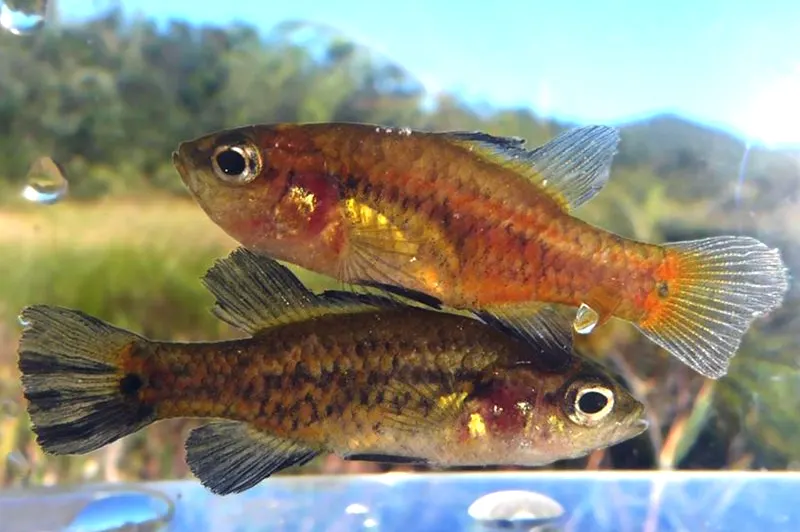
This is a small, deep-bodied fish, usually 3.5 to 4 centimetres long and rarely more than 6, though a maximum standard length of 7.5 centimetres has been reported. It is pale brown to olive, darker on the back, with a small mouth, a blue ring around the eye, one deeply notched dorsal fin and a round dark spot with an orange rim at the base of the tail.
In the breeding season the male's body and tail turn a stronger red and his fins darken.
Where it lives
Gilbert Whitley described the species in 1940. It lives in slow or still, tea-coloured, slightly acidic water, mostly in coastal wallum country, the Banksia heath of the east coast. The range is patchy and includes Fraser, Moreton and Stradbroke Islands. The fish needs dense water plants or root-filled banks for shelter, feeding and spawning.
The Red List assessment records permanent streams, marshes and swamps, and freshwater lakes and pools, at elevations from 5 to 45 metres. It estimates the area occupied at about 292 square kilometres within an extent of occurrence of about 20,974 square kilometres, and describes the population as severely fragmented.
Pins are Wikidata “endemic to” fields. Orange dots, when present, are GBIF occurrence tiles — survey bias included.
How it lives
The species has not been well studied. Breeding is mostly in spring and early summer, but sources differ on the details: one reports a season from September to December, sometimes into autumn, with spawning triggered at about 16.6 degrees Celsius, while a council account gives October to May and about 20 degrees.
Males defend patches of vegetation, and females lay sticky eggs among submerged plants. Young fish are thought to mature in 4 to 5 months. Adults forage in pairs and juveniles in small groups. The diet is small insects and their larvae, with some microcrustaceans and algae.
Why it is in trouble
The Red List assessment lists housing and commercial development, small-holder farming and grazing, silt and run-off, drought and an introduced fish, the mosquitofish (Gambusia holbrooki), as threats. Competition from the mosquitofish is also named in other accounts. The assessment records declines in area, extent and number of locations, and populations are too far apart to exchange fish.
A local council account lists collection for aquariums as a further threat, and the assessment records use of the fish as a pet or display animal.
What is being done
A recovery plan is in place, the species occurs in at least one protected area, and the assessment records a harvest management plan and education programmes. It reports no systematic monitoring scheme and no captive breeding. Habitat restoration, habitat protection and species recovery work are listed as actions. The fish is listed as endangered in New South Wales and nationally, and as vulnerable in Queensland.
Sources
Written for this catalog in our own words from the sources below, checked against them on 12 November 2026. Population figures are estimates and carry the year they were made. Status and assessment year: IUCN. 2026. The IUCN Red List of Threatened Species. Version 2026-1. iucnredlist.org.




